


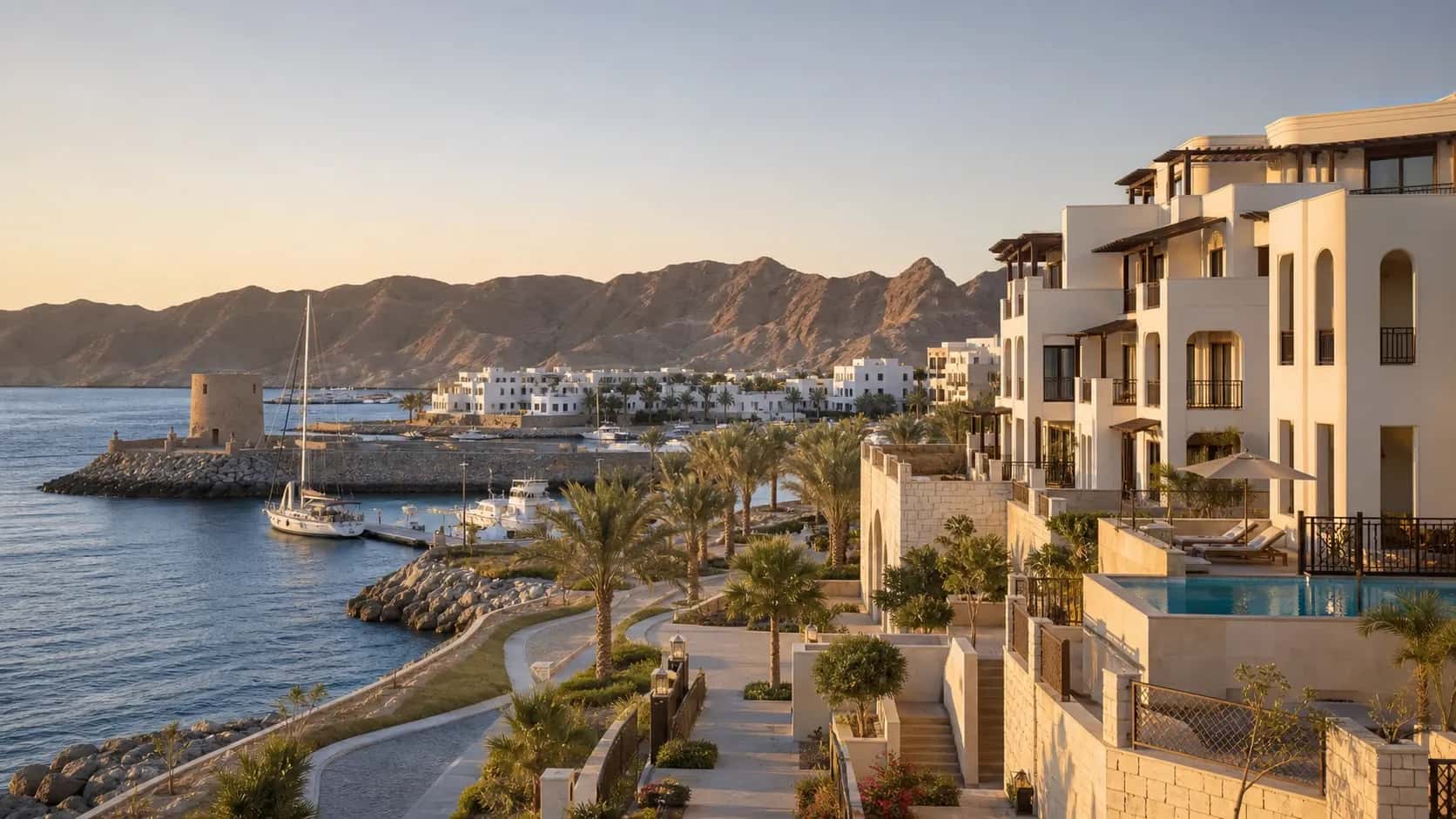
Real estate in Oman: ROI, taxes, and the condohotel model for an investor from Poland
The real estate market in Oman is based on Integrated Tourism Complexes (ITC) zones, which allow foreigners full freehold ownership. The Oman Vision 2040 strategy supports dynamic growth in property capital value, offering a stable alternative to saturated markets in the GCC region. Condo-hotel models managed by global hotel brands generate net rental yields of 7–9%, with a zero percent personal income tax rate for non-residents. The Omani Rial maintains a fixed peg to the US dollar, which ensures exchange rate security and capital protection for foreign investors.


Article summary
The most important conclusions from the article in 30 seconds.
The real estate market in Oman is based on Integrated Tourism Complexes (ITC) zones, which allow foreigners full freehold ownership. The Oman Vision 2040 strategy supports dynamic growth in property capital value, offering a stable alternative to saturated markets in the GCC region. Condo-hotel models managed by global hotel brands generate net rental yields of 7–9%, with a zero percent personal income tax rate for non-residents. The Omani Rial maintains a fixed peg to the US dollar, which ensures exchange rate security and capital protection for foreign investors.
Real Estate in Oman: ROI, Taxes, and the Condohotel Model for Investors from Poland
The real estate market in Oman has ceased to be a niche for European investors. Three factors are driving this: the government’s Oman Vision 2040 program, the development of Integrated Tourism Complexes (ITC), and the entry of global hotel brands into residential and resort projects in Muscat, Yiti, Jebel Sifah, and Salalah. For a Polish investor, this means a market that is less speculative than Dubai, has a lower price barrier than many premium locations in Europe, and offers a clear ownership model for foreigners.
However, the most important question is not is Oman growing but rather: how much remains for the investor after purchase costs, service charges, rental management, taxes, and vacancy risks? In this article, we analyze ROI, price per m², property rights in ITCs, the condohotel model, tax implications for Polish residents, and a comparison of Oman with Dubai, Europe, and Poland. No sales pitches. Just numbers, risks, and the decision-making process.
—
Fundamentals of the Omani Real Estate Market: ITC Zones and Property Rights
For a foreign investor, the key concept is the Integrated Tourism Complex, a government-approved tourism and residential zone where foreigners can acquire property under rules different from the standard local market. It is in these locations that projects available to investors from Poland are concentrated: Al Mouj Muscat, Muscat Bay, Jebel Sifah, AIDA in Yiti and Yenkit, Hawana Salalah, and selected projects within new master plans.
In the Omani market, one should not assume that every property can be purchased by a foreigner. Standard due diligence involves verifying whether a given investment has ITC status or another legal basis allowing for acquisition by a non-Omani buyer. The final document for a completed property is a title deed registered by the appropriate housing and planning authorities. When purchasing off-plan, the developer's license, payment schedule, escrow account, technical specifications of the unit, assignment rules, and handover conditions are also critical.
Oman promotes investment in the tourism and real estate sector through the state portal Invest in Oman, where tourism, hotels, and Integrated Tourism Complexes are identified as key investment areas. From a private investor's perspective, this means that demand for real estate in Oman is not based solely on the local labor market. Tourism, second homes, seasonal residences, short-term rentals, and the aparthotel model are playing an increasingly important role.
The Oman Vision 2040 strategy aims to diversify the economy and develop the private sector, cities, infrastructure, and tourism. For the real estate market, the most important aspects are not the strategic slogans themselves, but the concrete results: new roads, residential districts, hotel projects, marinas, golf courses, airport development, and an increased number of 3-5 star facilities. According to data from the National Centre for Statistics and Information cited by the Oman News Agency, occupancy in 3-5 star hotels in Oman rose to 56.7% in 2025, up from 49.9% the previous year, with the number of guests reaching 2.38 million. This is significant for resort investments, as the revenue pool in a condohotel depends on actual occupancy, not prospectus promises.
Compared to Dubai, Oman is a more selective market. Dubai offers greater liquidity, more transactions, and a broader resale market, but also a higher rate of supply. Oman has a lower volume, fewer projects, and a longer investment exit horizon, but in selected ITCs, it can provide a more stable rental profile, especially when the project has access to a beach, hotel, golf course, or marina.
For a Polish investor, the currency link is also important. The Omani Rial is pegged to the US Dollar, so currency exposure differs from buying an apartment in Poland financed and rented in PLN. In practice, the investor assumes USD/PLN risk but limits the risk of local emerging market currencies.
What to check before buying in an ITC
Before signing a reservation, PlanoGroup typically verifies five areas: the legal status of the project, payment structure, standard and scope of finishing, rental management model, and maintenance costs after handover. A team with 13-15 years of experience in foreign markets knows that the entry price is only one element. The final result is determined by annual fees, operator commissions, actual occupancy, owner usage rules, and secondary market liquidity.
—
ROI Analysis: How much does an apartment in Muscat actually earn?
Calculation of return on investment for different unit types
ROI in Oman must be calculated on a net basis, not based on brochure rental rates. In an investment project, the following matter: purchase price, registration fee, potential agency commission, service charges, rental management, utilities, renovation fund, vacancy periods, exchange rates, and revenue-sharing rules with the operator.
In current market analyses for Oman, one can assume the following indicative ranges:
- Studio or small apartment in a project with a good rental profile: approximately 7-9% net with effective management and low vacancy periods,
- 1-bedroom apartment: approximately 6-8% net,
- Larger apartment or villa: approximately 5-7% net, but with a greater role for capital appreciation.
These values should not be treated as a guarantee. For the investor, the simulation of the specific unit is more important than the market average. Two apartments in the same project can have different ROIs if they differ in view, floor, layout, exposure, hotel access, or short-term rental eligibility.
Prices per m²: Oman vs. Warsaw vs. Dubai
Based on current PlanoGroup offers for Oman, the entry threshold is lower than in many premium projects in Dubai and often comparable to or lower than the new apartment segment in top Warsaw districts. On the real estate and investment apartments in Oman page, you can find, among others:
- Nickelodeon Hotels & Resorts AIDA in Muscat: from approx. 765,000 PLN for a 47 m² unit,
- The Residences at Mandarin Oriental, Muscat: from approx. 1,565,000 PLN for 76 m²,
- Taqah Long Beach Hotel: from approx. 560,000 PLN for 39 m²,
- Zen Residences in Muscat Bay: from approx. 1,160,700 PLN for 128 m²,
- Marriott Residences AIDA: listed on the main PlanoGroup page as a project starting from approx. 1,285,000 PLN for 60 m².
This results in very different price levels per m²: from about 9,000 PLN/m² in selected projects to over 20,000 PLN/m² in branded residences of the highest hotel standard. Comparisons must take into account location, operator, and rental model. A cheaper unit in a project without a strong operator may have lower liquidity than a more expensive unit in a facility with a hotel brand.
For context, in the article Apartment in Warsaw or in Oman PlanoGroup points out that in Muscat, prices in ITC projects often fall in the 9,000-11,000 PLN/m² range, while in Warsaw, the premium segment can exceed 17,700-22,500 PLN/m². In Dubai, the benchmark is different: according to Knight Frank, the average apartment price in Q3 2025 was approximately AED 1,798 per square foot, which converts to about AED 19,350/m², and the prime segment in Q2 2025 reached about AED 3,850 per square foot. This shows why some GCC investors are looking for exposure outside of Dubai.
Transactional and annual costs
In Oman, a registration fee is standard when purchasing property. Many market materials for foreign investors indicate a level of about 3% of the transaction value, but every transaction must be confirmed in project documents and with a local lawyer, as rates and calculation methods can vary between asset types and procedures.
Annual costs include service charges. For ITC projects in Muscat, ranges of about 4-12 OMR/m² per year are common, and in facilities with more extensive hotel or resort infrastructure, fees may be higher. For a 75 m² apartment, this means about 300-900 OMR per year before costs for utilities, insurance, management, and any renovation fund. In the condohotel model, some costs may be deducted at the operator level before the owner's share is paid out.
For comparison, in Dubai, the official DLD transfer fee upon sale is 4% of the transaction value, as confirmed by Dubai Land Department materials. Additionally, the investor must check service charges in the official Service Charge Index. Poland, on the other hand, has different burdens: 2% PCC (civil law transaction tax) on the secondary market, VAT included in the price of a unit on the primary market, rental income tax, and higher financing costs if the investment is leveraged with a loan.
Net calculation example
Assume the purchase of an apartment for 1,000,000 PLN. If the gross yield is 9%, the annual gross income is 90,000 PLN. After deducting service charges, management, owner utilities, vacancy periods, and technical reserves, the net result may fall to 65,000-75,000 PLN, or 6.5-7.5% net. If the investor adds the 3% entry cost and legal fees, the real return on the total committed capital will be lower in the first years.
This may still be a better result than classic long-term rental in Warsaw after taxes and maintenance costs, but only if the project has the right rental profile. Oman's status as a GCC market alone is not enough. You need: location, operator, entry price, cost control, and realistic occupancy assumptions.
—
Condohotel Model: Passive Income Under a Hotel Brand
Operational mechanism and the role of the hotel operator
A condohotel in Oman works differently than a classic apartment bought for rental. The investor buys a unit in a hotel or hotel-apartment facility and then hands it over to an operator for management. The operator handles room sales, guest services, pricing, cleaning, maintenance, booking channels, and standard upkeep. The owner receives a share of the revenue or net result according to the rental pool agreement.
The most important documents are the sales agreement, owner regulations, rental management agreement, cost table, and rules for owner usage of the unit. If a project offers, for example, 14 days of owner usage per year, one must check whether these are days in high season, off-season, require prior booking, and whether they reduce the revenue share.
In Oman, the importance of hotel brands is growing because the investor buys not only square footage but also access to an operating system. Examples of projects to analyze in this context include Marriott Residences AIDA, Nickelodeon Hotels Resorts AIDA, The Residences at Mandarin Oriental, Muscat, and resort projects in Jebel Sifah and Muscat Bay. According to information from the Mandarin Oriental brand, The Residences at Mandarin Oriental, Muscat are being developed by Eagle Hills and include 156 beachfront residences. In the case of AIDA, official OMRAN Group materials and DarGlobal announcements indicate the development of the project with DarGlobal's participation.
Why a hotel brand affects the result
In short-term rentals, the occupancy rate and ADR (Average Daily Rate) are key. A unit in an ordinary building competes with photos, location, and price. A unit in a facility with a hotel operator benefits from brand recognition, central sales channels, service standards, loyalty programs, and infrastructure: reception, pools, restaurants, spas, beach clubs, golf courses, or family zones.
This does not automatically mean higher ROI. Branded residences usually have a higher purchase price and higher service charges. Their advantage lies in operational predictability, liquidity in the HNW (High Net Worth) segment, and the ability to use the property without managing it oneself. In the calculation, one must compare two scenarios: a cheaper unit without an operator and a more expensive unit with an operator, but with higher ADR and lower risk of operational errors.
Rental pool and transparency of settlements
In the rental pool model, revenues from many units go into a common pool and are then divided according to the rules set out in the agreement. The investor should check:
- whether the settlement concerns gross revenue or the result after costs,
- what the operator's commission is,
- what costs are deducted before the split,
- how often income is paid out,
- whether reports are audited,
- whether the owner bears additional FF&E (furniture, fixtures, and equipment) costs,
- what the rules are for renewing equipment after a few years.
In the purchasing process, PlanoGroup analyzes these elements before signing an agreement, because the difference between 8% gross and 6% net can determine the viability of the investment. For an investor from Poland, it is also crucial that rental management should not require ongoing contact with tenants, local services, or booking channels. This is the main reason why a condohotel can make sense for people diversifying capital outside of Poland.
—
Taxes and Fiscal Implications for Non-Residents
Absence of PIT and Double Taxation Agreements
For years, Oman was perceived as a jurisdiction without personal income tax. This description requires clarification today. The Omani tax authority announced the issuance of the Personal Income Tax Law based on Royal Decree No. 56/2025. The new PIT is set to take effect on January 1, 2028, and will cover individuals with an annual income exceeding 42,000 OMR, with a 5% rate on taxable income, according to the conditions specified in the law.
For an investor buying an apartment in 2026, this means that decisions should not be based on the simple slogan ,,no PIT". The correct phrasing is: currently, Oman's tax system is favorable for individuals, but from 2028, a new PIT regime for higher incomes will appear, and one must verify if and how it will cover rental income, the rental pool structure, and non-residents. In practice, an analysis with a tax advisor is necessary before purchase and before the first rental payout.
Polish tax residency and Oman
A Polish tax resident generally reports worldwide income in Poland. In the official list of double taxation agreements published by the Ministry of Finance, Oman does not appear as a country covered by a Polish agreement. Likewise, the list of tax agreements published by the Oman Tax Authority does not mention Poland.
The result is simple: a Polish investor should not assume the application of a classic Poland-Oman agreement if such an agreement is not in the official lists. Income from rent or disposal must be analyzed according to Polish national regulations, local Omani regulations, and any rules for crediting tax paid abroad, if tax is actually incurred.
In Poland, private apartment rental is usually settled via a lump-sum tax on recorded income at rates of 8.5% and 12.5% on the surplus above the statutory threshold. With foreign assets, issues of exchange rates, documenting costs, source of income, and qualification of payouts from the operator arise. The sale of property by a Polish resident may also trigger tax consequences in Poland, depending on the holding period and the method of settlement.
VAT, fees, and entry costs
Oman has VAT, but its application to a specific transaction depends on the type of property, primary or secondary market, project structure, and the seller's status. Therefore, during due diligence, one must obtain written confirmation of: net/gross price, VAT, registration fee, commission, legal costs, administrative fees, and future service charges.
Compared to Dubai, Oman may have a lower registration cost, but Dubai has greater transparency of public transactional tools and a highly developed DLD data ecosystem. Poland, on the other hand, has greater predictability of land and mortgage registers and bank financing, but higher tax burdens on rentals and lower exposure to the USD currency.
—
Portfolio Diversification: Oman vs. Dubai, Europe, and Poland
Comparison of risks and benefits of investing in Poland and the GCC region
Buying property in Oman should not be treated as a one-to-one replacement for an apartment in Warsaw. It is a different type of asset: currency-based, foreign, and operationally linked to tourism and ITC law. Its role in a portfolio is geographical, currency, and sectoral diversification.
In Poland, the investor gets closer proximity to the market and simpler oversight, but is exposed to the PLN, local rental regulations, renovation costs, rental tax, and growing competition from investment apartments. In Western Europe, the entry barrier is higher, local taxes more often burden the owner, and net yields in the prime segment can be lower. In Dubai, liquidity and international demand are strong, but prices after several years of growth require more discipline when buying.
Oman is in the middle. It has lower recognition than Dubai, a smaller secondary market, and less public data, but it offers exposure to tourism development, second homes, and limited supply of good seaside locations. An investor buying in Oman should not expect an immediate resale after a few months. A reasonable horizon is 5-10 years.
Oman vs. Saudi Arabia in the context of Vision 2030
The GCC region is changing not only because of Dubai. Saudi Arabia is implementing Vision 2030 and PIF projects, including NEOM, Red Sea Global, Diriyah, Qiddiya, and ROSHN. Official Public Investment Fund materials show the scale of investment in tourism, real estate, and infrastructure. This increases the importance of the entire region for international capital.
For a private investor, however, Oman has a different risk profile than Saudi Arabia. Saudi Arabia has a huge scale of projects, but part of the ownership market for foreigners is still in the reform phase and requires very careful legal analysis. Oman has a smaller scale but a clearer purchase model in ITCs and a calmer development profile. This is not a market for an investor looking for quick speculation. It is a market for capital seeking exposure to the GCC without buying the most expensive assets in Dubai.
Lifestyle as a calculation element, not a sales argument
In second-home real estate, lifestyle matters, but only if it can be combined with the numbers. The ,,2 weeks use" model can make sense if the owner uses the apartment for two weeks a year, and for the rest of the year, the unit works in rentals. However, one must check whether the owner days fall in high season or off-season, and how they affect the revenue pool.
Oman has real product advantages: coastline, Al Hajar mountains, marinas, golf courses, winter travel season, safety, and lower building density than Dubai. These elements increase demand for second homes and seasonal rentals, but they do not replace price analysis. A good view of the sea or golf course can justify a higher price per m² only if it translates into higher ADR, better resale, or lower vacancy.
Purchase Process and Due Diligence with PlanoGroup
The process of buying property in Oman should start with a portfolio strategy, not with choosing project photos. First, one must determine the goal: rental income, second home, capital protection in USD, exposure to the GCC, residency potential, or capital growth potential. Only then are the location, project, and unit type selected.
A typical process includes:
- defining budget, currency, and investment horizon,
- selecting ITC projects and branded residences,
- comparing price per m², service charges, and rental model,
- analyzing developer documents, licenses, escrow accounts, and SPAs,
- simulating net ROI in several occupancy scenarios,
- reserving the unit and paying according to the schedule,
- signing the SPA agreement,
- technical handover or construction monitoring for off-plan,
- registering the title deed,
- implementing rental management or an operator agreement.
PlanoGroup supports the investor at every stage: from location selection, through legal and tax analysis with local advisors, to coordinating the purchase and managing the property after handover. In practice, the greatest value of an advisor lies not in showing many offers, but in rejecting projects where legal, cost, or operational risks are too high in relation to the expected ROI.
—
If you are considering purchasing an investment apartment in Muscat, AIDA, Jebel Sifah, or Salalah, PlanoGroup can prepare an ROI calculation for specific units: with purchase price, entry cost, service charges, rental assumptions, tax impact, and resale scenarios.
It is worth talking about data, not general promises. In a foreign investment, the difference between a well-chosen project and a project bought under the influence of a sales presentation can mean several percentage points of ROI per year.
FAQ
Can a foreigner buy property in Oman?
Yes, but this usually applies to projects in ITC zones or investments permitted for foreign buyers. Before purchasing, the legal status of the specific project must be confirmed.
Does buying property in Oman involve taxes in Poland?
A Polish tax resident should analyze rental and sales income according to Polish regulations and local Omani regulations. Tax residency, source of income, and payout documentation are key.
Oman or Dubai: which market is better for an investor?
Dubai has greater liquidity and more transactional data, while Oman offers a more selective market with a lower entry barrier in selected projects. The choice depends on the investment horizon, risk, and expected liquidity.
What to check before buying an off-plan apartment in Oman?
The most important are: ITC status, developer license, escrow account, payment schedule, SPA agreement, annual costs, rental model, and rules for handover and title registration.

Author
Mariusz Cieślukowski
CEO / FOUNDER
Co-founder of PlanoGroup and the person responsible for the development of the entire group. He built a brand based on quality, trust, and effectiveness, developing it in the Spanish market and subsequently expanding operations to further investment destinations. Today, he is developing PlanoGroup - a project that responds to the needs of clients who are looking not only for real estate but also for new opportunities for living, investment, and relocation. He specializes in trend analysis and building investment strategies in foreign markets - including Spain, Oman, and emerging locations such as Montenegro.

Related articles

Return on Investment in Oman – Which Properties Earn the Most? Market Analysis 2025
Investing in Oman: Muscat and Salalah - where property value is growing

Apartment in Warsaw or apartment in Oman? A comparison of price per m², ROI, taxes, and lifestyle