

Jebel Akhdar in two days: 4×4 access and itinerary from Muscat
Jebel Akhdar can be visited in two days with one night on the Saiq Plateau. The drive from Muscat via Birkat al-Mawz takes about 2–2.5 hours. If you are choosing a combustion-engine car, book a 4×4 and have your driver's license and vehicle registration document confirming the four-wheel drive ready. You can also book a transfer from the foothills. On the first day, a short walk above the canyon works well, and on the second day, an early morning W18b hike between the villages and terraced farms. It is worth checking the mountain forecast, trail conditions, and access to hotel viewpoints. For two people, car rental, fuel, simple accommodation, and local meals are approximately 127–231 OMR. With regular stays in Oman, Muscat allows you to organize similar trips without changing your main base.


Article summary
The most important conclusions from the article in 30 seconds.
Jebel Akhdar can be visited in two days with one night on the Saiq Plateau. The drive from Muscat via Birkat al-Mawz takes about 2–2.5 hours. If you are choosing a combustion-engine car, book a 4×4 and have your driver's license and vehicle registration document confirming the four-wheel drive ready. You can also book a transfer from the foothills. On the first day, a short walk above the canyon works well, and on the second day, an early morning W18b hike between the villages and terraced farms. It is worth checking the mountain forecast, trail conditions, and access to hotel viewpoints. For two people, car rental, fuel, simple accommodation, and local meals are approximately 127–231 OMR. With regular stays in Oman, Muscat allows you to organize similar trips without changing your main base.
Two days and one night on the Saiq Plateau are enough to combine the drive from Muscat, a walk along the canyon, and a morning hike between villages. The drive to the Saiq area itself usually takes about 2–2.5 hours each way. Make the most important decision before booking your accommodation: choose a 4×4 vehicle authorized to pass through the checkpoint in Birkat al-Mawz, or book a transfer from the foot of the mountain. When you sleep on the plateau, you can start the second day without another climb, leaving the entire afternoon for the return trip.
The Polish name Dżabal Achdar, the English spelling Jabal Akhdar, and the navigation variant Jebel Akhdar all mean "Green Mountain" in the Al Hajar Mountains. At an altitude of about 2,000 meters above sea level on the Saiq Plateau, it is usually cooler than on the coast. You will feel the difference especially in summer, while in winter it is worth bringing an extra layer for the morning and evening. If Muscat is your base for a longer stay in Oman, you can organize such a weekend around the weather forecast, accommodation availability, and your own pace.
—
How to organize a 4×4 drive to Jabal Akhdar?
If you are renting a combustion-engine car, choose a 4×4 with a registration document confirming four-wheel drive. A Royal Oman Police checkpoint operates along the road from Birkat al-Mawz to the plateau. Anantara states that driver's licenses and car documents confirming 4×4 capability must be presented at the checkpoint.
What to establish before picking up the car?
- Confirm the model and rental conditions in writing. State your route as Muscat – Birkat al-Mawz – Saiq and ask if the rental company permits this drive within the agreement and insurance terms. Upon pickup, check the vehicle registration document (Mulkiya). The designation "SUV" in an offer does not determine the type of drive. If the description only says "AWD," ask for confirmation that the specific model is authorized.
- Book a transfer if you are driving a 2WD car or prefer to leave the mountain section to a driver. Before departure, agree on the meeting point, the option to leave the car overnight, the round-trip price, and the hotel pickup time. If you want to reach the trailhead in the morning, arrange this ride separately.
- Prepare your driver's license, registration document, rental agreement, and insurance confirmation. Also save the roadside assistance number from the agreement. Count on about 160–175 km for the drive from Muscat, depending on your starting point and accommodation. Add time for stops and potential waiting at the checkpoint to your driving time.
- Before descending, check how to select a lower gear in that specific model. Match your speed to the signs, road surface, and visibility. Use engine braking in accordance with the car's manual to limit prolonged strain on the brakes. If you feel that the brakes are becoming less responsive, stop in a safe place off the road. Emergency escape ramps are designed to stop a vehicle in the event of a total loss of braking ability.
The hotel service mentions a 4×4 requirement, but does not list a mechanical low-range transfer case as a separate requirement. In October 2026, the director of Visit Oman stated in an interview with the Oman Observer that electric vehicles without 4×4 are permitted. If you are considering such a drive, confirm the current rules for the specific vehicle before booking and check where you can charge it. You can find more about car rental and getting around Oman in our guide.
How to plan two days without excessive driving?
Plan one night on the plateau and stick to the Muscat – Birkat al-Mawz – Saiq route. Leave the first afternoon for a short walk, and plan your longest hike for the morning of the second day, when it is easier to adjust the length of the route to the weather and the time of your descent.
Order of drives and walks
- Depart from Muscat around 08:00. Set Birkat al-Mawz as a waypoint in your navigation and check the travel time from where you are staying. Refuel before the climb if necessary, and buy water for the afternoon and the following morning.
- Upon reaching the plateau, leave your luggage at your accommodation and choose a short walk with a view of the canyon. Figure out where you will leave your car the next day and which way you will return. If you are checking in only in the afternoon, a viewpoint near your accommodation is enough.
- On the second day, hike a section of the W18b trail or the entire route from Al Aqur through Al Ayn and Ash Shirayjah to Sajq. If doing a one-way hike, arrange a pickup at the end. If you are returning the same way, schedule enough time to get back to the car. Before setting off, ask at your accommodation about the availability of specific sections and any maintenance work on the trail.
- After lunch, set off from the plateau around 14:30–15:00. Treat this as an estimated time, and leave earlier if the day is short, visibility is poor, or you are returning the car earlier. Leave some buffer in Muscat for evening traffic and a break after the descent.
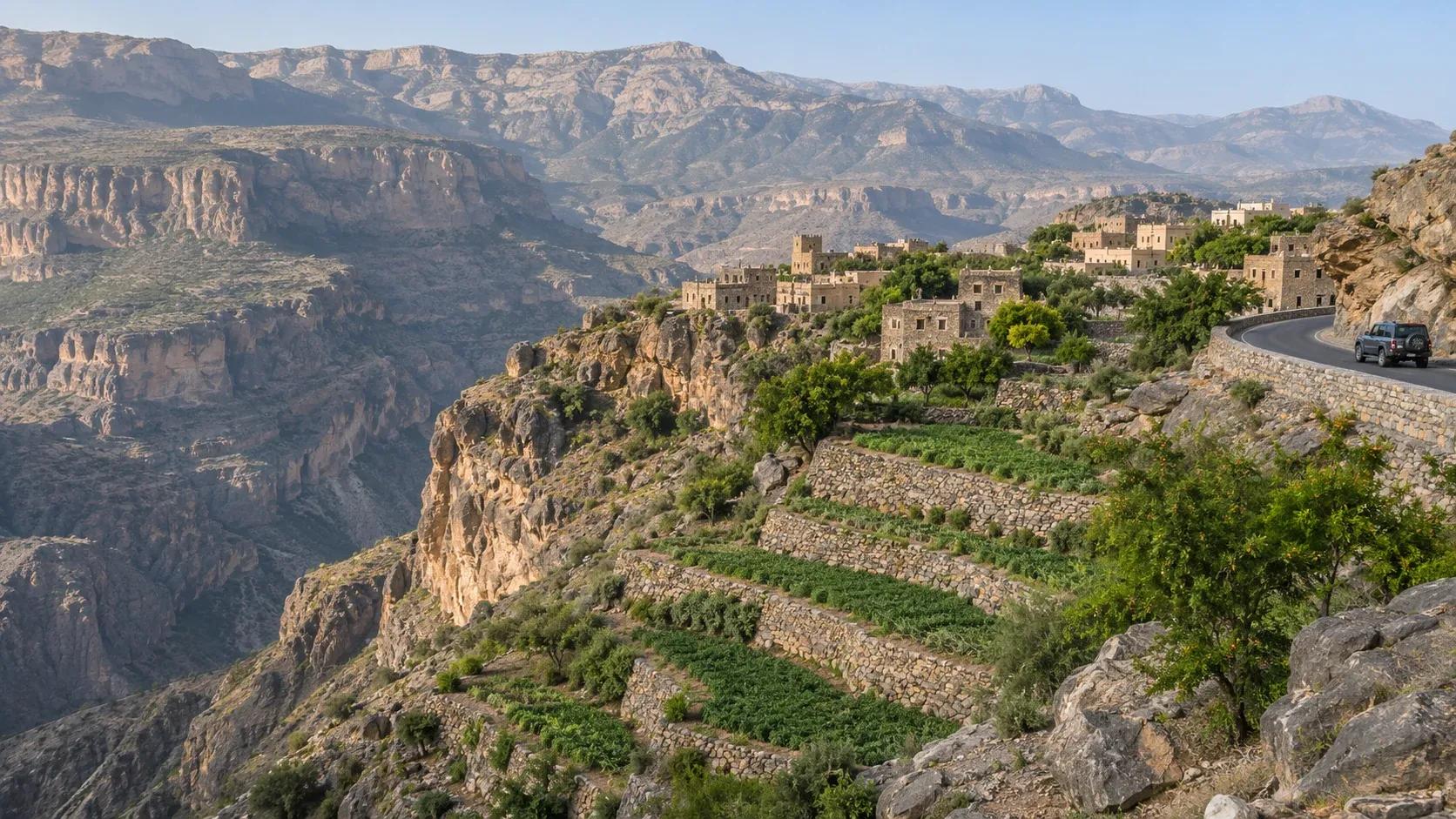
The W18b trail follows ancient paths between villages and terraced crops. Along it, you can see the falaj channels that supply water to orchards and gardens. Pomegranates and Damask roses grow on the terraces, among other things. In spring, you may catch the rose harvest and the processing of petals into rose water. The villages are inhabited, so stay on the trail and ask for permission before entering private property or workshops.
Plan separate trips for Jabal Shams and the Wahiba Sands desert. Driving to Jabal Shams means descending from the plateau to the lowlands and climbing back up via a different road. This adds hours behind the wheel at the expense of time on the trail. For regular stays, living in Muscat can make such trips easier. You can leave your gear in place and choose your weekend dates based on the weather, without moving all your luggage between regions.
—
How to check the weather, route, and reservations before departure?
Check the forecast for the Saiq Plateau itself and warnings for the Al Dakhiliyah region. Also determine whether selected places are open to the public and under what conditions you can enter private facilities, such as Diana’s Point terrace at Anantara Al Jabal Al Akhdar Resort.
Checking conditions 24 hours before departure
- The day before and on the day of departure, check Oman Meteorology reports regarding rainfall, storms, limited visibility, and flash floods in wadis. Rain in the upper part of a catchment area can raise water levels further down, so do not enter or drive through flooded riverbeds. Official recommendations regarding flash floods are also provided by British travel safety guidelines for Oman.
- Confirm your accommodation and ask about specific places and services. If you want to see Diana’s Point without booking a room, ask the hotel whether outside guests are permitted on that day and if a reservation is required (e.g., at the restaurant). Also clarify whether your booked transfer includes luggage and if there is a fee for canceling the ride in bad weather.
- Pack shoes with grippy soles, water, an extra layer, sun protection, and an offline map. For a hike lasting several hours, plan for at least 2 liters of water per person as a baseline and adjust your supply to the temperature, route, and needs of your group. On the W18b trail, sections with stone steps can be slippery after rain.
- Have a backup plan for bad weather. If a warning is in effect for the road or trail, postpone the hike or wait at your accommodation. Nizwa and Bahla can replace the mountain itinerary only if the road is passable and there are no warnings for that section. If the road is closed, follow the instructions of the authorities.
In winter, mornings on Sajq may require a sweatshirt and a windbreaker, even if light clothing is enough in Muscat. In summer, the cooler air on the plateau makes walking easier, but exposed sections of the trail still mean full sun. Over two days, it is worth keeping one flexible block in your itinerary so you can decide on a longer hike once you are there. Before you go, also take a look at our guide with practical information for traveling in Oman.
—
Two-day itinerary, budget, and FAQ
One-night schedule
- Day 1: Around 08:00 departure from Muscat, around 09:45–10:15 stop and checkpoint check in the Birkat al-Mawz area, around 10:30–11:15 arrival at the plateau. After lunch, leave 60–90 minutes for a walk, e.g., starting at 14:30, and return before dark. Adjust your arrival time if the hotel or driver specifies a different pickup window.
- Day 2: Around 08:00 start the W18b trail, and plan to finish the hike or return to the car before 12:00. After lunch, descend around 14:30–15:00, when visibility and conditions allow. With a smooth drive and a short stop, you will reach Muscat around 17:00–17:30.
How much to set aside for a trip for two?
An example budget for two days and one night for two people, calculated at a rounded exchange rate of 1 OMR ≈ 10.6 PLN. Items concerning accommodation and meals are planning assumptions, and actual costs depend on dates, room type, and the chosen restaurant. Flights and separately booked attractions are excluded from this calculation.
- 4×4 rental: about 60–120 OMR (640–1,270 PLN) for two days based on sample offers. Check whether the price includes CDW (Collision Damage Waiver) and what the deductible is. Also compare mileage limits, return hours, and the deposit.
- Fuel: about 12–16 OMR (125–170 PLN) as a reserve for about 400 km, depending on fuel consumption, extra driving, and fuel type.
- Transfer from the foothills: Anantara lists 35 OMR one-way or 55 OMR round-trip before surcharges, which is roughly 370 or 585 PLN respectively. To this option, add the drive from Muscat to Birkat al-Mawz and any driving on the plateau if needed.
- Accommodation: as a starting point, you can assume 30–50 OMR (320–530 PLN) per room in a simple property. When calculating a resort stay, consider a scenario of 180–350 OMR (1,910–3,710 PLN) per night. Compare the total reservation price, including taxes, breakfast, and cancellation terms.
- Food: budget 25–45 OMR (265–480 PLN) for local meals or 80–130 OMR (850–1,380 PLN) if you plan to eat at hotel restaurants. Check which meals are included with your accommodation.
For a couple choosing a 4×4 car, simple accommodation, and local meals, this roughly totals 127–231 OMR (about 1,350–2,450 PLN). If you drive a 2WD car to the foothills, compare the overall logistics of both options, taking into account transportation between the hotel and the trail.
Frequently asked questions before departure
Are Jabal Akhdar and Jabal Shams the same location?
No, these are two different mountain areas in the Al Hajar range with separate access roads. The Saiq Plateau and the villages on the W18b trail are part of Jabal Akhdar. Jabal Shams lies further west and requires a separate drive through the valley.
Does a hotel reservation replace the four-wheel drive verification at the checkpoint?
When entering with a combustion-engine 4×4 vehicle, bring your driver's license and the registration document confirming four-wheel drive. The hotel reservation is for check-in. If you arrive in a 2WD vehicle, coordinate the transfer meeting point with your hotel.
Can I leave my car at the foothills and ride up with a driver?
Yes. Before the climb, you can arrange a hotel transfer or a local 4×4 operator and leave your car near the pickup point. Confirm the exact parking spot, overnight parking availability, any potential fees, and the return trip time.
When do the roses bloom and when can you see rose water production?
The season usually falls in the second half of March and April. Specific dates depend on the weather and the harvest. If seeing the distillation process is important to you, check locally which workshop is operating on the day of your visit and whether they accept guests.
Can you see the plateau without a long trek?
Yes. Al Aqur, Al Ayn, Ash Shirayjah, and Saiq are accessible by road. You can choose one village and walk a short section of the W18b trail in both directions. If someone in your group avoids stairs or uneven ground, ask at your accommodation about walking paths to a selected viewpoint.
Is there an entrance fee, and how should one dress in the villages?
According to the access terms published by Anantara, there is no separate fee for passing through the checkpoint. Parking, guides, transfers, and private attractions may have their own rules. In inhabited villages, it is polite to cover your shoulders and knees and respect signs near private homes and crops.
Does the room price include a guided tour?
Check the scope of your chosen rate and the availability of tours on specific days. Ask whether the price of the walk is per person or per group, and whether it includes transportation to the starting point and pickup at the end of the route.
—
Muscat as a base for regular stays in Oman
If you plan several stays a year, living in Muscat can make two-day trips to the mountains much easier. When choosing an apartment, check the exit from the neighborhood to main roads, parking availability, and maintenance costs during the months you are not using it. Under a lock-and-leave formula—meaning you lock up your apartment and leave for an extended period—who can look after the property during your absence also matters.
The PlanoGroup team in Muscat helps compare apartments in Integrated Tourism Complex (ITC) projects, review acquisition rules and maintenance costs, and determine the scope of property management services after purchase. If you are looking for a second home in Oman, contact us and let us know how often you plan to visit and which parts of the country you want to use during your stay.

Author
Mariusz Sawicki
MEMBER OF THE MANAGEMENT BOARD
He combines experience from the financial and real estate sectors, which allows him to support clients in making informed and well-thought-out investment decisions. He views real estate purchases not only through the lens of emotions, but primarily through data, security, and potential. He specializes in investment analysis and risk assessment, particularly in emerging markets such as Oman. In his work, he focuses on specifics, transparency, and a partnership-based approach.