


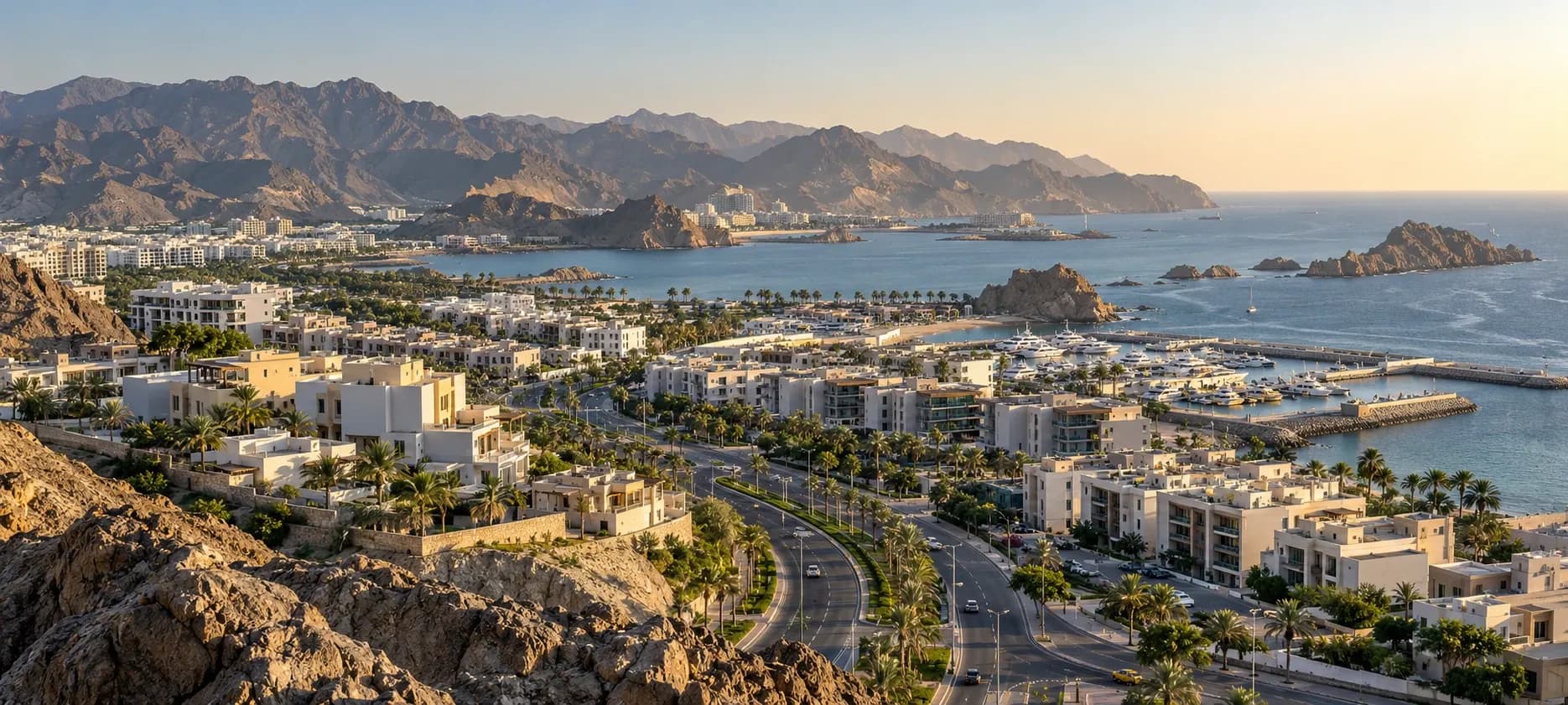
Real estate investing in Muscat: 72-hour location audit plan
Three days in Muscat should be treated as an audit rather than a series of sales presentations. On the first day, measure commutes from the airport and to amenities, check roads, sidewalks, and the surroundings of buildings at different times of day. On the second, compare Al Mouj and Muscat Hills: tenant profile, condition of common areas, rental rules, and actual service charges. On the third, check the progress of work in Yiti and the accessibility of Jebel Sifah, separating completed infrastructure from the master plan. Upon return, enter your observations, documents, and the seller's declarations into a single spreadsheet. Calculate net ROI after operator, maintenance, and vacancy costs, across several scenarios. ITC status, title deed, visa, and taxes require separate verification. The trip helps discard weak locations; only data and contracts justify the decision.


Article summary
The most important conclusions from the article in 30 seconds.
Three days in Muscat should be treated as an audit rather than a series of sales presentations. On the first day, measure commutes from the airport and to amenities, check roads, sidewalks, and the surroundings of buildings at different times of day. On the second, compare Al Mouj and Muscat Hills: tenant profile, condition of common areas, rental rules, and actual service charges. On the third, check the progress of work in Yiti and the accessibility of Jebel Sifah, separating completed infrastructure from the master plan. Upon return, enter your observations, documents, and the seller's declarations into a single spreadsheet. Calculate net ROI after operator, maintenance, and vacancy costs, across several scenarios. ITC status, title deed, visa, and taxes require separate verification. The trip helps discard weak locations; only data and contracts justify the decision.
Muscat cannot be evaluated from a single viewpoint or a developer's catalog. Developments stretch along the coast and between mountain ranges, meaning two apartments at a similar distance from the sea can have completely different access to the airport, work, school, and everyday services. For the owner, this is a matter of convenience; for the investor, it also dictates the tenant profile, occupancy rates, and subsequent resale potential.
Three days on site are enough to compare selected projects against the same list of criteria. They are not enough to confirm the rate of return or the legal status. Therefore, the 72-hour plan combines a commute test, observation of mature ITC complexes, inspection of new project progress, and the collection of documents for analysis upon return. Oman Vision 2040 and the Greater Muscat Structure Plan outline the city's development directions, but the investor must separately determine what is already operational near a specific property, what has been contracted, and what remains part of the master plan. The outcome of the trip should be a comparison sheet and a list of questions for the lawyer, property manager, and developer.
—
How to Plan 72 Hours in Muscat? Logistics and Site Audit
Day One: Routes, City Rhythm, and Surrounding Quality
Before flying out, select at most a few properties matching a single goal: personal stays, long-term rental, or short-term rental. Request the exact pin of the building entrance, the floor plan, the current price list, the payment schedule, the completion status, and the rental regulations. Map out three routes relevant to the future user: from the airport, to the workplace or service center, and to daily grocery shopping. Only with a list prepared this way can you use the 72 hours for verification rather than sales presentations.
On site, rent a car or test locally available ride-hailing services. If your plan involves Otaxi or Marhaba, check before your trip whether the app works on your phone, supports the addresses you are examining, and allows you to pick up a passenger at the required time. A future guest without a car might do the exact same thing. Note the waiting time, the cost of the ride, and whether the driver finds the entrance without extra directions. A car offers greater freedom for remote projects, but it does not replace the convenience test for a tenant.
Drive each key route twice: in the morning around 8:00 AM and in the afternoon around 5:00 PM on a workday. Measure door-to-door time, not just the time from the highway exit to a point on the map. Pay attention to entering Sultan Qaboos Street or the Muscat Expressway, the number of U-turns, traffic lights, parking, and the path from the parking lot to the apartment. In the case of workforce rentals, check the actual connection to the tenant's employment district; Ruwi might be a good testing point, but it does not represent all places of employment in Muscat. Repeat the measurement on the weekend if the project is intended to serve tourists.
After each drive, walk the surrounding streets. Photograph the condition of the pavement, pedestrian crossings, lighting, unfinished plots, and access to the beach or marina. Record the date, time, and location of the photo. Check whether a shop, pharmacy, and restaurant are accessible on foot or only across a multi-lane road. In high temperatures and over long distances, a "10-minute walk" on a map may mean a different level of usability than in Europe. Evening observation allows you to assess whether the neighborhood remains active after the sales office closes.
The Greater Muscat Structure Plan outlines spatial development, transport, and public spaces on a metropolitan scale. It is not a guarantee of value growth for a single apartment. For every infrastructure promise, ask for the plot-approved plan, the contractor, the source of financing, and the deadline. Separate investments that are already available from those that are planned. Such an audit method can be explored further in the PlanoGroup article on a scouting trip to Oman.
—
Al Mouj and Muscat Hills: What to Check in Mature ITC Projects?
Day Two: Management, Costs, and Real Tenant Profile
Treat Al Mouj as a benchmark for a functioning district with a marina, services, and a golf course. Visit it in the morning, around mealtime, and after 7:00 PM. Roughly count pedestrian traffic, check open venues, parking occupancy, and the condition of common areas across several buildings. One busy promenade does not prove rental demand for a specific apartment. Ask the operator for historical occupancy data of comparable units, the average rate after discounts, and seasonality. Inquire about the rules for short-term rentals in the building and whether the owner can choose their own operator.
In Muscat Hills, compare a different usage scenario: privacy, daily commute, and the needs of families or people working in Muscat. Stand by the tested building at various times, close the windows during the viewing, and check for noise from roads and flights. Assess the apartment's sun orientation, shading, and cooling costs. Ask about the potential tenant profile based on existing contracts and inquiries, rather than a general assurance that "diplomats live here." The building, square footage, number of parking spaces, and rules for using the infrastructure may matter more than the name of the community itself.
In both locations, request the service charge statement for the previous period, this year's budget, the scope of fees, and their historical changes. Determine who pays for air conditioning, water, internet, insurance, common area repairs, and the reserve fund for major repairs. Separate the association fee from the operator's commission, in-unit utilities, and guest acquisition costs. The article outline mentions a service charge share of 15–20% of revenue. This is not a verified norm for Al Mouj or Muscat Hills: calculate the share from a specific unit's bills and actual revenues. When history is absent, use multiple scenarios and highlight the uncertainty.
The Integrated Tourism Complex (ITC) status requires verification at both the project and unit levels. Omani regulations permit foreign property ownership in licensed complexes, but a lawyer must confirm the title type, restrictions, registration, rental eligibility, and resale rules. Separately, there is a procedure for obtaining a residency visa for property owners in an ITC. The purchase alone does not automatically grant tax residency; this depends on separate regulations and the individual's actual circumstances. Do not include residency or tax benefits in the model without individual verification.
When comparing Al Mouj to Dubai, compare the same parameters: the density and height of the specific development, common costs, listing liquidity, tenant demographic, and sales time. Do not assume a single G+6 or G+8 limit for the entirety of Oman. Height and development intensity stem from planning documents and plot-specific approvals. In rental analysis, more important than the catchphrase "low-rise development" is whether a planned neighboring phase will block the view and increase competition for tenants.
—
The Yiti and Jebel Sifah Direction: How to Assess Progress and Growth Potential?
Day Three: Developing Project and Resort Location
Yiti requires a different set of questions than a finished building in Al Mouj. Before visiting, request the approved master plan, phased schedule, utility connection plan, sales contract, escrow account rules, handover terms, and a document defining liability for delays. On site, compare the visualizations with what has actually been completed: roads, utilities, public space, and service facilities. Take photos of the exact spots shown on the plan. On The Sustainable City – Yiti's website, some facilities are described as part of the master plan; do not automatically treat them as operating services adjacent to the apartment.
Inquire separately about schools, parks, medical facilities, and retail. Who will be the operator? Has an agreement been signed? When is the facility scheduled to welcome users? Does completion depend on the sale of the next phase? This matters for two different forecasts: the future resident's comfort and the resale price. Capital appreciation can occur if the project delivers useful infrastructure and attracts buyers. It is not a result of merely announcing a plan. Include a delay variant in your spreadsheet along with the period during which the unit will operate without promised services.
Check Yiti's environmental assumptions in the technical documentation. Request the installation specifications, energy and water metering rules, warranties, projected maintenance costs, and details on who finances equipment replacement. Lower utility bills are only possible if the system achieves its declared parameters and its maintenance does not swallow up the savings. Developer materials provide a source of information about the project, but they do not replace operational data from completed phases.
Check Jebel Sifah as an alternative for a second home or vacation rental. Drive the entire route from Muscat, recording the actual travel time, driving comfort, cell phone coverage, and the availability of services along the way. Check the drive in daylight and after dark if you plan evening arrivals. On site, compare community life on a workday versus a weekend. For personal stays, the rhythm of use and access to the marina or golf course will matter; for rentals, seasonality, cleaning costs, key handover procedures, and the number of similar units available simultaneously are key.
In both locations, ask the advisor where the data on the developer's punctuality comes from: completed projects, handover registries, or sales materials. Evaluate the broker's experience through specific transactions and document verification methods, rather than just years on the market. In practice, what matters are the documents of the project under review, the history of delivering previous phases, and the ability to speak with owners of existing units.
—
From Observation to Spreadsheet: How to Turn a Trip into an Investment Model?
The Last Mile, Property Comparison, and Net ROI
Upon return, describe each property in an identical layout. Record the total price and price per square meter, usable floor area, legal title, construction status, handover date, purchase costs, and furnishing expenses. Add the measured travel time to the airport and to locations relevant to the target tenant, the availability of services within a realistic walking distance, noise, parking, and the quality of the building entrance. Create separate columns for what you saw, what the document confirms, and what the seller merely claims. This ensures that an attractive view does not mask a lack of everyday infrastructure.
Conduct the "last mile" test on foot from the apartment door to a grocery store, pharmacy, cafe, and public transport pickup point. Do not assume that chain names mentioned in the plan—such as Al Fair or Lulu—are operational near every property analyzed. Check specific locations, opening hours, and safe crossings. If the apartment is intended for a family, measure the route to the chosen school and medical facility; Royal Hospital and British School Muscat may serve as examples, but they only matter once the tenant profile is confirmed and the commute time is realistic. For a tourist, the beach, restaurants, and easy airport pickup may be more important.
Build the financial model from the revenue achievable in the given building, not from the highest asking rates in listings. For short-term rentals, calculate available nights × cautious occupancy × average net rate after discounts. For long-term rentals, account for vacancy periods and the time required to find a new tenant. Subtract from the revenue the operator's commission, service charges, owner-paid utilities, cleaning, insurance, maintenance, and the CAPEX reserve for furnishing replacement. Calculate net ROI as the annual operating cash flow after these costs divided by the total capital committed to the purchase and launch of the unit. Show financing costs and taxes in separate rows according to the investor's situation.
Compare three scenarios: baseline, weaker demand, and delayed launch. By changing one parameter at a time, you will see whether the outcome depends primarily on occupancy, rate, common costs, or entry price. Compare the price per square meter with offers for similar units and, if reliable transaction data is available, with those—accounting for the date, floor, view, and finishing state. A research firm's homepage or a developer's brochure is not yet proof of a specific building's transaction price. When data is absent, mark the comparison as listing-based.
Do not automatically transfer Dubai's development scale, liquidity, or pricing to Muscat. Lower building intensity can be a functional asset, but it does not guarantee a higher price by itself. Verify the local master plan, future phases, and demand within the target segment of the property. After the trip, submit your questions to a lawyer regarding the ITC license, title deed, rental restrictions, payments, handover, delays, and resale. Ask the investment advisor for rate sources, service charge bills, and operator terms. Only after this can a location comparison mature into a capital decision.
—
How to Prepare Your Route and Questions Before Departure?
If you are planning a viewing of ITC projects in Muscat, gather documents in advance and define your purchase goal. PlanoGroup can help structure a comparative route and outline questions for the developer, property manager, and local lawyer. For current prices and rental assumptions, request sources, dates, and a full list of costs; a standalone ROI forecast is not enough to make a decision.
—
FAQ
Can Muscat realistically be evaluated in three days?
Yes, provided the trip has a narrow scope. Three days allow you to test several routes, observe everyday services, compare the condition of completed buildings, and ask questions about new phases. They are not enough to evaluate the entire city, long-term occupancy, or legal status. Before leaving, select locations and send a request for documents; upon return, supplement your findings with a review of contracts and costs.
Is it worth starting with Al Mouj?
It is a useful benchmark because you can simultaneously observe the marina, services, public spaces, and residential buildings. However, it is worth comparing at least two buildings as well as visiting during both a quiet hour and the evening. The presence of guests on the promenade does not yet reveal how much a specific unit will earn. This is determined by factors such as the purchase price, view, rental rules, common costs, and the operator.
What should I check on the road to Yiti or Jebel Sifah?
Measure the door-to-door travel time, road surface quality, night driving comfort, and service availability along the route. In Yiti, separate completed infrastructure from scheduled items and ask about utility connections and subsequent phases. In Jebel Sifah, check whether the distance suits your planned personal stays or guest expectations, and how the property functions outside the weekend and peak season.
What documents should I prepare before departure?
Bring your passport and establish a budget that also covers purchase fees and furnishings. Prepare a list of compared properties, their plans and prices, questions regarding the ITC, title deeds, rentals, operators, and service charges. Request the SPA draft, payment schedule, phase plan, and management contract template in advance. Documents gathered before the meeting will allow you to check discrepancies on site rather than just listening to a general presentation.
Can a trip replace a legal analysis?
No. A site visit reveals accessibility, building quality, and the state of construction, but it does not confirm who holds the title to the unit, what restrictions the contract imposes, or what happens in the event of a delay. A local lawyer should check the ITC documents, ownership registration, payment terms, handovers, rentals, and resale terms. The potential residency and tax implications must be assessed separately.

Author
Mariusz Cieślukowski
CEO / FOUNDER
Co-founder of PlanoGroup and the person responsible for the development of the entire group. He built a brand based on quality, trust, and effectiveness, developing it in the Spanish market and subsequently expanding operations to further investment destinations. Today, he is developing PlanoGroup - a project that responds to the needs of clients who are looking not only for real estate but also for new opportunities for living, investment, and relocation. He specializes in trend analysis and building investment strategies in foreign markets - including Spain, Oman, and emerging locations such as Montenegro.

Related articles

Investments in Oman: How to plan a golf scouting trip?
Real Estate in Oman: How to Invest Wisely in ITC Projects

Real estate profitability in Oman: operating model, OPEX, CAPEX, and real net ROI