


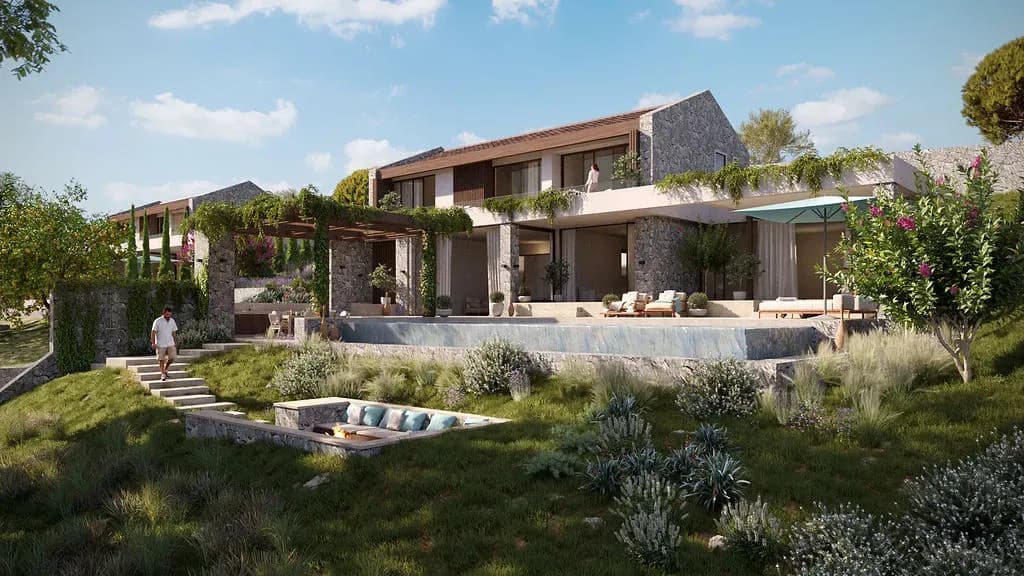
Real estate prices in Montenegro – how much does an apartment cost and is it worth investing?
Montenegro remains an attractive real estate market in Southern Europe in 2025, offering stable price growth and high return potential. The average price per square meter in 2024 was 1,800–2,000 euros, reaching up to 2,107 euros/m² on the coast, marking a 49.1% year-on-year increase in Q2 2024. Investors can achieve a 5–8% ROI from short-term rentals, benefiting from the absence of capital gains tax and low transaction costs. The country uses the euro, eliminating exchange rate risk, and allows foreigners full ownership rights and the ability to apply for residency. Popular locations such as Budva, Tivat, and Kotor generate the highest profits.


Article summary
The most important conclusions from the article in 30 seconds.
Montenegro remains an attractive real estate market in Southern Europe in 2025, offering stable price growth and high return potential. The average price per square meter in 2024 was 1,800–2,000 euros, reaching up to 2,107 euros/m² on the coast, marking a 49.1% year-on-year increase in Q2 2024. Investors can achieve a 5–8% ROI from short-term rentals, benefiting from the absence of capital gains tax and low transaction costs. The country uses the euro, eliminating exchange rate risk, and allows foreigners full ownership rights and the ability to apply for residency. Popular locations such as Budva, Tivat, and Kotor generate the highest profits.
For several years, Montenegro has been attracting increasing interest from investors across Europe. It is a small but dynamically developing country on the Adriatic Sea that combines beautiful landscapes, a stable economy, and transparent rules for foreign property buyers. An additional advantage is the fact that Montenegro uses the euro as its currency, even though it is not yet a member of the European Union – which eliminates exchange rate risk and increases the attractiveness of investments.
In 2024, the average price per square meter of an apartment in Montenegro was approximately 1,800–2,000 euros, and in popular coastal locations such as Budva, Kotor, or Tivat, prices can be several times higher. However, the market remains more affordable than in neighboring countries – Croatia or Italy – while maintaining high potential for value growth and solid rental yields. As a result, Montenegro is becoming one of the most interesting real estate markets in Southern Europe, offering investors a balance between security and attractive profit.
The real estate market in Montenegro in 2025 – an overview
The real estate market in Montenegro in 2025 continues to show strong signs of growth, although the momentum is beginning to shift into a more sustainable phase of development. According to expert analyses, apartment and house prices are still rising – though not as spectacularly as in 2023-2024.
Key trends and data:
- Nationwide, property prices rose by approximately 20.8% in 2024, which significantly exceeds the European average.
- In coastal regions (e.g., Budva, Kotor, Tivat), growth in 2023-2024 reached as high as ~49% in selected locations.
- In the northern parts of the country, which are less tourism-oriented, price growth was definitely moderate – e.g., ~39.9% in one of the studied periods.
- Quarterly data indicate that at the end of 2024, the growth rate for the entire market was approximately 8.2% y/y (in December).
- Experts predict that in 2025, growth will remain positive but more moderate – for example, in the Bay of Kotor region, forecasts suggest +1-3% annually.
Factors driving growth:
- Tourism: the strong position of the tourism industry attracts foreign investors and drives demand for vacation properties.
- Infrastructure and regulations: the country is focusing on infrastructure development, and investment policy favors property acquisition by foreigners.
- Euro as currency: Montenegro uses the euro, which eliminates exchange rate risk for investors from eurozone countries or beyond.
Note on risks and limitations:
- Despite the increase in the supply of new apartments, the coastal segment is already experiencing constraints related to land scarcity and high entry prices.
- Price increases in prime locations may reduce rental profitability, especially if investors expect quick returns.
- In some less touristy regions, the market remains less active – which means that the choice of location is crucial.
How much does real estate cost in Montenegro?
Below you will find indicative real estate prices in Montenegro – useful for investors interested in the market. Prices are given in euros per square meter (€/m²) and are based on the latest available data.
Price ranges by location
| Location | Indicative price €/m² | Market description |
|---|---|---|
| Coast (Budva, Kotor, Tivat) | ~€2,000 – €4,000 / m² | Tourism market, popular among investors. |
| Luxury seaside townhouse (premium) | ~€5,000 – €14,000+ / m² | Top locations: marinas, villas, views. |
| Capital – Podgorica | ~€1,700 – €2,300 / m² | Local market, standard apartments. |
| Inland / less touristy regions | ~€700 – €1,400 / m² | less popular locations, potential for value creation. |
Key notes and commentary for investors
- In Q2 2024, the average price on the coast reached approx. €2,107/m², which meant an increase of +49.1% year-on-year.
- In less touristy regions, the growth rate was slower — e.g., the central region reached ~€960/m² in Q2 2024.
- The premium segment significantly outperforms the averages — luxury apartments and villas can cost over €10,000/m².
- For investors, this means that the location and quality of the property are crucial for both the entry price and the potential return.
- The market is characterized by a wide price range — from the budget segment to ultra-premium — which provides opportunities to choose an investment strategy.
What are the taxes and costs when buying property in Montenegro?
Buying property in Montenegro is relatively simple and tax-efficient. The tax system is transparent, and transaction costs are among the lowest in the Southern European region.
Taxes on property purchases
| Transaction type | Tax / fee | Description |
|---|---|---|
| Secondary market | 3 – 6% of the property value | Transfer Tax. The rate depends on the municipality's decision. |
| Primary market | VAT 21% | Instead of a transfer tax – paid by the developer (usually included in the price). |
| Annual property tax | 0.25 – 1% of the cadastral value | Determined locally by municipalities; payable once a year. |
| Rental income tax | 9 – 15% | From net rental income (after deducting costs). |
| Capital gains tax | 0% | For individuals – no taxation on the sale of real estate. |
(Sources: Monstat, Investropa, Global Property Guide, Meedar Montenegro 2024)
Additional transaction costs
- Notary fee: approx. 0.5 – 1% of the property value.
- Court and registration fee (cadastre): up to €50.
- Legal services: approx. €500 – €1,000, depending on the complexity of the case.
- Real estate agency commission: usually 3% of the transaction value (paid by the buyer or split).
What you should know as an investor
- All taxes and fees are paid in euros (EUR).
- Property maintenance costs (energy, water, local fees) are lower than in most EU countries.
- There is no capital gains tax, which makes long-term investments particularly attractive.
- There are no restrictions on the purchase of real estate by foreigners in Montenegro (with the exception of agricultural land).
Thanks to a transparent tax system and low transaction costs, Montenegro remains one of the most investor-friendly real estate markets in the Adriatic region.
Return on investment – is real estate in Montenegro profitable?
For several years, Montenegro has remained among the top countries with the highest return on real estate investment in the Balkan region. Thanks to dynamic tourism development, a stable currency (euro), and growing demand from foreign buyers, residential and apartment investments in this country are becoming increasingly profitable.
Average Return on Investment (ROI)
- Average short-term rental return: 5 – 6% gross per year, and in prime locations (Budva, Kotor, Tivat) up to 8%.
- Long-term rental (e.g., in Podgorica): usually 3 – 5%, but characterized by greater stability.
- Compared to many European Union markets, the ROI in Montenegro is very favorable – for example, in Spain or Italy, the average return is 3–4%.
(Sources: GlobalPropertyGuide 2024, Investropa, Meedar Montenegro)
Factors increasing profitability
- Tourism seasonality: May–September is the main short-term rental period; during this time, occupancy in popular resorts exceeds 90%.
- Growing tourist traffic: in 2024, the country was visited by over 2.6 million tourists (a record result).
- Low taxes: no capital gains tax and relatively low tax on rental income.
- Constant increase in property prices: over the last 5 years, average prices have risen by more than 40%.
Who is this investment profitable for?
- For those looking for a safe capital investment in euros.
- For investors planning vacation rentals with the possibility of using the property themselves.
- For entrepreneurs thinking about long-term residency or business expansion in a non-EU country that uses the European legal system and currency.
Montenegro offers investors a balance between stability and profitability. It is a market that is still less saturated than Croatia, while simultaneously gaining popularity among foreign buyers. For many investors, this is the last moment to enter the market before further price increases and growing competition.
Can foreigners buy property in Montenegro?
Yes – foreigners can freely purchase real estate in Montenegro, both on the primary and secondary markets. This is one of the reasons why this country has become one of the most foreign-investor-friendly markets in the Adriatic region.
Rules for property purchase by foreigners
- No ownership restrictions: foreigners have full ownership rights to apartments, flats, houses, and commercial premises.
- Exception: prohibition on acquiring agricultural land (except when the purchase is made through a company registered in Montenegro).
- Ownership right: the buyer receives a full title (freehold), confirmed in the cadastral register (List Nepokretnosti).
- Transaction registration: takes place at a notary, who sends the documentation to the district court and the cadastre office; the process usually takes from 7 to 30 days.
Residency based on property ownership
Owning property in Montenegro entitles you to apply for a Temporary Residence Permit.
- Required documents: notary deed, proof of ownership, health insurance, and proof of financial means.
- The permit is issued for 12 months with the possibility of annual renewal.
- Residency can be extended to family members.
For investors, this means not only easy access to the market but also the possibility of legal and long-term stay in a country with the euro currency and a stable legal system.
Purchase through a company – an alternative for business investors
- Investors planning to purchase land or larger projects can establish a limited liability company (DOO).
- The registration process usually takes a few days and allows for the acquisition of agricultural land and the conduct of investment or development activities.
Thanks to liberal regulations, transparent procedures, and full ownership rights, Montenegro stands out from most Southern European countries. It is a simple, safe, and legal way to enter a real estate market with growing potential.
Most interesting investment locations in Montenegro
Although Montenegro is a small country, its real estate market is surprisingly diverse. Depending on your investment goals — whether it's short-term rental, a luxury vacation apartment, or a long-term capital investment — it is worth looking at the following locations.
Budva – the heart of Montenegrin tourism
- The most famous and dynamic city on the Adriatic.
- Wide range of apartments – from compact vacation flats to modern premium investments.
- Average prices: €1,700–3,500 / m², ROI from vacation rentals up to 8% per year.
- Ideal for investors focused on short-term rentals and quick return on investment.
Tivat – luxury and the Porto Montenegro marina
- A symbol of the modern, premium segment of the Montenegrin market.
- Porto Montenegro is one of the most expensive and prestigious locations in the country – apartments here reach €7,000–23,000 / m².
- High demand from international clients, stable value growth.
- A great choice for investors looking for safe, prestigious properties with high long-term potential.
Kotor – history, culture, and premium tourism
- A UNESCO-listed city, surrounded by mountains and the fjord of the Bay of Kotor.
- Properties within the Old Town are extremely limited – prices reach €3,500–6,000 / m².
- An ideal place for investors who value unique character and historical value.
- Tourist season extended to 8–9 months due to the popularity of cruises and boat trips.
Bar – a developing alternative
- A port city with increasingly better infrastructure and high growth potential.
- More attractive prices: €1,500–2,200 / m², still below the average for the coast.
- Good road and rail connections with Podgorica.
- For long-term investors – excellent price-to-potential ratio.
Ulcinj – exotic and a destination with a future
- Located in the south of the country, right on the border with Albania.
- Long season, unique climate, wide beaches, and lower prices: €1,000–1,500 / m².
- Growing interest from investors from Western Europe and Arab countries.
Podgorica – the capital and business center
- The largest and most stable internal market.
- Demand for long-term rentals (employees, diplomats, expats).
- Prices: €1,700–2,300 / m², lower risk and high sales liquidity.
- A suitable direction for investors looking for stable cash flow.
Montenegro offers unique diversity — from luxury apartments in marinas to affordable flats in developing cities. The choice of location should depend on your investment strategy: Budva and Kotor for high returns, Tivat for safety, and Bar and Ulcinj for value growth over time.
Is it worth investing in Montenegro in 2025?
Key advantages of investing
- Euro currency (EUR) – no exchange rate risk and easy settlements.
- Attractive return on investment – average 5–7% gross in top locations.
- Stable price growth – market in an expansion phase, with long-term potential.
- Transparent regulations – full ownership rights (freehold) for foreigners.
- Low taxes and transaction costs – significantly lower than in EU countries.
- Strong tourism and infrastructure development – ports, marinas, new roads, and airports.
- Possibility of obtaining residency through property purchase.
Conclusion:
In 2025, Montenegro remains one of the most attractive real estate markets in Southern Europe. Thanks to a stable economy, a growing tourism sector, and favorable regulations for investors, this country offers a good balance between safety and profit potential. It is a great moment to consider a purchase – before prices catch up to the level of neighboring markets, such as Croatia or Greece.
Summary – Montenegro: a small country, big investment potential
Montenegro is consistently building its position as one of the most attractive real estate markets in Southern Europe. Thanks to a stable economy, the euro as a currency, transparent property law, and a dynamically growing tourism sector, this country offers investors a real chance for a safe and profitable return on capital.
Average property prices – still lower than in neighboring Croatia – and high rental yields (5–7% gross) make Montenegro an interesting alternative to more mature Mediterranean markets. Additional advantages include low taxes, a simple purchase process, and the possibility for investors to obtain residency.
For those looking for a balance between safety and growth potential, Montenegro in 2025 is a destination worth keeping on your radar.

Author
Patrycja Kordys
BOARD MEMBER | SALES DIRECTOR
For nearly 17 years, she has been associated with the premium real estate market. She gained her experience working with international clients—particularly German and English speakers—ensuring the highest standard of service and communication. After years of working on the Costa del Sol, she now focuses on the dynamically developing market of Oman, where she supports clients in discovering new investment opportunities and lifestyles. She combines professionalism with a natural ease in building relationships, ensuring that the purchasing process is smooth and stress-free.
