


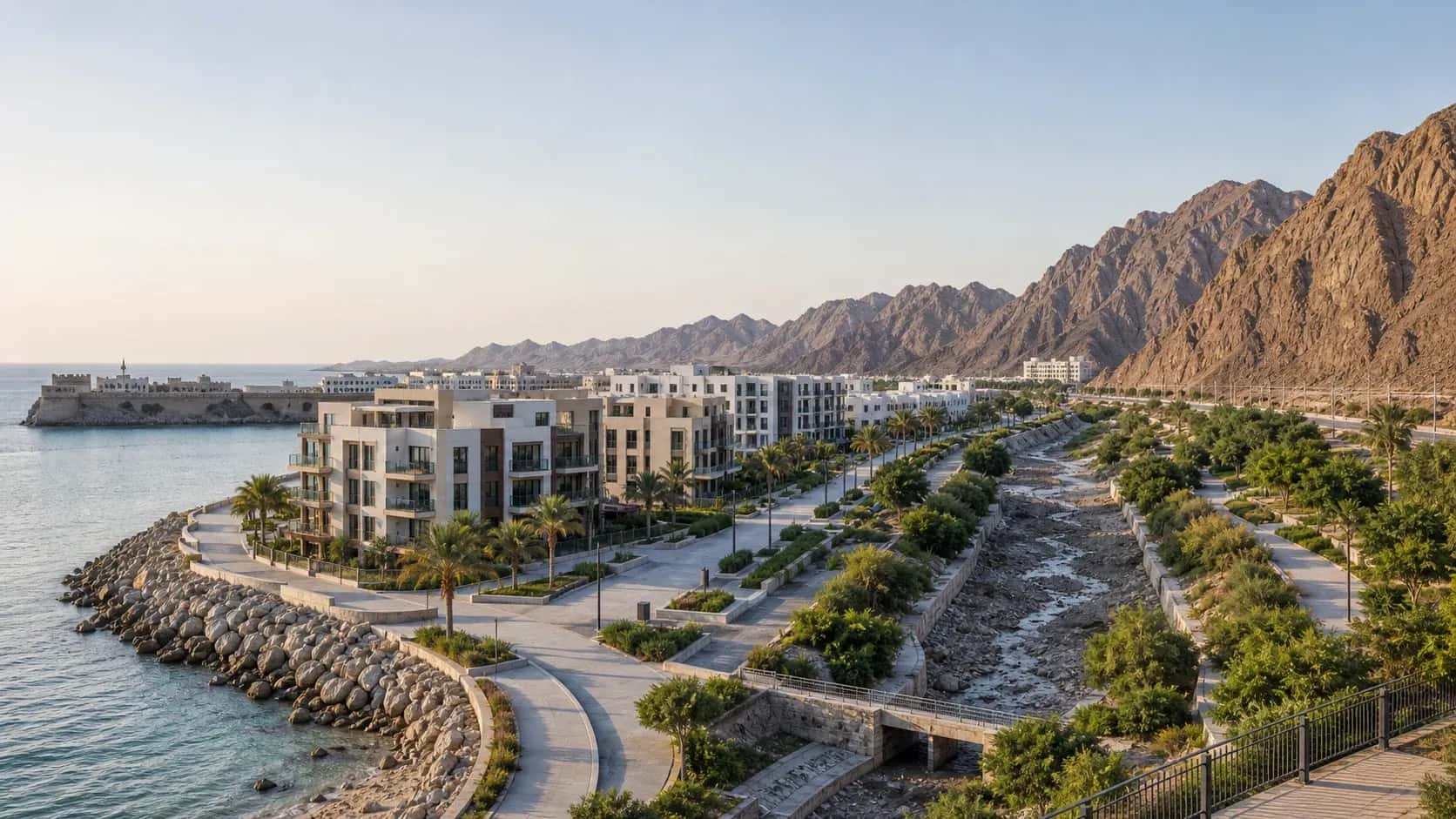
Real estate in Muscat: waterfront, wadi, and safety
Investing in waterfront properties in Muscat requires a detailed analysis of terrain elevations and drainage systems to protect against flash floods in wadi channels. The Oman Vision 2040 strategy is modernizing infrastructure in key districts such as Al Mouj and Muscat Bay, placing an emphasis on the climate resilience of buildings. The profitability of coastal investments is determined by maintenance costs (service charges) resulting from the saline environment and the efficiency of HVAC systems. Proper technical due diligence allows for capital protection over a long-term horizon while maintaining a stable ROI.

Article summary
The most important conclusions from the article in 30 seconds.
Investing in waterfront properties in Muscat requires a detailed analysis of terrain elevations and drainage systems to protect against flash floods in wadi channels. The Oman Vision 2040 strategy is modernizing infrastructure in key districts such as Al Mouj and Muscat Bay, placing an emphasis on the climate resilience of buildings. The profitability of coastal investments is determined by maintenance costs (service charges) resulting from the saline environment and the efficiency of HVAC systems. Proper technical due diligence allows for capital protection over a long-term horizon while maintaining a stable ROI.
Is a waterfront apartment in Oman always a better choice? This is one of the most important questions for an investor analyzing Muscat. Proximity to the sea, a view of the bay, or being near a wadi bed can increase rental demand, but aesthetics alone are not enough to protect capital. In the premium segment, operational parameters matter: ground elevation, distance from flood zones, drainage quality, material resistance to salt and humidity, HVAC efficiency, and the level of Service Charge after the building is completed.
This article analyzes three pillars of the decision: waterfront potential, the hydrological specifics of wadis, and the building's climate resilience. The Greater Muscat Structure Plan indicates that Muscat is to develop its waterfront, wadi parks, green corridors, and resilient infrastructure. For an investor, this means an opportunity, but also a need for due diligence before signing an SPA. It is worth starting with a review of seaside properties in Oman and comparing it with the technical documents of a specific project.
—
Does a waterfront apartment in Muscat always have better rental potential?
Profitability vs. seasonality of coastal locations
A waterfront in Muscat can improve rental demand, but it does not always improve net ROI. A higher entry price per m² must be covered by higher occupancy, a better daily rate, or greater resale liquidity. An investor should distinguish between three things: a sea view, actual access to the beach, and service facilities. Only the combination of these elements creates an advantage for short-term rentals and long-term expat stays.
The GMSP treats the waterfront as an urban asset. Vol. 1 points to the Muscat City Waterfront, Muscat Central Waterfront, Al Mouj, and projects such as the Al Qurum Culture Hub and the Muscat City Beach Plan. The plan also provides for the preparation of a strategy for the entire Greater Muscat waterfront, the development of tourist activities, marinas, water sports, and shoreline improvements. This is important because the value of an apartment depends not only on the water line, but on whether the area is managed, accessible, and resilient to coastal risks.
In rentals, seasonality works both ways. In winter, Muscat benefits from tourist and business demand; in summer, humidity and temperature can limit short-term stays unless the project has good service, parking, efficient cooling, and proximity to services. For long-term rentals, commutes, schools, offices, marinas, shops, and the ability to function daily without excessive costs are more important.
Step-by-step before buying a waterfront apartment:
- compare the price per m² with locations away from the shore but well-connected;
- check if the view means actual access to the beach, promenade, or marina;
- ask the rental operator about occupancy in winter and summer, not just the average annual yield;
- compare the Service Charge with the scope of services: security, marina, pools, greenery, parking, beach;
- check if the project is in an ITC zone if, as a foreigner, you expect a legal title appropriate for a foreign buyer.
As an investment context, it is worth reading the PlanoGroup analysis on real estate prices in Oman and the text on ROI in Oman.
—
What is a wadi and why is it crucial for investment security?
Hydrological specifics of Oman and the phenomenon of flash floods
A wadi is a periodic riverbed that for most of the year may look like a dry valley or a landscape element. In Oman, however, it must not be treated as an ordinary green belt. During heavy rainfall, water from the mountains and higher terrain can quickly flow through valleys, channels, and natural depressions. The risk does not stem from the daily presence of water, but from rare, high-intensity events.
The GMSP explicitly identifies wadi flooding as one of the main components of climate risk in Greater Muscat. Vol. 1 indicates that risk mapping includes extreme heat, wadi flooding, storm surge, and population density. The plan also emphasizes the need to update flood maps and protect natural flow corridors. Oman's official meteorological system also describes Flash Flood Guidance as a tool for monitoring threats related to sudden rainfall.
For a second-home investor, proximity to a wadi can have advantages: a view, silence, access to recreational areas, and lower building density. However, the same element can increase operational risk if the access road, garage, lobby, pump stations, or technical rooms are located too low. In investments like Muscat Bay, AIDA, or projects in valleys, the most important question is not whether the area looks good, but how water flow was designed for extreme events.
How to read wadi risk step-by-step:
- ask for a site plan with wadi beds, drainage channels, and ground elevations;
- check where garage entrances, ramps, technical rooms, and main access roads are located;
- ask what rainfall scenario was adopted in the drainage design;
- determine whether drainage depends solely on the developer's infrastructure or connects to the city system;
- compare risk maps from the GMSP with developer documents instead of basing your decision on site visualizations.
—
How to check flood risk and drainage systems before buying?
Technical due diligence and verification of urban infrastructure
Technical due diligence in Muscat should start with the building's foundation height. The investor should know the elevation of the ground floor, garage, lobby, and technical rooms relative to the nearest wadi, sea level, and planned drainage channels. If the developer cannot explain these parameters, the risk does not disappear. It remains with the owner, tenant, and operator.
The GMSP indicates that previous flood maps were not sufficiently detailed, and the new model is based on a risk-based approach. Vol. 1 provides for strategic maps, then detailed 1D-2D wadi and floodplain modeling, as well as regular updates in line with the latest climate knowledge and land-use changes. The plan also lists risk mitigation tools: channelization, dams, conventional stormwater drainage, Sustainable Drainage Systems, development control, flood hazard maps, and early warning systems.
At the city level, the MoHUP informs that Greater Muscat is to include a protection system consisting of over 16 dams and 250 km of drainage channels. This is a context that should be compared with the documentation of a specific project, not treated as an automatic guarantee of safety. The official description of the plan can be found on the Ministry of Housing and Urban Planning website.
Checklist before paying the first installment:
- demand a drainage drawing and a description of storm water management;
- check where water drains outside the investment area and who is responsible for maintaining the channels;
- ask for an EIA, technical permits, and agreements with the relevant authorities if the project is located near a wadi or the coast;
- determine if neighboring plots can change the natural water runoff after development;
- ask if the project has an emergency procedure for garages, elevators, pumps, and backup power;
When taking possession of a unit, it is worth verifying technical elements separately. The PlanoGroup guide on taking over real estate from a developer in Oman will be helpful.
—
Climate resilience in practice: materials and HVAC technologies
Securing property against the extreme conditions of the Gulf
Climate resilience in premium real estate is not just a slogan in a brochure. It means the building's ability to maintain functions, costs, and rental quality despite high temperatures, humidity, salinity, dust, and periodic weather events. In practice, the investor should check the facade, insulation, glazing, HVAC system, corrosion protection, condensate drainage, and service plan.
In the coastal zone, salt and humidity accelerate the wear of railings, fittings, external installations, facades, terraces, and air conditioning systems. A higher price for a waterfront apartment may therefore require a higher maintenance fund. This does not have to be a disadvantage if the budget is transparent and materials are chosen for the environment. The problem starts when the prospectus shows pools, gardens, and a marina, but does not show a service plan and costs after the fifth year of use.
HVAC has a direct impact on rentals. A long-term tenant looks at bills, noise, temperature stability, and air quality. A second-home owner also looks at remote monitoring, failure alarms, humidity in an empty unit, and service during their absence. Smart home solutions are only useful if they support specific functions: temperature control, leak detection, energy monitoring, and service requests.
Questions for the developer or project engineer:
- what are the parameters of the glazing: UV filter, heat transfer coefficient, wind resistance, and airtightness;
- how are metal elements protected against corrosion in the saline zone;
- is the HVAC system central, split, VRF, or other, and who is responsible for service;
- does the insulation of the roof, walls, and windows limit the heating of the unit;
- will the owner receive a maintenance plan and projected replacement costs over a 5-10 year cycle.
—
What costs does a project with extensive recreational infrastructure and greenery generate?
Analysis of service charge and the repair fund
Pools, marinas, gardens, promenades, greenery by the wadi, and a private beach raise the standard of use, but always have a cost. The Service Charge should be analyzed as an element of the financial model, not a minor administrative fee. In coastal resorts, costs are generated by, among other things, security, cleaning, pool maintenance, irrigation, elevator service, common area energy, beach management, landscaping, facade repairs, and the repair fund.
The GMSP assumes an increase in open space per capita from 2.8 m² to 9 m² and the implementation of wadi parks, regional parks, green streets, and improved beach areas. From the city's perspective, this is a direction beneficial for quality of life and rental attractiveness. From the owner's perspective, however, one must check which elements are public infrastructure, which are communal, and which burden the owners in a given project.
Water for irrigation, maintenance of greenery, and protection against salinity can be significant in the budget. If the project communicates large gardens, lagoons, or extensive common areas, the investor should see the operating budget and cost-sharing rules. A lack of transparency in the Service Charge reduces the predictability of net ROI even when the location has strong rental demand.
Step-by-step when analyzing a management agreement:
- ask for the current or projected Service Charge per m² and the history of changes if the project is completed;
- check which costs are covered by the owner and which by the rental operator;
- determine if there is a sinking fund or repair fund and what it can be used for;
- check if fees differ for apartments, villas, garden units, and marina units;
- compare gross ROI with net ROI after Service Charge, utility costs, insurance, and rental management.
For a broader cost background, it is worth comparing this analysis with the PlanoGroup text on the Oman market and price levels.
—
Location matters: Al Qurum, Al Ghubra, or Muscat Bay?
Overview of top Muscat districts in terms of risk and potential
There is no single answer for every investor. Al Mouj, Al Qurum, Al Ghubra, Muscat Bay, and projects near Yiti and AIDA have different risk profiles, different rental demand, and different maintenance costs. Therefore, the choice of location should result from the goal: second home, capital diversification, long-term rental for expats, seasonal rental, or an exit strategy after value growth.
Al Mouj and the Muscat Central area have the advantage of infrastructure: marina, services, airport access, recognition among tenants, and connection to the business and event area. Al Qurum is strong as a mature urban district, but the investor must check coastal risks, building condition, and the limitations of older construction. Al Ghubra appears in the GMSP as an area of urban change, which may support value growth over time, but requires patience and an analysis of the infrastructure schedule.
Muscat Bay and locations in the valleys offer a strong second-home product: mountains, bay, limited building density, privacy, and high demand for holiday stays. Here, due diligence should be more technical: access road, wadi, drainage, retaining walls, ground elevations, and common area service. A good location in the landscape does not exempt one from engineering assessment.
Decision table in descriptive form
- Near the sea: strong seasonal demand, higher attractiveness for short-term rentals, but greater importance of salinity, humidity, coastal erosion, and Service Charge.
- Near a city park or green street: often better daily utility and lower exposure to coastal risks, but less visual effect in rental marketing.
- Project in a wadi valley: strong landscape value and second home, but analysis of water runoff, access, security, and emergency procedures is necessary.
Current projects can be compared with the PlanoGroup real estate offer in Oman and the article on the stability of the Muscat real estate market.
—
How can PlanoGroup help with project analysis?
If you are planning to buy an apartment in Muscat and want to assess the technical and legal profile of a project, the PlanoGroup team can support the analysis of the location, developer documents, ITC status, maintenance costs, and rental model. In practice, this means checking not only the price and view, but also risk maps, SPA provisions, Service Charge, HVAC standards, and handover procedures.
PlanoGroup helps guide you through the process from location selection, through document auditing and discussions with the developer, to rental management after purchase. A starting point can be contacting PlanoGroup or reviewing real estate offers in Oman.
FAQ
Does a waterfront apartment in Muscat have greater rental potential?
It may, but only if the higher purchase price is justified by access to services, the beach, the marina, efficient management, and real occupancy. A water view without infrastructure and without a predictable Service Charge is not enough to assess net ROI.
What is a wadi and why does it matter when buying?
A wadi is a periodic riverbed or valley that drains water after heavy rainfall. It may be dry for most of the year, but during flash floods, it affects the safety of access, garages, technical rooms, and project infrastructure.
Does proximity to the sea mean higher maintenance costs?
Often, yes. Salinity, humidity, wind exposure, and intensive use of common areas can increase the costs of maintaining facades, metal, terraces, greenery, pools, and HVAC systems. That is why the Service Charge must be analyzed before purchase.
How to check the climate risk of a project in Oman?
You should compare GMSP maps, developer documents, ground elevations, drainage plans, EIAs, technical permits, and emergency management plans. For an off-plan project, it is worth asking what rainfall scenario and what level of security were adopted in the design.
Are projects with lots of greenery always better investments?
Not always. Greenery, parks, and wadi parks can improve quality of life and rental demand, but they generate costs for irrigation, maintenance, and service. In an investment model, you must compare the increase in rental attractiveness with the costs of maintaining common areas.
Author
Mariusz Cieślukowski
CEO / FOUNDER
Co-founder of PlanoGroup and the person responsible for the development of the entire group. He built a brand based on quality, trust, and effectiveness, developing it in the Spanish market and subsequently expanding operations to further investment destinations. Today, he is developing PlanoGroup - a project that responds to the needs of clients who are looking not only for real estate but also for new opportunities for living, investment, and relocation. He specializes in trend analysis and building investment strategies in foreign markets - including Spain, Oman, and emerging locations such as Montenegro.

Related articles
Why is Muscat the most stable real estate market in the Gulf? Analysis 2020–2025
What are the property prices in Oman? 2025 Guide
Property handover from a developer in Oman – a complete guide