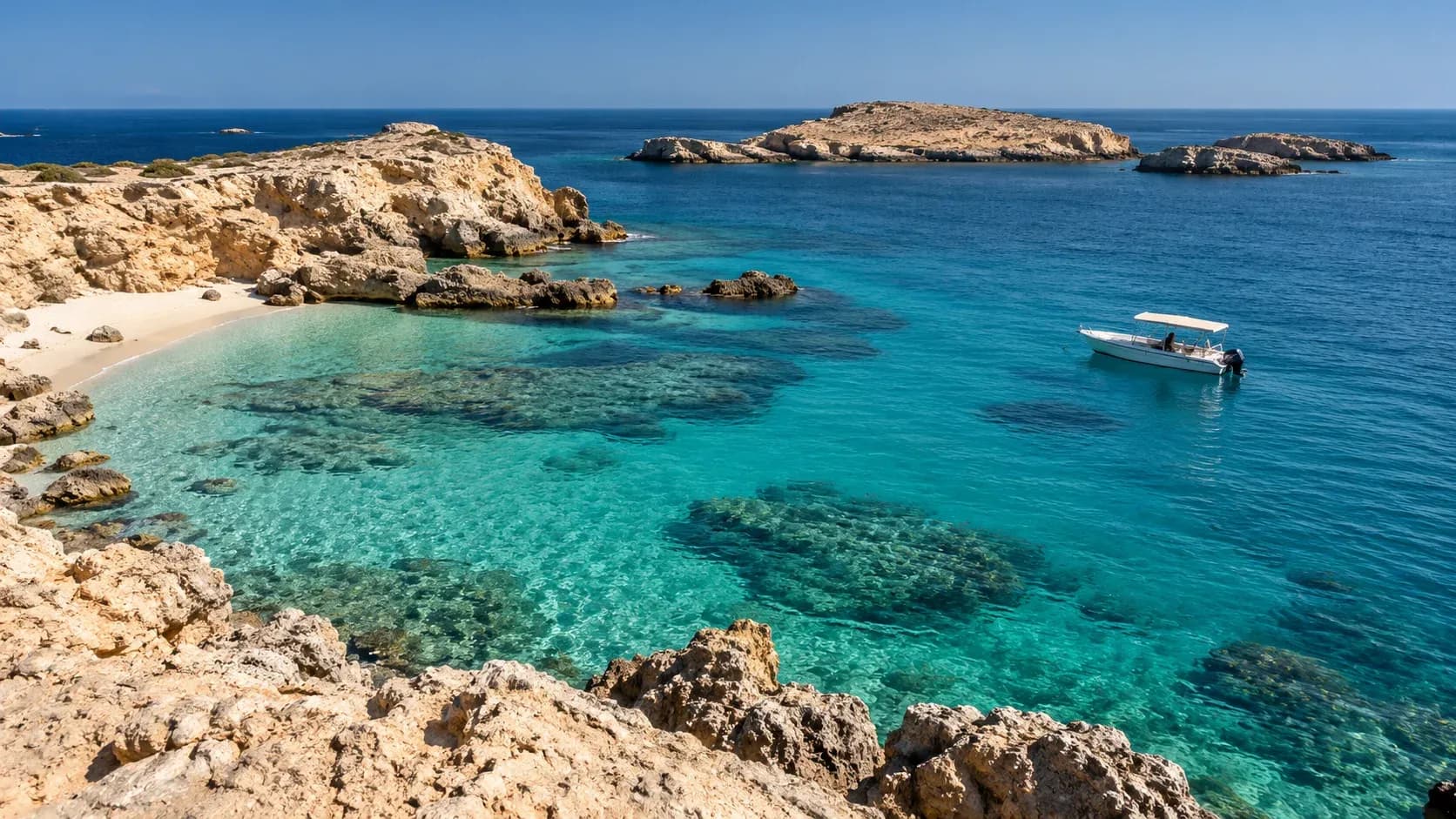
Daymaniyat Islands from Muscat: cruise, snorkeling and permits
A trip to the Daymaniyat Islands from Muscat requires checking the operator, an Environment Authority permit, and booking conditions. The article separates boat snorkeling, landing on the shore, and camping. It explains the landing ban from May to October, provides official visit fees, and outlines the rules for overnight stays on designated islands. It compares the stated crossing times from Seeb and Al Mouj and shows why you need to confirm the meeting port. It includes a weather check procedure, refund policies, and boat equipment details, a packing list, and an FAQ on children and nature conservation. It helps plan a trip during an owner's stay or real estate meetings, with a margin for rescheduling and without promising encounters with specific animals.


Article summary
The most important conclusions from the article in 30 seconds.
A trip to the Daymaniyat Islands from Muscat requires checking the operator, an Environment Authority permit, and booking conditions. The article separates boat snorkeling, landing on the shore, and camping. It explains the landing ban from May to October, provides official visit fees, and outlines the rules for overnight stays on designated islands. It compares the stated crossing times from Seeb and Al Mouj and shows why you need to confirm the meeting port. It includes a weather check procedure, refund policies, and boat equipment details, a packing list, and an FAQ on children and nature conservation. It helps plan a trip during an owner's stay or real estate meetings, with a margin for rescheduling and without promising encounters with specific animals.
A trip to the Daymaniyat Islands is worth planning around three key elements: what the permit includes, where the boat departs from, and what happens to the payment if conditions prevent the trip. These are separate issues that are not resolved by the slogan "snorkeling from Muscat" alone. Time spent on the water, going ashore, and camping overnight must be treated individually. Each of these activities has its own limitations.
From May until the end of October, landing on the islands and camping are prohibited. This does not mean an automatic closure of snorkeling trips from boats. The scope of the permit and current marine conditions also matter. The framework of the visit is defined by the reserve's regulations and the procedures of the Environment Authority, while payment and cancellation terms result from the contract with the operator. For someone combining property viewing with a stay in Oman, this means a simple rule: the boat trip should have a separate block in the calendar and a backup variant. Below, we explain how to verify formalities, choose a marina, and prepare participants.
Source verification: October 28, 2026. Permit prices refer to official government fees; crossing times are declarations of the indicated operators, depending on the vessel and conditions.
—
How to choose a trip and confirm the reserve permit? Daymaniyat Islands from Muscat
Choose an operator who will confirm the company name, the vessel performing the trip, and the method of obtaining the Environment Authority permit. Before making a payment, obtain the total price in writing and information on whether the reserve fee is included. The tour voucher alone does not explain the scope of the permit.
Verification of vessel license, passenger list, and Environment Authority fees
Check the company and the boat. Request the operator's registration details, confirmation of commercial tour organization rights, and the vessel number. Compare the company name on the confirmation with the payment recipient; upon boarding, check the consistency of the boat. Article 2 of Ministerial Decision No. 62/2019 requires the boat's registration number and the captain's identity document upon entering the reserve. Verification of the company's remaining documents is an additional control element before purchasing the service.
Separate the service price from the administrative fee. Find the item "permit" or "government environmental permit" in the offer or voucher. Obtain confirmation of the permit category, the date of the visit, and who is submitting the application. If an additional payment is to be made on-site, agree on the amount and the method of documenting the payment before booking.
Agree on participant details. Ask what data is needed for the passenger list and the formalities of the operator, marina, and Coast Guard. Submit them through the company's official channel and check the spelling of the names. Do not assume that every trip requires sending a passport scan: the EA paid service catalog indicates a lack of required attachments, and the booking practice depends on the type of expedition. Also, determine the scope of the operator's insurance and your own policy.
Confirm the meeting point. No later than the day before the trip, obtain a GPS pin, the name of the marina, pier or dock, briefing time, and crew contact info. Compare these data with the voucher and driving route. This is an organizational recommendation; it should not be treated as an official reporting deadline.
The reference point is the Environment Authority service catalog. For single-day permits, it lists:
- Adult visit: 3 OMR for foreigners and 1 OMR for Omani citizens.
- Child or student visit under 16: 1 OMR for foreigners and 0.1 OMR for Omani citizens.
- Adult diving visit: 6 OMR for foreigners and 3 OMR for Omani citizens.
These are different permit categories, not amounts for automatic summing. For regular snorkeling, confirm the applied category with the operator. The commercial "child" tariff may cover a different age range than the official tariff. Do not calculate the reserve fee solely from the tour price list.
Gov.om describes the procedure for obtaining a permit: application, payment, verification, and issuance of the permit. If the organizer handles the formalities, ask for written confirmation that your reservation is covered. Cash surcharge in itself does not prejudge a problem; the problem is the lack of prior information about the amount and its purpose.
When planning your entire stay, the guide Oman – what to know before traveling? will also be helpful. Checking travel formalities and checking the boat trip are two separate tasks.
—
How to match the date with the ban on landing on the islands?
If you care about a beach walk, plan your visit from November 1 to April 30, subject to the permit and day conditions. From May 1 to October 31, landing, camping, and overnight stays on the islands are prohibited. The cruise and snorkeling from the deck may be organized during this period; the seasonal availability of beaches does not determine the safety of departure.
Protection period in Ministerial Decision No. 62/2019
- Define the purpose of the trip. State in your inquiry whether snorkeling, a beach stop, or camping is the priority. Compare the response with the product description and the month of the visit. A photo of the beach in the offer is not confirmation that going ashore will be part of your trip.
- Check the protection calendar. Open the permit conditions on Gov.om, and for camping also the EA guidelines. Verify the scope of activities for the selected date. The ban has specific calendar limits; simply using the term "winter season" is too imprecise for booking.
- Choose a time with a margin for schedule changes. Ask about the morning cruise and return plan; departing around 08:00–09:00 can make organizing the day easier. Compare the schedule with the briefing and commute. A morning hour does not guarantee calm seas, so leave final arrangements dependent on the forecast and the captain's decision.
- Agree on the route variant. Ask for approximate snorkeling spots, e.g., around Al Joon or Kharabah, and how to change locations in case of currents and swells. Check if the plan includes only water or also permitted land stops. For camping, demand a designated spot covered by the permit.
The dates of restrictions are confirmed by the Gov.om government service card. The regulation relates them to the protection of bird nesting; the protection of nesting turtles indicated in the EA rules is also significant. Opening the beach season does not grant freedom of movement through habitats or approaching nests.
Outside the closure period, camping is allowed only in designated areas on Jabal Al Kabir and Al Joon. EA specifies a limit of maximum 12 people or 5 tents. Treat it as a restriction to be confirmed in a specific permit, rather than a pool that can be increased by dividing a single group into reservations. A day visit permit does not replace overnight permission.
Summer snorkeling has different characteristics than a winter beach stop. In Extra Divers materials regarding Oman Explorer, the surface water temperature during summer Daymaniyat trips is described roughly as 26–30°C. This is not a forecast for a specific location; the operator notes the impact of currents and thermoclines. Inquire about thermal comfort and the need for additional protection for your date.
Daymaniyat Tours indicates in the season and fauna FAQ the possibility of observing whale sharks from June to September. This is information about the presence of wild animals, not a guarantee. Photos of turtles and stingrays should be treated similarly. The value of a well-organized trip should stem from the quality of care, selection of spots, and nature conservation, without making the assessment dependent on encountering a specific species.
—
How to check snorkeling conditions and cancellation rules?
Check the marine forecast for the route and obtain refund conditions before paying. The decision to sail depends on the vessel, weather, authority restrictions, and the captain's assessment; a single number from an app does not replace this assessment. A full refund in case of cancellation should result from the booking terms, not an oral promise from the seller.
Marine safety and the "weather cancellation" clause
- Check the forecast and its update time. 24–48 hours before the trip and in the morning on the day of departure, check Oman Meteorology reports. Compare wind, swells, and warnings for the relevant body of water with the operator's information. If the chart does not work or data is old, ask the crew for an up-to-date report. This is a recommended check rhythm, not a statutory deadline.
- Read the cancellation terms. Keep the regulations and price confirmation. Check separately client resignation, cancellation by the organizer, a ban on sailing, and a route change of an already started trip. Ask for a record indicating the refund amount, possible deductions, settlement deadline, and choice between a refund or a new date.
- Verify boat equipment. Request confirmation of the number of seats, properly sized life jackets, communication means, a first aid kit, and the method of boarding from the water. At the briefing, check the fit of the jacket and listen to instructions. Ask how the crew helps a tired person in the water and who leads the group.
- Report participant needs. Provide children's age and weight, swimming skill level, and significant limitations. Get an answer on whether the chosen product is suitable for them and provides the necessary care. A jacket does not replace skills required by the operator or adult supervision.
The official Oman Meteorology – Sea State service presents wave height and direction, wind, and wave period, among others. Do not apply a single threshold of 1.2–1.5 m as an automatic rule for all small boats. Wave length and direction, currents, vessel design, and water entry point also matter. A weather app does not constitute permission to sail or snorkel.
An example of the difference between a contract and an expectation is shown by Daymaniyat Tours & cancellation policy. Cancellation of the entire trip by the company means a refund of the payment received for it; the client may instead agree on a different date. A mere change of snorkeling spot or skipping the beach does not automatically grant a full refund. Separately purchased taxis, hotels, or flights are not automatically covered by the settlement. These are the terms of this operator; check the individual regulations for another company.
Seeb, Al Mouj, and Bandar Al Rowdha: which marina to choose?
Compare the total time from leaving the apartment to returning, as well as the time actually spent on the water. A "half-day" declaration does not have to mean the same snorkeling time across different companies.
- Seeb Marina: Daymaniyat Tours states about 25–30 minutes of cruising. This is an estimate for their cruises, not a permanent property of every vessel. Add commute and briefing time separately.
- Al Mouj Marina: Daymaniat Shells declares 45–50 minutes to the reserve. Meanwhile, Daymaniyat Norana indicates about 45 minutes. When comparing offers, also check sanitary facilities, shading, and the location of the meeting point.
- Marina Bandar Al Rowdha: demand confirmation that you are buying a trip to Daymaniyat. Daymaniyat Tours assigns dolphin trips to this marina and conducts its island trips from Seeb. Without indicating a specific boat and route, do not assume 60–80 minutes from a general description. Longer time at sea may matter for people prone to seasickness.
Private charter or group cruise?
Group cruise: check the number of participants, stop times, required skills, and the scope of assistance in the water. A lower cost per seat does not determine comfort if the group has diverse needs.
Private charter: establish schedule flexibility, exclusivity of the boat, crew assistance, toilet, and actual range of sun protection, e.g., bimini. Include these elements in the confirmation. The private nature of the trip does not override reserve rules or the captain's decision.
During a short owner stay, leave a day allowing the cruise to be rescheduled. If the apartment is rented, first confirm its availability and owner usage rules. We expand on this topic in the article Second home as an investment – how to manage rental and ROI?. The trip should fit into the schedule of the stay and meetings concerning real estate.
—
Booking list, equipment, and FAQ
What to confirm and pack before the trip
Save the voucher, crew contact, marina location, and cancellation terms so they are available without an internet connection. Before leaving, check the range of equipment included in the price and whether the boat has a toilet, drinking water, and shaded areas for all participants. Do not plan to supplement equipment only on the island.
- ID document in a form agreed with the operator: passport for a traveler or Oman Civil ID for a resident. Visa confirmation, if applicable to the stay, does not replace an ID document. Do not send copies of documents to a random intermediary.
- UV rashguard shirt, headwear, and glasses. Plan sun protection also for the time spent sitting in the boat.
- Sunscreen; when choosing a mineral variant, check the ingredients, e.g., the presence of zinc oxide or titanium dioxide, and the absence of oxybenzone and octinoxate. The US National Park Service points out this approach in reef guidelines. The inscription "reef-safe" alone is not proof of the product's complete environmental neutrality.
- Mask, snorkel, and fins, i.e., the ABC set, if you use your own equipment. When the equipment is provided by the company, confirm sizes and check mask fit before entering the water.
- Waterproof bag, i.e., dry bag, towel, change of clothes, and phone protection. Secure documents and the booking confirmation as well.
- Water and snacks, if the confirmed package does not provide a sufficient amount. Report allergies and dietary needs before the trip.
- Regular medications and, if needed, seasickness medication chosen with a doctor or pharmacist. Check the leaflet, including the impact on drowsiness and contraindications. Do not choose a preparation only on board.
Tips on filters and clothing can be found in National Park Service – Sunscreen. American Academy of Dermatology explains the limitations of the term "reef safe". These are recommendations regarding skin and environmental protection, not an indication of a separate Omani obligation to purchase a specific cosmetic.
Nature conservation and actual trip standards
Do not touch or chase turtles, do not stand on corals, and do not collect shells, stones, or reef fragments. Do not interfere with bird or turtle nests. Take waste to a place where it can be properly disposed of. Crew instructions regarding distance from animals and movement in the water are part of the trip organization, not an addition to the program.
The basis for establishing the reserve is Royal Decree No. 23/1996. Detailed prohibitions and sanctions are defined, among others, by Ministerial Decision No. 62/2019, Articles 2 and 6. Article 6 provides for administrative fines of 50–100 OMR for individuals and 100–300 OMR for diving clubs and companies for violations of Article 2, doubled for repeated violations. These ranges should not be replaced by a single amount of "up to 500 OMR" attributed to the decree establishing the reserve. The above does not exhaust possible liability under other regulations.
Daymaniyat is an expedition to a reserve, not a seaside resort. Do not assume access to toilets, a pier, gastronomy, or constant shade on the chosen beach. Sanitary facilities and rest in the shade should be planned on the vessel; the presence of a toilet itself must be confirmed for a specific boat. With limited mobility, also ask about the ladder, boarding stability, and how to potentially go ashore.
Operator operating models: what to actually compare
- Daymaniat Shells, also called Daymaniyat Shells: organizes trips from Al Mouj. In the group snorkeling description, it separates the tour price from the environmental fee and requires basic swimming skills. This is important when booking for beginners.
- Daymaniyat Tours: in booking terms, it distinguishes group cruises with permits included and a private boat with a permit surcharge. Confirm assistance rules for weaker swimmers for the chosen product.
- Extra Divers / Oman Explorer: publishes separate diving safari rules, including diving documents and insurance. Such a cruise with overnight stays on a ship, referred to as a liveaboard, requires a different stay plan than single-day snorkeling from a marina.
These are examples of service models, not a ranking or confirmation of a current license or availability. The choice should result from the documents of a specific booking.
—
—
Plan your stay in Muscat with PlanoGroup
If you are combining a stay in Muscat with viewing real estate or using your own apartment, contact the PlanoGroup team in Oman. We will agree on a meeting schedule and help determine logistical issues worth confirming before booking your free time. The scope of investment consulting, post-purchase service, and local support is determined for a specific stay. The cruise requires separate confirmation with the chosen organizer.
—
FAQ
How to behave around turtles and corals?
Observe animals without touching, feeding, surrounding, or blocking their path. Maintain a position above the reef that avoids fin contact with corals; if you experience difficulties, ask the guide for help or return on board. Nests and eggs must not be touched or disturbed. A photograph does not justify approaching in a way that causes animal distress.
How long does the crossing from individual marinas actually take?
Take specific companies' declarations as reference points: about 25–30 minutes from Seeb according to Daymaniyat Tours and 45–50 minutes from Al Mouj according to Daymaniat Shells. This is a one-way time, depending on conditions and the destination. For Bandar Al Rowdha, obtain route confirmation to Daymaniyat and timing from the organizer; do not transfer data from dolphin cruises. Add the briefing and the commute to the proper pier to the plan.
How to prepare a child for a speedboat trip?
Before paying, provide the child's age, weight, and swimming skills. Confirm a fitted life jacket, sun protection, sanitary facilities, and the possibility of staying on deck under adult supervision. Establish rules for movement during the ride and water entry during the briefing. The availability of children's seats does not mean that a given trip is suitable for every infant or toddler.
Is turtle observation a guaranteed part of the trip?
No. The program may include places where turtles are observed, but the presence of animals depends on natural conditions. Do not treat photos or species descriptions as a guarantee. Choose a trip organization that allows the crew to change locations or end observations when required by nature conservation or safety.
Can a dog enter the reserve?
No. Regulations prohibit bringing cats, dogs, and other animals into the reserve; this is not solely a ban on going ashore with them. Therefore, do not assume that leaving the dog on board solves the problem. Organize pet care before purchasing the trip.
Is it allowed to take a coral fragment or shell as a souvenir?
Do not take them from the reserve, even if they look dead or abandoned. The ban on collecting nature elements and damaging the reef does not depend on the value of the item. A souvenir can be a photograph taken without interfering with the environment. Clarify doubts with the guide before touching a find.
Is the permit fee the same as the tour price?
No. The permit concerns access or a specific activity in the reserve, and the tour price covers the company's service. The operator may combine them into a single amount or show them separately. Before paying, check the final price, taxes, fees, and children's age category; do not treat the slogan "all inclusive" as a detailed settlement.
Can you camp on any island outside the closure period?
No. Overnight stays require a proper permit and a designated spot on Jabal Al Kabir or Al Joon. Before booking, obtain confirmation of the spot, group size, number of tents, and pickup method. A commercial accommodation offer does not grant the right to independently choose another beach.

Author
Beata Cieślukowska
COO / FOUNDER
For over 17 years, she has been supporting clients in investing in premium real estate, with a particular focus on investment apartments and condo-style projects. Over the years, she has built her position in the Costa del Sol market, where she helped clients select properties that combine lifestyle with investment potential. Today, she is developing PlanoGroup, expanding operations into international markets – including Oman and other investment destinations. She combines experience, market intuition, and an individual approach, which allows her to match a property not only to a budget but, above all, to the client's goal.