


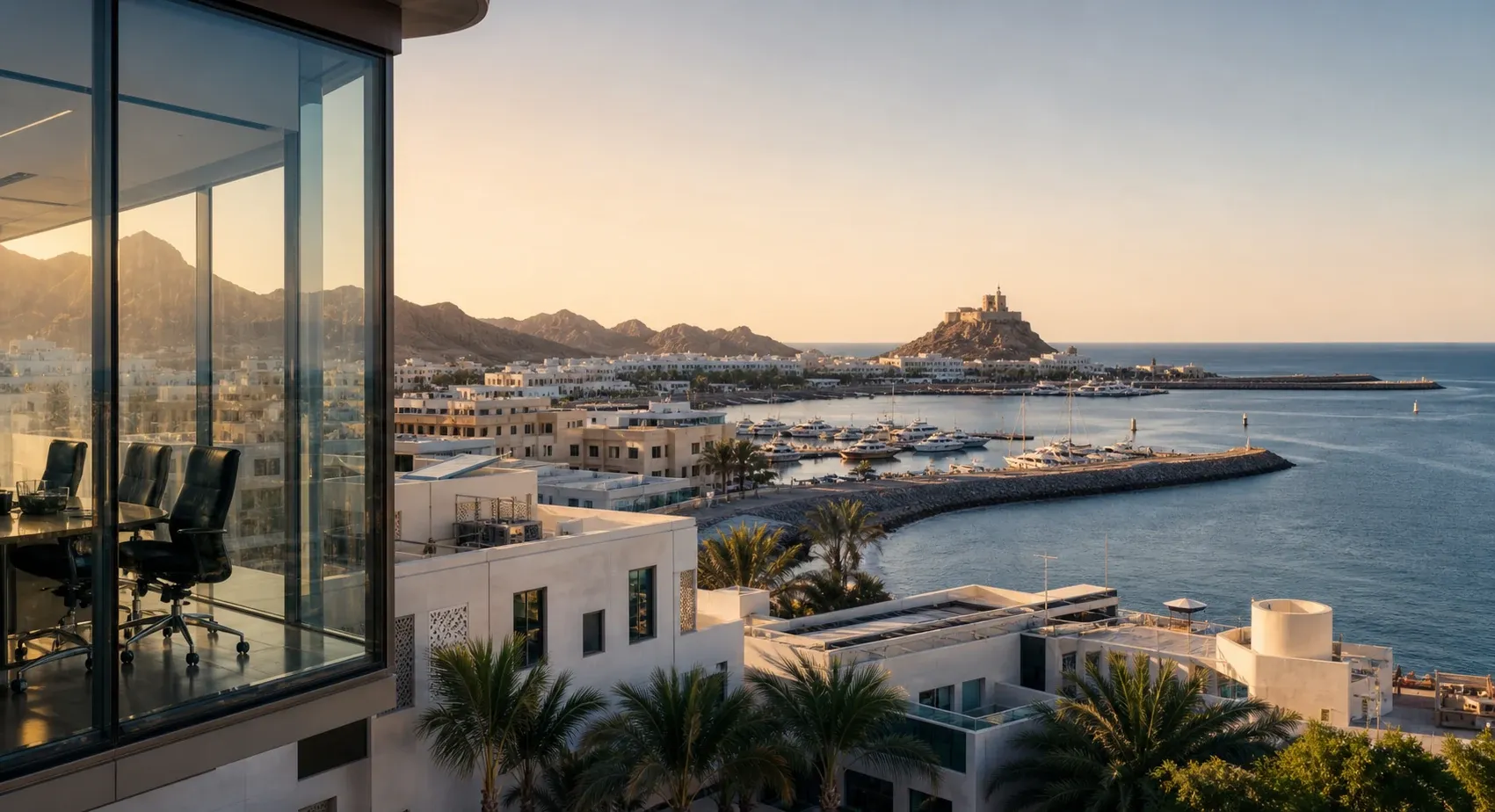
Why is the European Union opening a diplomatic mission in Oman, and what does this mean for investors and the real estate market?
The opening of the permanent EU mission in Oman is an important political signal, but for an investor, it matters as part of a bigger picture: Oman Vision 2040, Greater Muscat, tourism, ITCs, logistics development, and the neutrality policy. These processes may increase interest in the market, but they do not eliminate investment risks. It is not worth buying real estate in Oman because of a single announcement. However, it is worth using this announcement as a starting point for analyzing the country, the law, infrastructure, expat demand, maintenance costs, and market liquidity. For an investor, understanding why such decisions are made and how they fit into Oman's long-term development is more important than the event itself.


Article summary
The most important conclusions from the article in 30 seconds.
The opening of the permanent EU mission in Oman is an important political signal, but for an investor, it matters as part of a bigger picture: Oman Vision 2040, Greater Muscat, tourism, ITCs, logistics development, and the neutrality policy. These processes may increase interest in the market, but they do not eliminate investment risks. It is not worth buying real estate in Oman because of a single announcement. However, it is worth using this announcement as a starting point for analyzing the country, the law, infrastructure, expat demand, maintenance costs, and market liquidity. For an investor, understanding why such decisions are made and how they fit into Oman's long-term development is more important than the event itself.
Opening a permanent Delegation of the European Union in Muscat is not just a diplomatic dispatch. According to the EEAS announcement on the EU Delegation in Muscat, the EU and Oman signed an agreement creating the legal framework for the representation's operations. This does not automatically change apartment prices, freehold laws, or the purchasing process for foreigners. However, it matters as a signal: Oman is strengthening its relations with Europe, developing a policy of neutrality, and building the position of a country that wants to attract capital, business, and expats.
For an investor, the mechanism is more important than the news itself. A permanent EU presence can improve the flow of information, increase the number of economic contacts, and gradually lower the barrier to entry for European companies. In the real estate market, such an impact is indirect: it concerns utility demand, expat rentals, Integrated Tourism Complex (ITC) projects, off-plan assets, rental yields, service charges, and capital appreciation potential. This topic connects well with the analyses on the PlanoGroup blog, especially with the clusters on Oman Vision 2040, Muscat, ROI, and buying real estate in Oman.
From the perspective of PlanoGroup, a team operating on the ground in Oman, the EU's decision aligns with the direction we have been observing for several years. In conversations, not only the price per square meter is increasingly important, but also the legal structure of the project, developer transparency, escrow accounts, and the real function of the property after handover.
Why did the European Union decide to open a diplomatic mission in Oman?
The first reason is geography. Oman lies along trade routes between the Indian Ocean, the Arabian Sea, and the Gulf of Oman, close to the Strait of Hormuz. For the EU, this means significance in trade, shipping security, energy, and logistics. The second reason is Oman's foreign policy. The Sultanate pursues a cautious policy of balance and can talk to various actors in the region, which has real operational value for European diplomacy.
The third reason is economic. Oman is reducing its dependence on oil, developing tourism, logistics, ports, economic zones, low-carbon energy, and urban projects. The EU is looking for partners for trade, decarbonization, infrastructure, and private investment. A permanent mission in Muscat allows this cooperation to be conducted locally rather than exclusively through periodic visits.
How should an investor read this decision step by step?
Step 1: check the source, i.e., the official EEAS announcement, and distinguish the signing of the agreement from the actual launch of the office.
Step 2: separate diplomacy from price effects, because the delegation does not automatically raise asset values.
Step 3: juxtapose the event with Oman Vision 2040, GMSP, ports, tourism, and mixed-use projects.
Step 4: for a specific purchase, check the land status, ITC, escrow account, SPA, payment schedule, service charge, and rental rules.
What will the EU representation in Muscat deal with?
The EU Delegation will conduct political and economic dialogue, coordinate relations in the fields of trade, energy, security, climate, education, logistics, and investment. It is not a body that regulates the housing market. Its significance lies in the fact that EU-Oman relations are gaining a permanent working structure on the ground.
For real estate, the indirect effect matters. If companies, institutions, and advisors from Europe analyze Oman more often, the demand for housing for specialists, serviced apartments, medium-term rentals, and well-located properties in Muscat increases. This applies in particular to locations with access to offices, schools, services, the airport, the marina, and main roads.
In conversations with developers and local partners, the question is increasingly raised as to how residential projects should respond to the influx of specialists and service companies, rather than exclusively to holiday demand. This is a significant shift in emphasis: the market talks more often about the end user, management standards, and cost predictability.
Does the presence of the European Union increase Oman's credibility for investors?
It should not be claimed that the EU's decision alone definitely increases Oman's credibility. An investor evaluates a country through its law, taxes, currency stability, quality of courts, market liquidity, political risk, transaction costs, and the possibility of exiting an investment. The EU delegation is a signal, not proof of security.
The mechanism is as follows: a permanent relationship with the EU improves the legibility of Oman's international position. If, at the same time, the country develops infrastructure, tourism, logistics, and residential projects, the investor sees a more coherent picture of the market. This can reduce the psychological barrier, especially for people who previously compared Oman mainly to Dubai.
How to assess country risk before purchasing real estate?
Step 1: check whether the project is located in an Integrated Tourism Complex (ITC) and whether the purchase grants a freehold title.
Step 2: ask the developer for the land title, permits, escrow account, SPA template, finishing standard, and construction schedule.
Step 3: calculate net ROI, taking into account service charges, the operator, furnishing, CAPEX, vacancies, and currency conversion.
Step 4: assess exit liquidity, i.e., who can buy the asset in a few years: an expat, a local buyer, a GCC investor, or a buyer from Europe.
How has Oman been building its international position for several years?
Oman is not copying Dubai. Its model is more phased and is based on economic diversification, ports, logistics, tourism, quality of life, and urban planning. The official description of Oman Vision 2040 presents the strategy as a national benchmark for social and economic planning up to 2040. For the real estate market, this means that development does not depend solely on private developers, but also on the direction of state policy.
The Greater Muscat Structure Plan (GMSP) is of great importance. The official Greater Muscat program describes the capital as an area combining mobility, housing, economic districts, and public spaces. The MoHUP Greater Muscat project profile indicates an area from Muttrah to Barka, over 100 kilometers of coastline, and over 137 thousand hectares of urban planning. For an investor, this is data on future supply, transport accessibility, and potential demand.
In practice, Oman is developing ports, airports, economic zones, mixed-use development projects, and ITC zones. Therefore, an apartment buyer should look at the location through its function: whether the property will serve an expat, a tourist, a second-home user, a corporate employee, or a family looking for long-term rental.
On the ground in Muscat, it is easy to notice that investors can overestimate the sea view itself while underestimating the commute, the neighborhood of services, and the pace of infrastructure handover. In everyday work, we place greater weight on whether a project has a clear function in the city and whether it can be defended in a rental model.
Can the EU decision affect the real estate market in Oman?
The impact is indirect. The EU delegation does not automatically increase demand for apartments, but it can support processes that affect the housing market over time: the presence of companies, more frequent business travel, the development of services, the influx of specialists, and better visibility of Oman in Europe.
This is still not a guarantee of price growth. Prices depend on supply, location, project standard, financing costs, exchange rates, the quality of the rental operator, and secondary market liquidity. Therefore, the EU's decision should be read as one element of macro analysis, rather than as an independent purchasing premise.
We observe this phenomenon not only in announcements but also in client questions. Conversations less and less frequently end with whether Oman is cheaper than Dubai; they more often concern who the tenant will be, how the operator works, and whether the project has a realistic exit scenario.
How to check the impact on the project step by step?
Step 1: determine utility demand, i.e., who will actually be the tenant.
Step 2: compare planned supply in the same district and segment.
Step 3: check the rental operator, commissions, reporting, occupancy assumptions, cleaning fees, and renovation rules.
Step 4: calculate the base and conservative scenario: gross income, service charge, operator commission, CAPEX reserve, vacancies, and lower rent.
What does the real estate market in Oman look like compared to other GCC countries?
Each GCC market is at a different stage. Dubai has high liquidity and strong recognition, but also fierce competition and high off-plan supply. Saudi Arabia has a huge urban development program and strong internal demand. Qatar is smaller and requires special liquidity analysis. Bahrain is sometimes considered due to a lower entry threshold. Oman is calmer, less saturated, and more closely tied to tourism, second homes, and ITCs.
Dubai
Dubai provides scale, easier resale in many districts, and a deep rental market. The price is greater competition, a higher entry threshold, and greater dependence on active management. Therefore, the Dubai versus Oman comparison should include not only gross ROI, but also fees, vacancies, and the risk of oversupply.
Saudi Arabia
Saudi Arabia has a larger scale and strong urban programs, but foreign ownership of real estate requires separate regulatory analysis. For an investor from Poland, this is a market with a different risk profile than Oman.
Qatar and Bahrain
Qatar has capital and infrastructure, but a smaller market. Bahrain may have a lower entry threshold in selected segments, but a different demand depth. In both cases, taxes, ownership laws, maintenance costs, and actual rentals must be compared.
Oman
Oman combines stable foreign policy, ITC projects, tourism development, and lower saturation than Dubai. The risk is lower secondary liquidity, which is why the choice of location, developer, and operator is more important than the macro narrative itself.
Can foreigners buy real estate in Oman?
Yes, but not everywhere. Foreigners focus mainly on Integrated Tourism Complex (ITC) projects, where purchases on freehold terms are possible. In such zones, the buyer can usually enjoy ownership, rental, resale, and inheritance rights, and in certain cases also residency linked to the purchase. Details depend on the project, the value of the property, and current administrative requirements.
Before making a decision, it is worth starting with the guide for Polish buyers in Oman, and then moving on to a specific project. Just knowing that a property is located in Oman is not enough. You must confirm the ITC, legal title, developer, escrow account, SPA, service charge, and rental rules.
Buying in Oman step by step from a due diligence perspective
Step 1: demand confirmation of ITC status and freehold rights.
Step 2: check the developer, construction financing, permits, and execution history.
Step 3: analyze the SPA: payments, delays, handover, standard, additional costs, and ownership registration.
Step 4: calculate maintenance costs, including service charges, renovation fund, operator, insurance, and equipment.
Step 5: confirm whether short-term rentals are permitted and what the revenue-sharing model looks like.
Why are investors increasingly analyzing Oman alongside Dubai?
Oman appears alongside Dubai not because it is its copy, but because it responds to different portfolio needs. Dubai offers liquidity and scale. Oman offers a lower entry threshold in many projects, less saturated supply in ITC zones, and capital appreciation potential resulting from infrastructure, tourism, and urban planning.
The most important difference concerns the price-to-risk ratio. In Dubai, an investor pays for the city's brand and liquidity. In Oman, they pay for an earlier market phase and exposure to the development of Muscat, Salalah, or Yiti. This does not automatically mean a higher result. It means that you need to compare the entry price, rental yield, maintenance costs, operator, and resale scenario.
It is worth juxtaposing this topic with the Muscat market analysis and the discussion of Oman's economy. If the market is stable but less liquid, the asset should have a clear function: proximity to the airport, offices, the sea, a golf course, a marina, services, or a tourist zone.
Does the opening of the EU mission mean new opportunities for Polish investors?
For Polish investors, the EU's decision is a signal for deeper analysis, not a reason for a quick purchase. Greater visibility of Oman in Europe and more frequent economic contacts can be expected. One should not expect guaranteed rentals, automatic price growth, or simplified purchasing procedures.
The investor should first determine the function of the asset. The logic of buying an apartment for expats in Muscat will be different from a holiday apartment in Salalah, and different again from a second-home property with hybrid rental. For Capital Appreciation, the GMSP, the stage of district development, and exit liquidity are of greater importance.
Working with investors from Poland, we see greater discipline in questions. A few years ago, discussions were dominated by country security and the purchase law itself; today, issues of service charges, rental reporting methods, equipment reserves, and differences between units in the same investment appear more frequently.
How to translate this signal into offer selection step by step?
Step 1: choose the asset function: expat rental, tourism, second home, golf, marina, or exposure to district development.
Step 2: select a location and compare real estate in Oman in PlanoGroup's offer, e.g., Marriott Residences AIDA offer, The Sustainable City Yiti, and Taqah Long Beach.
Step 3: juxtapose the price per m², payment schedule, service charge, rent, occupancy rate, operator commission, and equipment.
Step 4: check the possibility of assignment, transfer costs, developer's right of first refusal, and the secondary market for similar units.
Step 5: confirm local taxes and rights with an advisor.
FAQ
Did the European Union have an embassy in Oman before?
Not in the form of a permanent EU Delegation in Muscat. Oman was handled within the framework of the broader EU diplomatic architecture in the region. The new representation is to operate directly in the Sultanate, which increases institutional presence but does not change Oman's status vis-à-vis the EU.
Does the opening of the EU mission change regulations regarding real estate purchases by foreigners?
No. Purchasing rules result from Omani law, project status, and ITC regulations. The investor still needs to check freehold, ownership registration, rental rules, maintenance costs, and residency options. The EU's decision does not replace due diligence.
Does the EU decision mean it is easier to do business in Oman?
Not directly. The EU Delegation can facilitate institutional dialogue and the exchange of information, but the entrepreneur still needs to analyze local licenses, banking, taxes, company structure, regulatory compliance, and local partners.
Is Oman a member of the European Union or the Schengen Area?
No. Oman is an independent GCC country and belongs neither to the EU nor to Schengen. The opening of the EU Delegation means strengthening diplomatic relations, not changing residency, tax, or real estate purchasing laws.
Can the opening of the EU representation affect real estate prices?
The event itself does not cause price increases. However, it can increase Oman's visibility for investors, companies, and expats. Prices will be decided by location, supply, utility demand, rental operators, maintenance costs, and resale liquidity. The investor's question should not be "will prices rise after the announcement," but "does the chosen project have sustainable sources of demand."

Author
Mariusz Cieślukowski
CEO / FOUNDER
Co-founder of PlanoGroup and the person responsible for the development of the entire group. He built a brand based on quality, trust, and effectiveness, developing it in the Spanish market and subsequently expanding operations to further investment destinations. Today, he is developing PlanoGroup - a project that responds to the needs of clients who are looking not only for real estate but also for new opportunities for living, investment, and relocation. He specializes in trend analysis and building investment strategies in foreign markets - including Spain, Oman, and emerging locations such as Montenegro.

Related articles

Economy in Oman – stable growth and new opportunities for investors

Why is Muscat the most stable real estate market in the Gulf? Analysis 2020–2025
Dubai vs. Oman: where to buy a luxury property to earn more and pay less?