


Public transport in Oman and property value
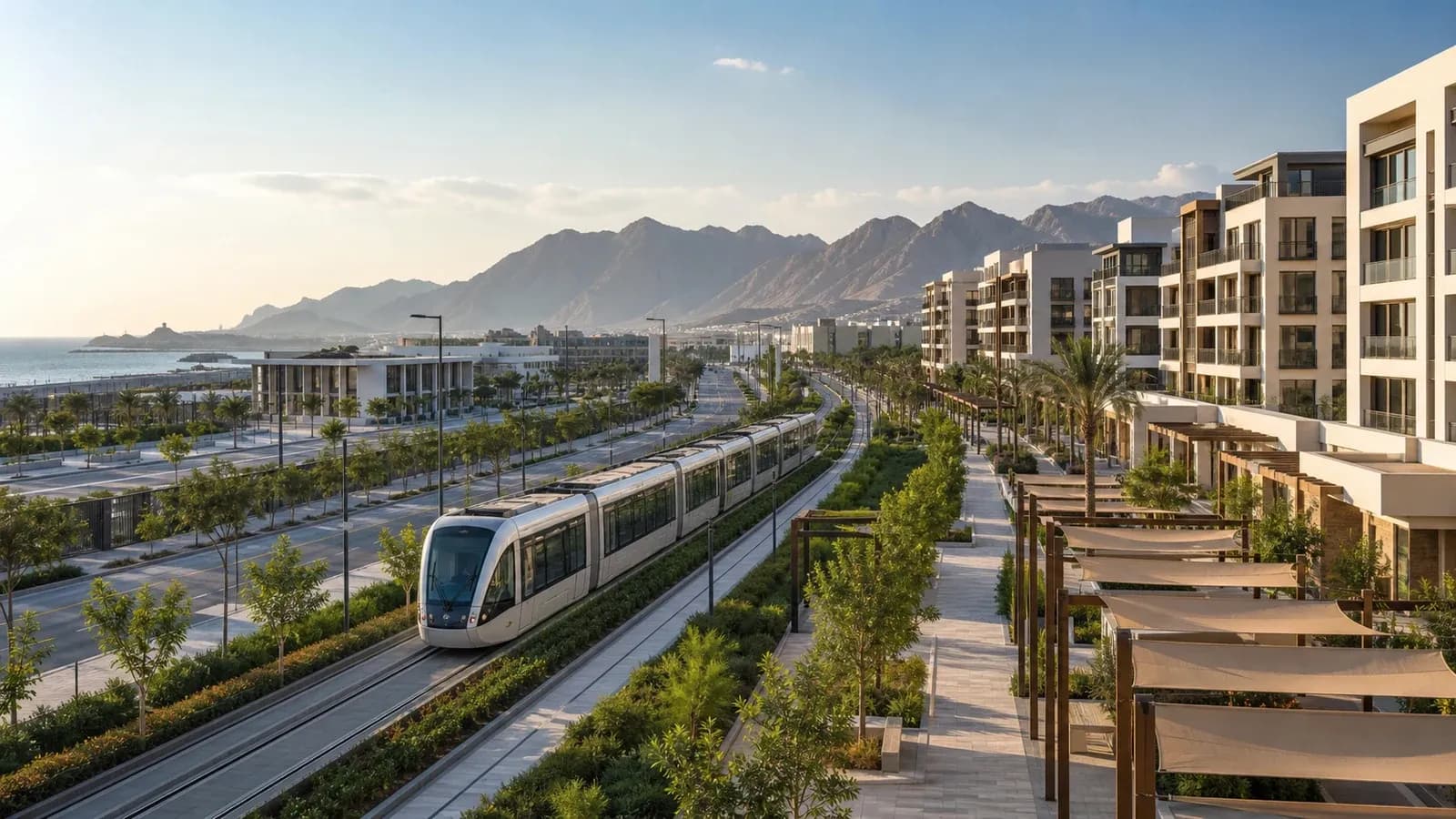
The Oman Vision 2040 strategy introduces a Transit-Oriented Development model that integrates modern urban planning with the LRT network and the Blue Spine corridor. Proximity to transport hubs in Muscat could increase property values by 20–30%, mirroring mature markets like Dubai. The 55 km-long Blue Spine corridor will connect Sultan Haitham City with the Ruwi business district, creating a new economic backbone for the city. Investments made within a 10-minute walk of stations benefit from rental liquidity and stable capital growth.


Article summary
The most important conclusions from the article in 30 seconds.
The Oman Vision 2040 strategy introduces a Transit-Oriented Development model that integrates modern urban planning with the LRT network and the Blue Spine corridor. Proximity to transport hubs in Muscat could increase property values by 20–30%, mirroring mature markets like Dubai. The 55 km-long Blue Spine corridor will connect Sultan Haitham City with the Ruwi business district, creating a new economic backbone for the city. Investments made within a 10-minute walk of stations benefit from rental liquidity and stable capital growth.
Does the proximity of planned public transport matter when buying an apartment in Oman?
For decades, Muscat has developed as a car-dependent city. For a property buyer, what mattered was proximity to Sultan Qaboos Street, efficient access to the airport, access to the coast, or a position within a recognizable master plan. The Greater Muscat Structure Plan (GMSP) changes the way an investor should read the city map. The plan does not assume only further urban sprawl. It introduces a network of connections: LRT, BRT, commuter rail, mobility hubs, Transit-Oriented Development (TOD), Park & Ride, soft mobility, and the Blue Spine corridor, which connects transport, the economy, water, greenery, and future urban densification.
For an investor from Poland, this does not mean a simple conclusion: buy near every planned station. That would be too mechanical. What matters is whether the project is within real walking distance of transport, whether services and jobs are planned around the hub, whether the building stands on its own as an investment before the infrastructure is launched, what the service charge is, and whether the purchase price does not already include too high a premium for the future.
According to the GMSP, Greater Muscat is to transition from a car-dependent layout to a more compact city with a hierarchy of public transport and better access to services. The plan indicates, among other things, 55 km of LRT/Metro corridor, 42 stations, a target of 20% public transport share in car-plus-public-transport trips by 2040, 7 Transit-Oriented Developments, and 15 transfer stations between mass transit lines. These are numbers that should be included in the analysis of an apartment's location just as much as the price per square meter, payment schedule, and potential yield.
In a broader context, it is worth comparing this article with PlanoGroup's analysis on how Oman Vision 2040 affects property prices, and with the guide on transport in Oman and the planned role of the GCC railway. However, the substantive basis of this analysis remains in two GMSP documents: Vol. 1 Greater Muscat Structure Plan and Vol. 3 GMSP Technical Background.
—
What is TOD and why is the Transit-Oriented Development model changing the market in Oman?
Definition and the 10-minute walk rule
Transit-Oriented Development means development planned around public transport. It is not just about a building located near a station. In the TOD model, the station, pedestrian access, ground-floor services, building density, offices, apartments, public spaces, and the reduction of excessive car dependency form a single urban system. From an investor's perspective, this is important because the tenant does not just evaluate the apartment. They also evaluate what their day looks like: how long it takes to walk to transport, whether there is shade along the way, whether there are sidewalks, whether there is retail in the area, and whether commuting to work does not require standing in traffic jams every day.
The GMSP identifies TOD as a tool for densifying the city at points that are to serve a larger number of residents and jobs. The plan includes specific targets: 7 Transit-Oriented Developments by 2040, a minimum residential density around primary and metropolitan hubs within a 5-minute walk of the station at 80 dwelling units per hectare, and commercial intensity indicators for primary, metropolitan, and district hubs. This is important because it shows that transport is intended to influence not only mobility but also the type of development and the rental structure.
For an investor buying an apartment, this means three benefits, but each requires verification. The first is a potentially larger tenant base: people working in offices, services, education, MICE, the airport, or the knowledge sector have a reason to live near a hub. The second is greater resistance to vacancies if the location provides real access to work and services. The third is greater resale liquidity, because the next buyer sees not just a unit, but a part of the city with a function.
Not every investment describing itself as TOD meets these conditions. In Muscat, the climate and the first and last part of the route are important. A distance of 800 meters in a straight line does not necessarily mean a real 10-minute walk if there is a lack of crossings, sidewalks, shade, lighting, and safe access along the way. The GMSP emphasizes the importance of soft mobility, universal accessibility, and the quality of the environment around stations. For a buyer, this is a practical criterion: you have to check the pedestrian route, not just the pin on the map.
The TOD model differs from a traditional gated community. A gated community may offer a controlled environment, a pool, and private services, but it is often car-dependent. TOD works differently: its value grows when the user has access to transport, work, retail, and services without the need for long daily commutes. For the primary market, this means a different way of assessing ROI. The apartment is not a standalone product; it is part of an urban system.
Step by step: how to assess if a project truly benefits from TOD
- Ask the developer to accurately mark the project on the GMSP map and indicate the nearest planned hub: primary, metropolitan, district, local, or neighborhood.
- Check the real pedestrian route to the station or stop. Measure the walking time along the existing or planned street grid, not a radius on the map.
- Ask if offices, retail, schools, health services, parks, or mixed-use developments are planned within walking distance. A station alone without functions around it has less significance for rentals.
- Compare the number of parking spaces, Park & Ride rules, and the availability of alternative transport before the launch of LRT or BRT.
- Determine if the apartment price already includes a premium for future infrastructure. If the project is significantly more expensive than similar buildings in the area, ask what exactly justifies the difference.
- Compare the project with PlanoGroup materials on rental management in Oman, because a location near transport does not replace a good operational rental model.
—
Blue Spine: Muscat's economic backbone and its impact on property value
55 km corridor: From Sultan Haitham City to Ruwi
The Blue Spine in the GMSP is more than just a transport route. It is a concept of a corridor that is intended to connect mobility, greenery, water management, wadis, new job centers, mixed-use districts, and urban density development. For an investor, the Blue Spine is useful because it allows one to read Muscat not as a collection of separated projects, but as a system of connections. If an apartment is located near this system, its value does not come only from the view or the lobby standard, but from access to future flows of people, services, and employment.
The GMSP shows that one of Muscat's problems is urban sprawl and high car dependency. The document indicates that about 92% of trips are made by car, and further population growth without changing the mobility model would increase infrastructure costs and pressure on main roads. The Blue Spine addresses this problem by combining spatial development with transport and densification in selected locations.
The corridor is particularly important where it connects new growth areas with existing or planned job centers. The plan includes, among others, Sultan Haitham City, As Seeb TOD, Knowledge & Innovation Park TOD, Burj Al Sahwa TOD, Ghala CBD TOD, Al Ghubra TOD, Al Qurum TOD, and Ruwi TOD. These are not marketing names for a sales brochure. These are points that indicate where the GMSP wants to concentrate mobility, functions, and building intensity.
For an investor, the Blue Spine can change the concept of a center. In a car-dependent city, the center is often understood as a place on a main artery or by the coast. In a city with public transport, the center can become a network of hubs: places where work, services, rentals, education, and commuting intersect. This is important when buying off-plan, because some projects may look like transitional locations today, but in the plan, they serve as a connector between future growth areas.
This does not mean that every project near the Blue Spine is automatically safer. Value depends on whether the infrastructure will be useful for the future tenant, whether the building will be delivered before the transport is built, whether there are jobs nearby, and whether the service charge will not weaken the net result. The Blue Spine is therefore a strategic filter, but it does not replace due diligence.
Step by step: how to read the Blue Spine when analyzing a location
- Mark the project relative to the Blue Spine corridor and the nearest GMSP hubs.
- Check if the project is located near residential, business, educational, tourist, or logistics functions. A different tenant chooses Ghala CBD than a resort area.
- Ask which infrastructure elements will be ready on the day of receiving the keys: road, sidewalk, transport, services, parking, lighting, pedestrian connections.
- Compare the project with investments in mature locations, e.g., Al Mouj or Muscat Bay, to understand if the premium for the future is justified.
- In the ROI calculation, separate the rental income today from the potential value increase after the infrastructure is launched.
—
Is an apartment near a planned LRT station a better investment? Data analysis and ROI
Transit premium, ROI, and comparison without unconfirmed promises
Proximity to a planned LRT or BRT station can increase investment potential, but only if the station is part of a broader urban system. In real estate analysis, there is often talk of a transit premium, i.e., a premium for access to transport. In the case of Muscat, however, it must be calculated carefully, because the GMSP describes the direction until 2040 and does not guarantee an identical result in every location.
The content plan included references to Dubai and London. I am not transferring these numerical data to the article because they do not result from the provided PDFs. However, one can describe a mechanism that is universal: public transport can increase property value when it shortens commute times, increases the number of potential tenants, improves access to work and services, and strengthens resale liquidity. In Muscat, this mechanism is particularly important because the city is moving away from a model of strong car dependency.
The GMSP indicates several data points that help assess the scale of the change. The plan assumes 55 km of LRT/Metro corridor, 42 stations, expected daily boardings in the LRT corridor at 300,000, and with full implementation of transport and land-use strategies, a potential of over 450,000 daily boardings. The document also indicates that the system is to achieve a minimum commercial speed of 45 km/h and that 80% of the railway length is to be separated from car traffic. These are parameters that can change tenant behavior, but only after the infrastructure is implemented.
For an investor, an apartment near a planned station is stronger if it meets three conditions. First, the building has reasonable value without the LRT: car access, parking, services, and demand are acceptable at the moment of handover. Second, the station is not a distant concept, but an element of a clear corridor with jobs and services. Third, the purchase price does not already assume the full success of the transport. If the entire premium was collected at the sales stage, the investor takes the risk of implementation without an appropriate margin.
The impact of LRT and BRT on the tenant profile can be significant. A resort project will be evaluated through the prism of tourism, second homes, and management quality. A project near Ghala CBD, Madinat Al Irfan, the airport, or the Knowledge & Innovation Park may attract expats, office workers, specialists, and people looking for long-term rentals. This is a different occupancy model and a different yield calculation.
Step by step: how to calculate ROI near a planned station
- Calculate the base scenario without the impact of LRT/BRT: rent possible today, vacancies, service charge, management costs, and resale liquidity.
- Calculate the infrastructure scenario: higher occupancy, greater demand, potential resale premium, but only after the transport is launched.
- Determine how many years may pass between the building handover and the functioning infrastructure. This period affects the return on capital.
- Compare the price per square meter with projects of a similar class outside the transport corridor.
- Ask the developer for the documents on which they base their communication about the station: GMSP map, local plan, road agreements, infrastructure stage.
- Compare the project with the Planogroup article on ROI in Oman so as not to confuse gross income with net result.
—
How to check the real distance to future transport and not overpay?
Verification of the Greater Muscat Structure Plan
The most common mistake when analyzing transport is measuring distance in a straight line. In Muscat, due to the climate, wide roads, wadis, undeveloped land, and level differences, the real walking distance can be significantly longer than the distance on a map. The GMSP emphasizes the importance of first- and last-mile, soft mobility corridors, universal accessibility, and the quality of space around stations. For an investor, this is not an urban detail, but an element affecting rentals.
Distance intervals are also important in the transport plan. The GMSP shows a mechanism for reducing parking requirements depending on the distance to mass transport: 200 m, 500 m, and 800 m. For an investor, these values are useful as a practical scale for assessment. A project within 500 m of a station, with convenient access, is a different category than a project 1500 m from a station, even if both use the same slogans about LRT in sales.
Verification should start with MoHUP and GMSP maps, but it cannot end there. You need to check if a real pedestrian route exists or is planned between the project and the station. Are there crossings over arteries? Does the route pass through private plots? Does the project provide for shading, trees, arcades, sidewalks, lighting, and protection from car traffic? Will the tenant want to walk this route in the summer?
The second risk is price. If the developer has already added a large premium for a future station, the investor should ask what specific infrastructure stages are confirmed. A high price may be justified if the project is located at a strong hub, in a mixed-use development, with offices, services, and good accessibility. However, it may be risky if the only argument is a planned line on a map.
The third element is supporting infrastructure. The GMSP points to Park & Ride, interchange parking, soft mobility hubs, mobility hubs, and intermodality. This means it is worth looking not only at the station but also at how the user transfers from a car, bicycle, scooter, bus, BRT, or pedestrian route. For the tenant, the entire commute chain counts, not just the presence of a stop.
Step by step: how not to overpay for a transport promise
- Measure the real pedestrian route to the station: building entrance, sidewalk, crossings, barriers, walking time.
- Check if the distance falls within the practical thresholds of 200 m, 500 m, or 800 m, which the GMSP uses for parking policy.
- Ask the developer to indicate whether the nearest station is LRT, BRT, commuter rail, mobility hub, or just a feeder route stop.
- Compare the price per square meter with projects without transport, but of similar standard and in the same zone.
- Ask which transport elements will be operational on the day of handover, and which are part of the 2040 horizon.
- Assess current car access and parking. The project must also work before the infrastructure is launched.
- Prepare questions for a lawyer and advisor based on the Planogroup guide on the primary market in Oman.
—
Risks and strategies: How to safely enter the primary market near transport corridors?
Scenarios A and B in investment analysis
Investing near transport corridors requires two scenarios. Scenario A assumes that the infrastructure is not operational at the time of building handover or its impact on rentals is still limited. Scenario B assumes that the LRT, BRT, mobility hubs, and services around the station begin to improve accessibility, and the location gains in utility. The mistake is that many investors buy the price from Scenario B, but for the first few years, they live with the rent from Scenario A.
Scenario A should answer the question: is the apartment rational as an investment without a future station? You need to calculate the rent based on current car access, current neighborhood, building standard, parking, service charge, and management. If the result is acceptable, transport becomes a bonus. If the result is weak, the investor is financing mainly the future.
Scenario B concerns capital appreciation after the infrastructure is launched and the district matures. In this variant, one can assume a broader tenant base, lower vacancies, better resale liquidity, and greater location resilience. However, such a scenario should have conditions: which transport sections must be built, what services must be operational, what jobs must appear in the area, and what level of competitive supply might limit rent growth.
There are also technical risks. Proximity to a transport route can mean noise, pedestrian traffic, greater load on common areas, the need for security, and other maintenance costs. In premium projects, one should ask about acoustic solutions, the distance of the building from the tracks or BRT corridor, the location of entrances, window insulation, facade standard, and the organization of ground floors. A unit near transport should not be a unit exposed to nuisances without compensation in the price.
The Service Charge is particularly important in this analysis. A project at a transport hub may have higher intensity of use of common spaces, receptions, parking, pedestrian paths, and services. If community fees are poorly calculated, the net yield may be lower than in a project further from the station but cheaper to maintain.
Step by step: how to manage schedule risk
- Ask for the building construction schedule and separately for the public infrastructure schedule.
- In the ROI calculation, assume a period without the impact of LRT/BRT, e.g., the first years after handover.
- Check if the current access road, parking, and services are sufficient for the tenant.
- Ask about acoustics, the location of the unit relative to the route, window standard, and pedestrian traffic organization.
- Ask for the projected service charge and the rules for its update after the building is handed over.
- Write down the conditions of Scenario B: what must happen for the assumed transport premium to be real.
- Do not make decisions solely based on visualizations of the district after full completion.
—
Investor checklist: What to look for in the master plan and at the developer's?
Practical steps before signing an off-plan contract
Buying off-plan near a transport corridor requires a more detailed checklist than buying a finished apartment. The investor is buying a future building, a future neighborhood, and often future infrastructure. Each of these layers has a separate schedule and separate risks.
The first element is pedestrian distance. Check not only how many meters separate the project from the station, but what the route looks like. Is the road public? Is there a sidewalk? Does the plan provide for shading? Will crossing the main artery be safe? Does a wadi or undeveloped land lengthen the route? In Oman, the quality of access can be more important than the distance itself.
The second element is current access. If the building is handed over before the LRT or BRT, the tenant will use a car. Ask about the number of parking spaces per apartment, guest parking, access to main roads, potential traffic jams, and access to the airport or job centers. A project that does not work today is more dependent on the infrastructure scenario.
The third element is mixed-use. In the GMSP, mixed functions are important because they support public transport and rental demand. If only apartments are planned at the station, the transport effect may be weaker. If offices, retail, services, education, health, and public spaces are to be built nearby, the location has a better chance of becoming the tenant's daily choice.
The fourth element is the density of neighboring plots. TOD often means higher building intensity. This can support the location's value, but it can also change the view, traffic intensity, and character of the neighborhood. Ask the developer what building parameters apply to neighboring plots and whether taller buildings are planned in the immediate vicinity.
The fifth element is documents. At the sales office, it is worth asking for more than just a brochure. Ask for land status, ITC status, contract template, escrow account, payment schedule, planning documentation, reference to MoHUP maps, projected service charge, and management rules after handover. For an investor from Poland, it is also important who will manage the unit after purchase.
Step by step: list of questions for the developer
- What is the exact land status and is the project available to a foreign investor as freehold?
- Is the project located in an ITC area or another permitted ownership model for foreigners?
- Which station or mobility hub is closest to the project and on what document is this information based?
- What is the real pedestrian route to transport and who is responsible for its execution?
- Will services, roads, parking, and pedestrian access be operational on the day of handover?
- How is the service charge calculated and what does it include?
- What are the rules for renting, management, and resale?
- Is the payment schedule linked to construction stages and do funds go to an escrow account?
- What are the planned functions on neighboring plots?
- Can PlanoGroup or a local operator take over rental management after handover?
—
PlanoGroup support in choosing a location in Muscat
If you are analyzing the purchase of an apartment in Muscat, information about LRT, BRT, or the Blue Spine is not enough. You need an analysis of the location, price, documents, and rental model. PlanoGroup can help compare off-plan projects and finished properties in Oman in terms of real walking distance, ITC status, service charge, schedule risk, tenant profile, and alignment with the investor's strategy.
In practice, a good decision should answer three questions. Does the location make sense today? Will it gain from the planned infrastructure? Does the purchase price provide a safety margin if the transport is built later than the building? Only by combining these three answers can one assess whether a project near a transport corridor is a rational asset or just a well-told future.
FAQ
What does TOD mean for residential investments?
TOD, or Transit-Oriented Development, is a model of development planned around public transport. For an investor, this means analyzing not only the building but also the station, pedestrian access, services, offices, public spaces, and the potential tenant base. In the GMSP, TOD is a tool for densifying the city at selected hubs, so it can influence rentals and resale if the infrastructure is actually operational.
Is a planned LRT line enough for a project to be a good investment?
No. A planned LRT line is a strong argument, but it does not replace the analysis of price, documents, schedule, developer, service charge, and current demand. The project should stand on its own even before the transport is launched. If the entire investment thesis is based on a future station, the time risk is high.
How far from transport should an apartment be?
It is best to analyze the real pedestrian route, not the distance in a straight line. The GMSP shows the importance of 200 m, 500 m, and 800 m zones for parking policy. In practice, a project within 500-800 m of a station can make sense if the access is convenient, shaded, safe, and connected to services. A distance of 1500 m is a different risk category.
Does an apartment on a main route always have an advantage?
Not always. Proximity to a main route can facilitate car access, but it can also mean noise, lower quality of pedestrian space, and less comfort of living. The GMSP shifts the emphasis from mere proximity to a road to access to public transport, soft mobility, mixed-use development, and jobs. Therefore, the entire layout counts, not just the address on an artery.
How to calculate an investment near planned infrastructure?
First, calculate the base scenario without the impact of new infrastructure: rent, vacancy, service charge, management, car access, and current services. Only then calculate the growth scenario after the launch of LRT or BRT. The difference between the scenarios shows how much you are paying for the future and whether the price premium is reasonable.
Does the Blue Spine mean that all projects in its vicinity will increase in value?
No. The Blue Spine is an important element of the GMSP, but the value of a specific apartment depends on the project, price, legal status, management quality, maintenance costs, and real accessibility. The corridor helps to indicate areas for analysis, but it is not a guarantee of a result.

Author
Mariusz Cieślukowski
CEO / FOUNDER
Co-founder of PlanoGroup and the person responsible for the development of the entire group. He built a brand based on quality, trust, and effectiveness, developing it in the Spanish market and subsequently expanding operations to further investment destinations. Today, he is developing PlanoGroup - a project that responds to the needs of clients who are looking not only for real estate but also for new opportunities for living, investment, and relocation. He specializes in trend analysis and building investment strategies in foreign markets - including Spain, Oman, and emerging locations such as Montenegro.

Related articles
Vision Oman 2040 – how does the state's long-term strategy affect real estate prices?
Transport in Oman – how to get around, how much it costs, and what will the GCC train change?

Greater Muscat Structure Plan 2040 and the real estate market in Oman: how to read the city plan before buying an apartment