


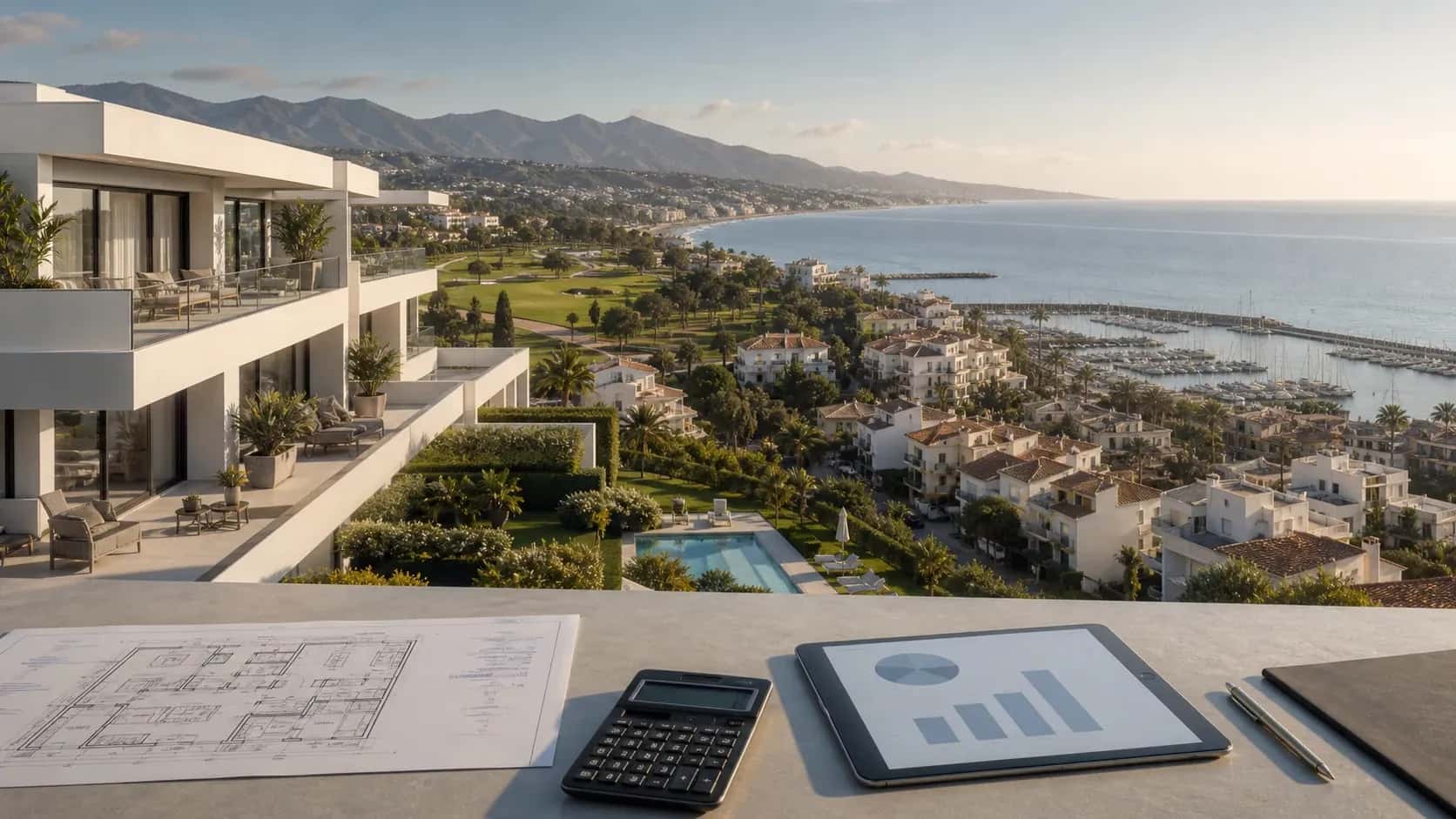
Real estate in Spain: primary or secondary market?
Purchasing real estate on the Costa del Sol requires comparing two different market entry models. The primary market usually involves 10% VAT, AJD tax, stage payments, construction schedule risks, and the opportunity for capital appreciation before handover. The secondary market in Andalusia is most often based on a 7% ITP, faster entry into rental, easier location assessment, and the necessity for a more in-depth technical and legal audit. For an investor from Poland, this is not a choice between "new" and "ready-to-move-in." It is a decision regarding risk profile, capital liquidity, time to cash flow, taxes, service charges, community regulations, and the actual resale value of the asset. This article organizes the decision from the perspective of a premium investor who wants to buy an apartment, a second home, or a rental asset on the Costa del Sol without simplifications and without promises of guaranteed results. In our analysis, we use the PlanoGroup working logic: first the investor's goal, then the total budget, followed by legal verification, location analysis, and only at the end, the selection of specific offers. You can find current starting points for further analysis on the Planogroup foreign real estate offers page and on the Planogroup blog.


Resumen del artículo
Las conclusiones más importantes del artículo en 30 segundos.
Purchasing real estate on the Costa del Sol requires comparing two different market entry models. The primary market usually involves 10% VAT, AJD tax, stage payments, construction schedule risks, and the opportunity for capital appreciation before handover. The secondary market in Andalusia is most often based on a 7% ITP, faster entry into rental, easier location assessment, and the necessity for a more in-depth technical and legal audit. For an investor from Poland, this is not a choice between "new" and "ready-to-move-in." It is a decision regarding risk profile, capital liquidity, time to cash flow, taxes, service charges, community regulations, and the actual resale value of the asset. This article organizes the decision from the perspective of a premium investor who wants to buy an apartment, a second home, or a rental asset on the Costa del Sol without simplifications and without promises of guaranteed results. In our analysis, we use the PlanoGroup working logic: first the investor's goal, then the total budget, followed by legal verification, location analysis, and only at the end, the selection of specific offers. You can find current starting points for further analysis on the Planogroup foreign real estate offers page and on the Planogroup blog.
The decision to purchase a property on the Costa del Sol—whether to choose an apartment from a developer or a ready-to-move-in unit from the secondary market—should be based on your investment model, not on the first impression from a presentation. An off-plan apartment in Estepona with a 24-month delivery timeline is analyzed differently than a unit located in a mature community in Marbella, and differently again than a city apartment in Malaga intended for medium-term rental.
The primary market offers the opportunity to purchase an asset that meets current technical standards, often with better energy efficiency, a garage, storage room, community amenities, and a staged payment schedule. At the same time, the investor must evaluate permits, the escrow account, Bank Guarantees, the risk of delays, and the timing of the LPO issuance, i.e., the Licencia de Primera Ocupación (First Occupation License).
The secondary market offers the advantage of time. The unit already exists, allowing you to check exposure, noise levels, the community, fees, neighbors, rental history, the Nota Simple document, VFT status, and the actual technical condition. However, it requires greater due diligence, as renovation costs, restrictions in the community bylaws, or issues with the legality of modifications can significantly alter the economics of the transaction.
In their broader international strategy, PlanoGroup investors also compare other jurisdictions. In Oman, they analyze the Integrated Tourism Complex, the Greater Muscat Structure Plan (GMSP), freehold status in ITC zones, escrow accounts, and mixed-use development projects. In Spain, the equivalents of this work are the analysis of the PGOU (General Urban Development Plan), licenses, the property registry, the community, and local tourist rental regulations.
—
Primary or secondary market in Spain: a comparison of investment parameters
Fundamentals of choice: time, location, and standard
The first parameter is time. The secondary market allows you to take possession of an asset after signing the notarial deed, registering it in the Registro de la Propiedad, and receiving the keys. If the property has an active tourist license, is in good technical condition, and is equipped according to market expectations, the investor can relatively quickly begin the commercialization process. In practice, however, one must account for time for a photo session, preparing descriptions, operator onboarding, administrative filings, and potential maintenance work.
In the off-plan model, time works differently. Capital is committed in stages, but rental income only begins after handover. The advantage is the potential for Capital Appreciation between reservation and project completion, especially when the investor enters early into a project with a good location, limited supply, and a clear urban plan. The risks remain construction delays, changes in financing costs, and shifts in demand during the construction period.
The second parameter is location. The secondary market often provides access to mature parts of Marbella, Puerto Banús, Nueva Andalucía, Benalmádena, or the first line of development, where new land is limited. In such places, the investor buys not only square footage but also an existing micro-market: infrastructure, access to services, tenant profiles, transaction history, and resale liquidity.
The primary market develops more frequently in zones where the urban plan allows for larger residential developments: Estepona, Casares, Manilva, parts of Benahavís, or the outskirts of Malaga. There, it is worth analyzing not only the investment description but also future supply within a few kilometers, access to the A-7/AP-7 highway, distance to the airport, international schools, golf courses, and planned services.
The third parameter is technical standard. A new apartment should comply with the Código Técnico de la Edificación, feature up-to-date insulation, installation, and energy solutions, and include warranty documentation. A secondary market unit requires an assessment of the condition of installations, air conditioning, insulation, joinery, the terrace, garage, elevator, common areas, and the community's renovation fund. The difference between the purchase price and the cost of bringing the unit up to rental standard can determine the ROI.
Investor decision parameters
- Entry time: The secondary market usually allows for quick operational start-up; the primary market requires a horizon of 18–24 months or longer.
- Purchase costs: The secondary market in Andalusia usually involves ITP (Transfer Tax), while the primary market involves VAT (IVA) and AJD (Stamp Duty). The tax difference affects the cash-on-cash return.
- Legal risk: In the primary market, you check the developer, licenses, guarantees, and schedule; in the secondary market, you check the Nota Simple, debt, the community, the legality of changes, and rental status.
- Negotiation potential: In the secondary market, price is negotiated more often; with a developer, you are more likely to negotiate equipment, a parking space, the schedule, or a finishing package.
- Resale liquidity: In both models, it is not just the price that counts, but the group of future buyers, the unit's functional advantage, exposure, terrace, parking, and access to services.
For PlanoGroup, advisory neutrality means assessing the investor's profile before recommending a market type. An investor focused on quick yield may prefer a ready-made unit. An investor with a longer horizon who accepts the construction phase may consider the primary market. A person buying a second home should additionally weigh the comfort of their own stays, not just rental income.
—
Differences in purchase costs: ITP 7% vs. VAT 10%
The math of transactions on the Costa del Sol
The biggest difference between the primary and secondary markets appears in taxes. When purchasing a new property from a developer in Spain, there is typically a 10% VAT (IVA) and AJD, or Actos Jurídicos Documentados. In Andalusia, the AJD rate for many residential transactions is usually indicated at 1.2%, but the investor should always confirm the current rules for a specific transaction and financing method via the Junta de Andalucía portal or with a tax lawyer.
When purchasing from the secondary market from a private individual, you do not pay VAT. Instead, there is ITP, or Impuesto sobre Transmisiones Patrimoniales. In Andalusia, the general rate for used properties is usually 7%. It is worth remembering, however, that the tax base may be linked to the valor de referencia (reference value), not just the price visible in the contract. This is one of the reasons why the tax calculation should be created before signing the Contrato de Arras (earnest money contract), not just before the notary.
Example: for a property priced at 1,000,000 EUR, the difference between 10% VAT and 7% ITP is 30,000 EUR, even before accounting for AJD, notary fees, registry, legal services, bank costs, and potential renovation. In practice, the primary market may require about 11–13% in incidental costs, and the secondary market often about 9–11%, depending on financing and the scope of legal services. These are working ranges, not a universal rule.
Costs common to both models include the notary, entry in the Registro de la Propiedad, legal services, translations, NIE number, bank account, bank valuation for a mortgage, bank commissions, and insurance. On top of this are post-purchase costs: IBI (property tax), Basura (trash collection), Service Charge or Comunidad fees, utilities, insurance, rental management, non-resident tax settlements, and a reserve for repairs.
Step by step: how to calculate total acquisition cost
- Step 1: Determine the transaction price and check whether we are talking about the primary market, secondary market, or an assignment of rights from a developer contract. An assignment may have a different cost structure and requires separate legal analysis.
- Step 2: Verify taxes. For a new property, ask about VAT, AJD, the payment schedule, and how payments are secured. For the secondary market, check ITP, the valor de referencia, the deadline for filing Modelo 600, and the scope of obligations after signing the deed.
- Step 3: Add transaction costs. Ask your lawyer for an estimate of notary, registry, legal services, translations, and bank costs. Do not rely solely on an online calculator because financing, the buyer's status, and the purchase structure change the result.
- Step 4: Add operating costs. Compare Comunidad, IBI, Basura, insurance, Service Charge, rental management, operator commission, and technical reserve. For a premium apartment, community costs can significantly lower the net yield.
- Step 5: Build three scenarios: conservative, base, and optimistic. In each, compare occupancy, average daily rate or monthly rent, operator costs, vacancy periods, seasonality, and potential modernization work.
- Step 6: Compare the result with other markets. If the investor is also analyzing Oman or Dubai, you must compare not only gross ROI but also entry costs, taxes, the freehold model, resale liquidity, rental regulations, and the predictability of maintenance costs. Helpful background is provided by Dubai vs. Oman analysis.
—
Primary market: when is a new investment the optimal choice?
Developer guarantees and 21st-century technical standards
The primary market makes sense when the investor accepts the construction time and wants to buy an asset with a predictable technical standard. A new building should offer parameters often missing in older communities: better insulation, higher energy efficiency, an elevator, garage, storage room, larger terraces, aerothermal systems, preparation for electric vehicle charging, access control, and common areas designed for current usage models.
For the investor, however, it is not about the catalog of amenities. What matters is the impact of these elements on maintenance costs, tenant demand, resale liquidity, and price resilience against competitive supply. A pool, gym, coworking space, spa, or concierge only make sense if the Service Charge does not consume an excessive portion of rental income. Therefore, the analysis should calculate the community cost per m2 and check whether the amenities match the tenant profile in a given location.
In off-plan projects, staged payments can be an advantage. A 30/70 or 40/60 model allows you to manage liquidity and not commit the entire amount on the day of reservation. In practice, this requires checking whether each payment is secured by a Bank Guarantee (Aval Bancario), whether funds go to the correct account, and what conditions apply in the event of delays, specification changes, or contract withdrawal.
The primary market can also be a good tool for Capital Appreciation, but only under specific conditions. You need a location with limited supply, a reasonable entry price level, a credible developer, a transparent schedule, and a product that will be resalable not only among investors but also among end-users. The mere fact that a project is new is not enough.
Step by step: how to check a developer and off-plan project
- Step 1: Ask for the developer company's data, history of completed projects, building license number, and information about investment financing. Check if the selling entity is the owner of the land or has full rights to use it.
- Step 2: Verify the building license and the project's compliance with the local plan. It is worth checking the PGOU, land encumbrances, access to infrastructure, access roads, and potential environmental restrictions. For larger mixed-use development projects, it is important whether the service part will be built in parallel with the residential part.
- Step 3: Analyze the reservation agreement and the private contract. Pay attention to the payment schedule, penalties for delay, finishing standard, the possibility of tenant-requested changes, the long-stop date, and refund rules.
- Step 4: Ask for an Aval Bancario for every payment. In Spain, securing buyer payments is one of the central elements of protection when buying from a developer. The investor should know which bank issues the guarantee, for what amount, and by what date.
- Step 5: Check the LPO. The Licencia de Primera Ocupación confirms that the building can be used as intended. Without an LPO, there may be problems with utilities, financing, insurance, renting, and resale.
- Step 6: Compare the price per m2 with the local market. Use transaction portals, offer data, industry reports, and conversations with local rental operators. For price background, you can monitor Spanish Property Insight.
In the context of the PlanoGroup offer, an example of a primary market project on the Costa del Sol is Zenity Blau Estepona. This type of asset should be analyzed through the prism of location, square footage, community costs, delivery date, technical standard, and competitive supply in Estepona.
—
Secondary market: why does a ready-made apartment still attract capital?
Location, history, and immediate ROI
The secondary market has an advantage where the investor wants to evaluate reality, not a project. A ready-made apartment can be viewed at different times of the day to check noise, sunlight, exposure, view, the condition of common areas, community behavior, and real access to services. This is especially important in locations where the price per m2 depends on very small differences: distance to the beach, floor, terrace orientation, view, parking, or the quality of neighboring buildings.
The second advantage is the possibility of faster entry into rental. If the unit has a VFT license, has been rented before, has equipment that meets market standards, and does not require renovation, the investor can start generating income faster. It is worth separating gross ROI from net. The net result depends on Comunidad, IBI, Basura, the operator, platform commissions, cleaning costs, repairs, seasonality, non-resident tax, and vacancy periods.
The third advantage is historical data. In the secondary market, you can ask for utility bills, the history of community fees, Comunidad meeting minutes, information about planned renovations, the amount of the renovation fund, and actual maintenance costs. With the primary market, the investor often works on estimates that may change after the building is handed over.
The secondary market is not simpler, however. An older building may require renovation of installations, air conditioning replacement, terrace waterproofing repairs, community work, or legalization of changes made by the previous owner. In Marbella, Estepona, or Benalmádena, there are units in good locations but with documentation that requires careful organization before purchase.
Step by step: secondary market due diligence
- Step 1: Download the Nota Simple from the Registro de la Propiedad. Check the owner, property description, square footage, mortgage encumbrances, easements, seizures, restrictions, and data consistency with the offer. The starting point is the Registradores de España service.
- Step 2: Ask for a Certificado de estar al corriente. The document should confirm that the seller has no arrears with the community. A verbal assurance from an agent or owner is not enough.
- Step 3: Read the community bylaws and meeting minutes. Look for entries regarding short-term rentals, renovations, use of common areas, planned investments, lawsuits, and Comunidad increases.
- Step 4: Verify the tourist license. Check if the VFT license exists, if it can be transferred or recreated, what rules apply in the given municipality, and if the community has introduced restrictions.
- Step 5: Perform Technical Due Diligence. The inspection should cover electrical and water installations, air conditioning, dampness, the terrace, windows, doors, insulation, the condition of the kitchen and bathrooms, parking, and the storage unit. In the premium segment, the buyer should know the cost of bringing the unit to rental standard before signing the contract.
- Step 6: Calculate the modernization scenario. If the strategy assumes fix-and-flip or raising the rental rate after renovation, you must compare the cost of work, execution time, community restrictions, permits, and the real resale price in a given micro-market.
Secondary market analysis requires discipline but can provide a strong investment profile: a known location, a quick operational start, and greater control over the actual state of affairs. This is often a good choice for an investor who wants to see a working asset first and only then optimize its results.
—
Analyzing Costa del Sol locations by property type
From Malaga to Manilva – investment profiling
The Costa del Sol is not one market. It is a strip of local micro-markets with different prices, seasonality, tenant profiles, and resale liquidity. Therefore, the question primary or secondary market should only be asked after the question about location and purchase purpose.
Marbella is a market with high entry barriers, high recognition, and limited supply in main zones such as the Golden Mile, Sierra Blanca, Nueva Andalucía, or Puerto Banús. In many cases, the secondary market has more value there because it provides access to locations that cannot be easily recreated. However, the investor must very carefully assess the building's condition, community regulations, and modernization costs.
Estepona has a different profile. In recent years, it has attracted primary market projects, larger residential developments, and investors looking for a price-to-standard ratio. In Estepona, you must especially check future supply, access, distance from the center, quality of common areas, Service Charge, and whether tenants will treat the location as an alternative to Marbella or as a separate market.
Benahavís and Casares are strongly associated with the golf segment, views, larger square footage, and clients looking for privacy and resort facilities. In such locations, it is not just the price per m2 that counts, but also distance to services, travel time to the airport, quality of the golf course, the level of urbanization maintenance, and market liquidity off-season.
Malaga is an urban market. For an investor, it means access to medium-term rentals, students, employees, expats, urban tourism, and year-round demand. At the same time, tourist rental regulations in cities are more politically sensitive, so before buying, you must check local restrictions, the community, and the real possibility of commercialization.
Manilva and Casares Costa may offer a lower entry threshold than central parts of Marbella, but they require careful liquidity analysis. A lower purchase price does not always mean a better net yield if the season is shorter, price competition is greater, and resale is slower.
How to match location to investor goals
- Second home: The priority is the comfort of your own stays, access to the airport, beach, restaurants, medical care, and year-round services. ROI is important but should not dominate the property's utility.
- Short-term rental: Seasonality, license, community bylaws, proximity to the beach, parking, terrace, number of bedrooms, equipment standard, and operator cost count. It is worth comparing ADR and occupancy rates for similar units.
- Medium-term rental: Schools, transport, internet, apartment layout, workspace, access to services, and off-season demand stability are important. Malaga and the surroundings of larger centers may have an advantage here over typical holiday zones.
- Capital Appreciation: You need to look for locations where end-user demand is growing, infrastructure is improving accessibility, and supply is not excessive. Growth in asking prices alone is not enough—you need data on transactions and the time offers are on the market.
- Geographic diversification: An investor comparing Spain with Oman, Dubai, or Montenegro should compare taxes, freehold, entry costs, rental regulations, currency risk, and resale liquidity. In this context, Warsaw vs. Oman comparison and Muscat market stability analysis may be helpful.
—
Risk management and transaction security
How to avoid mistakes when buying in Spain?
The biggest mistakes when buying property in Spain usually result from haste, too narrow a cost calculation, and treating the notarial process as full protection for the buyer. A notary in Spain confirms the legality of the deed and the identity of the parties, but does not replace an independent lawyer working for the buyer. It is the lawyer who should check documents, risks, taxes, the registry, the community, and contract terms.
In the primary market, the risk is a lack of full control over time. A delay in handover, a shift in the LPO, a change in financing costs, or a difference between the visualization and the final standard can change investment assumptions. Therefore, the contract should clearly regulate the schedule, guarantees, penalties, finishing standard, and handover rules.
In the secondary market, the risk is more technical and documentary. A unit may look good but have dampness, improperly built terrace enclosures, community arrears, a dispute with neighbors, rental restrictions, or installations requiring replacement. This does not always disqualify the purchase, but it must be factored into the price and schedule.
Another area is exit liquidity. Even before buying, the investor should ask: to whom will I sell this property in 5–7 years? If the answer is only other investors looking for high yield, the asset may be more sensitive to interest rate hikes and a drop in rental rates. If the property also has end-user demand, the risk is usually lower.
Step by step: from reservation to post-purchase management
- Step 1: Establish a strategy. Write down the purpose of the purchase: second home, short-term rental, medium-term rental, capital protection, Capital Appreciation, or a mixed model. Without this, it is difficult to assess whether the chosen property fits the portfolio.
- Step 2: Build a total budget. Include price, taxes, notary, registry, lawyer, bank, equipment, renovation, insurance, Service Charge, IBI, Basura, and a reserve for vacancy.
- Step 3: Verify documents before the Contrato de Arras. Do not sign a reservation agreement without checking basic data: owner, encumbrances, license, community, developer status, or payment security.
- Step 4: Ask the developer or seller operational questions. For the primary market: when will the LPO be ready, what are the guarantees, where do payments go, what is the projected Service Charge. For the secondary market: what are the community costs, are there arrears, does the community allow rentals, were there works done without a permit.
- Step 5: Compare indicators. Determine price per m2, total cost, gross yield, net yield, cash-on-cash return, time to rental entry, modernization cost, projected resale time, and result sensitivity to a drop in occupancy.
- Step 6: Plan post-purchase management. Choose an operator, rental model, pricing policy, technical service, accounting, non-resident settlements, and rules for owner use of the property. Without this, ROI will remain a calculation on paper.
PlanoGroup supports the investor through these stages: from asset selection, through due diligence, to organizing post-purchase service. It is also worth using the second home services section, as post-transaction management often determines the quality of the investment result.
—
When is it worth talking to an advisor?
If you are comparing the primary and secondary markets on the Costa del Sol, prepare three pieces of data before the conversation: total budget, investment horizon, and the assumed property usage model. Only then can you meaningfully compare offers, taxes, risks, and potential yield.
PlanoGroup can help with offer selection, cost assessment, profitability analysis, document verification, and coordination of the purchase process. For investors diversifying capital outside of Poland, it is worth comparing Spain with other markets, such as Oman, Dubai, or Montenegro. The starting point can be primary market offers and current analyses on the PlanoGroup blog.
FAQ
Is the primary market in Spain more expensive in terms of taxes than the secondary?
Usually, yes. When purchasing a new property from a developer, the investor pays 10% VAT and AJD, whereas when purchasing a used property in Andalusia, there is usually 7% ITP. The tax difference for an asset worth 1,000,000 EUR can be tens of thousands of euros. However, you must look at the total cost, because the secondary market may require renovation, and the primary market may have a higher Service Charge after the project is completed.
Can a secondary market property be rented out faster?
Yes, if the unit is in good technical condition, has equipment, community consent, and an active tourist license, or is suitable for medium-term rental. The speed of entering the rental market does not automatically mean a higher ROI. Before buying, you must check rental rates in the micro-location, seasonality, operator costs, platform commissions, non-resident taxes, community fees, and a reserve for repairs.
When does a new investment in Spain make more sense than a ready-made apartment?
The primary market is justified when the investor accepts the construction time, wants to spread out payments, is looking for a higher technical standard, better energy efficiency, and potential value growth between purchase and handover. The condition is checking the developer, licenses, Bank Guarantee, schedule, LPO, and community costs. Without this verification, off-plan can have too many risks hidden in time.
Is it possible to negotiate the price on the Costa del Sol?
In the secondary market, price negotiation is more common, especially when the property requires renovation, has been on the market for a long time, or the seller is under time pressure. In the primary market, developers less frequently lower the list price, but they may negotiate equipment, a parking space, the payment schedule, a furniture package, or reservation conditions. In both models, the negotiation argument should be data: price per m2, maintenance costs, legal status, comparable transactions, and the real cost of bringing the unit to an investment function.
What should be checked first before choosing between the primary and secondary market?
First, the purchase purpose and total budget. Only then the market type. The investor should answer whether they are buying for rental, for their own stays, for capital protection, for Capital Appreciation, or for a combination of these functions. Then you need to calculate taxes, fees, renovation, equipment, Service Charge, operator costs, and a reserve for vacancy periods. Without this calculation, comparing offers is superficial.
Does a VFT tourist license always pass to the buyer?
You should not assume this automatically. The status of the license must be checked in the specific municipality, with a lawyer, and within the community. Tourist rental regulations in Spain are local and can change, and the community can introduce restrictions. When buying for short-term rental, the investor should obtain written confirmation that the chosen commercialization model is possible.
Does the secondary market always provide a better yield than the primary?
No. The secondary market may enter the rental market faster, but net yield depends on the entry price, renovation, fees, seasonality, and management quality. The primary market may have a higher tax cost and a later start of income, but sometimes it provides better energy efficiency, higher liquidity among buyers looking for a ready standard, and potential value growth during the construction period.

Autor
Beata Cieślukowska
COO / FOUNDER
For over 17 years, she has been supporting clients in investing in premium real estate, with a particular focus on investment apartments and condo-style projects. Over the years, she has built her position in the Costa del Sol market, where she helped clients select properties that combine lifestyle with investment potential. Today, she is developing PlanoGroup, expanding operations into international markets – including Oman and other investment destinations. She combines experience, market intuition, and an individual approach, which allows her to match a property not only to a budget but, above all, to the client's goal.

Artículos relacionados

Differences between the primary and secondary market in Oman – what to choose?


Why is Muscat the most stable real estate market in the Gulf? Analysis 2020–2025

Return on Investment in Oman – Which Properties Earn the Most? Market Analysis 2025