


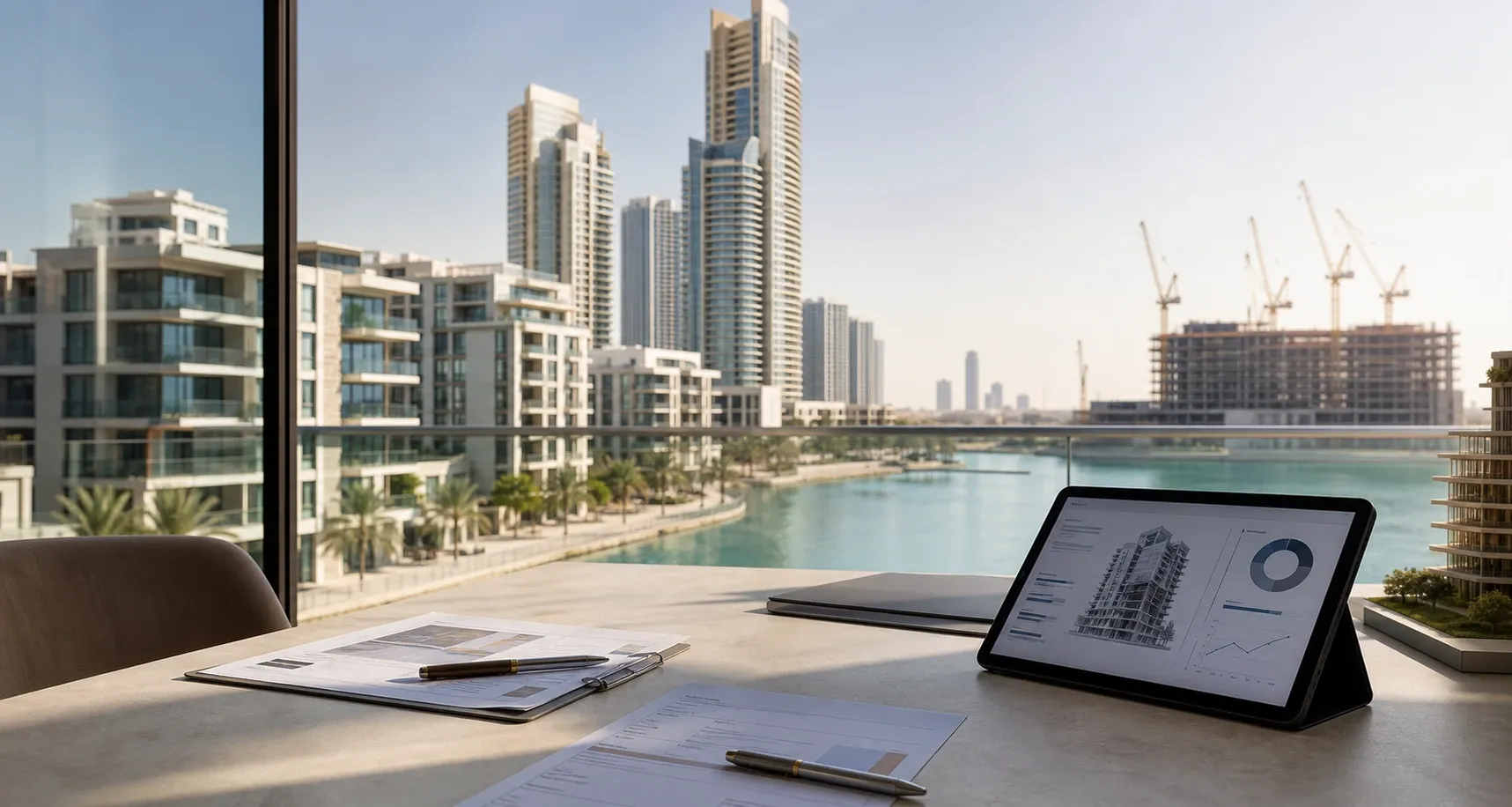
Escrow account in the GCC: Oman, Dubai and Saudi Arabia
An escrow account is one of the most important cash flow control mechanisms when purchasing off-plan property in the GCC region. Its purpose is to separate funds paid by buyers from the developer's standard operating account and to tie disbursements to project documents, construction progress, and the supervision of a regulator or escrow bank. In Dubai, the foundation of the system is Law No. 8 of 2007 and the supervision of the Dubai Land Department and RERA, and investors can check the status of a project via the Project Status Enquiry service and the Dubai REST application. In Saudi Arabia, key elements include Wafi licenses, REGA registries, and the rules for opening escrow accounts outlined in SAMA regulations. In Oman, analysis must no longer rely solely on Royal Decree 30/2018, as Royal Decree 79/2025 repealed that system and transferred the subject to a new real estate market regulatory regime. Therefore, in 2026, an investor should verify the project's current license, MoHUP documents, off-plan sale conditions, the account dedicated to the specific project, and the draft SPA before making any reservation payment.


Article summary
The most important conclusions from the article in 30 seconds.
An escrow account is one of the most important cash flow control mechanisms when purchasing off-plan property in the GCC region. Its purpose is to separate funds paid by buyers from the developer's standard operating account and to tie disbursements to project documents, construction progress, and the supervision of a regulator or escrow bank. In Dubai, the foundation of the system is Law No. 8 of 2007 and the supervision of the Dubai Land Department and RERA, and investors can check the status of a project via the Project Status Enquiry service and the Dubai REST application. In Saudi Arabia, key elements include Wafi licenses, REGA registries, and the rules for opening escrow accounts outlined in SAMA regulations. In Oman, analysis must no longer rely solely on Royal Decree 30/2018, as Royal Decree 79/2025 repealed that system and transferred the subject to a new real estate market regulatory regime. Therefore, in 2026, an investor should verify the project's current license, MoHUP documents, off-plan sale conditions, the account dedicated to the specific project, and the draft SPA before making any reservation payment.
Buying off-plan in Oman, Dubai, or Saudi Arabia can make investment sense, but only if the investor's money is channeled into the right control system. Escrow is not a promise of profit, does not guarantee value appreciation, and does not remove the risk of delays. However, it is a tool that mitigates one of the most serious risks in properties under construction: the uncontrolled use of buyers' funds outside of the project they paid for.
Therefore, for a Polish investor, the most important question is not: does the project have beautiful visualizations, but: is there a project escrow account, who manages it, on what legal basis does it operate, when can money be paid out to the developer, and do the account details match the SPA agreement? This article organizes the procedure in three jurisdictions: Dubai, Saudi Arabia, and Oman. It also shows where escrow genuinely helps and where it must be supplemented by legal, technical, and financial due diligence.
—
What is escrow in an off-plan purchase?
Escrow in an off-plan transaction is an account assigned to a specific development project. The buyer does not transfer money to a regular company account, commercial account, agent's account, or marketing account. Funds go to an account whose purpose is described in the project documents, the escrow bank agreement, and local regulations. In a proper structure, the account is tied to the project name, the developer, the bank, the construction schedule, and the payout rules.
Technically, escrow acts as a filter between the buyer and the developer. Money should not be disbursed simply because the next installment is due according to the sales calendar. In a well-described system, a payout should be tied to a construction milestone, a technical document, a consultant's report, a regulator's approval, or the escrow bank's procedure. This is the essence of milestone-based payments: funds follow the actual progress of the project, not just the sales narrative.
Operating Account vs. Project Escrow Account
An operating account is used by the company for ongoing operations: salaries, marketing, office costs, commissions, financing other projects, and daily settlements. A Project Escrow Account should be a project-specific account. Its purpose is that buyers' funds are allocated to a specific investment and cannot be freely mixed with the developer's other funds.
This distinction is practical. If a buyer pays a booking fee to a parent company account, an intermediary's account, a foreign account, or a sales representative's private account, they lose the ability to easily control the cash flow. Even if the project is well-known and the developer's brand is recognizable, a mere transfer to the wrong account can make it difficult to later claim a refund.
Who controls payouts from escrow?
Depending on the market, control is exercised by an escrow bank, a regulator, a technical consultant, an auditor, or a combination of these institutions. In Dubai, the system is based on DLD/RERA, banks accredited as account trustees, and project payout procedures. In Saudi Arabia, the investor should look at the Wafi license, developer registration, and banking rules described in SAMA regulations. In Oman, one must check the current MoHUP/Tatwir documents and the legal basis of the account for a specific investment.
It is not enough to ask: do you have escrow? Better questions are: which bank holds the account, what is the exact beneficiary name, is the account assigned to this phase of the project, who approves the payouts, what documents trigger the payment, and what happens to the money in the event of project cancellation.
What escrow limits and what it does not guarantee
Escrow can limit the risk of embezzlement, funding other investments with buyers' money, and payouts detached from construction progress. It can also improve the investor's negotiating position with the developer because it forces documentation: project number, account, schedule, reports, and refund procedures.
However, this does not mean full capital protection. Escrow does not guarantee the absence of delays, construction quality, lack of disputes, rental yield, price appreciation, smooth resale, or obtaining residency. It does not replace the analysis of the SPA, land title deed, developer license, Service Charge, finishing standard, post-handover CAPEX, and exit strategy. Escrow primarily answers the question: where does the money go and under what rules can it be released.
Minimum due diligence before a transfer
Before the first payment, the investor should request: the project number, the developer's name as registered, the bank name, escrow account confirmation, project payment plan, draft SPA or PSPA, refund policies, project cancellation procedure, licensing documents, and a construction progress report. If the developer is unwilling to share these elements before the booking fee, this is not a minor formality, but a signal to halt payment.
—
How to check an escrow account in Dubai?
Dubai has one of the most developed systems for handling off-plan projects in the region. The legal basis for escrow accounts is Law No. 8 of 2007 Concerning Escrow Accounts for Real Estate Development in the Emirate of Dubai. The law defines an escrow account as a project bank account that receives payments from buyers of off-plan units and project financing. It also states that a developer selling off-plan must operate within the registers and approvals of the Dubai Land Department.
In practice, this means the investor should demand not only a brochure and a payment plan, but also confirmation of project registration. The data in the contract should be consistent with the data in DLD systems: project name, developer name, plot or project number, construction status, and payment terms.
The role of DLD, RERA, Oqood, and Dubai REST
The Dubai Land Department is responsible for real estate registries and public services, while RERA is part of the oversight system for developers and projects. Oqood functions as the digital registration of off-plan contracts prior to the final Title Deed. For the buyer, Oqood is important because it confirms that the purchase in a project under construction has been recorded in the appropriate system rather than remaining merely a private arrangement with the developer.
DLD provides the Project Status Enquiry service, which allows checking project information, including completion percentage and project details. According to the service description, one can use the DLD website, the Dubai REST app, or the WhatsApp channel, and searching can be done by plot number, project number, or project name. This should be one of the first steps before paying the next installment.
The 20 percent mechanism and account activation
In materials concerning escrow account activation, DLD points to requirements related to a technical report, bank guarantee, developer contribution, financing, or work progress level. The service description refers to account activation with a bank guarantee up to 20 percent completion or based on the work progress percentage after 20 percent completion, according to the DLD technical report. For an investor, this does not mean they can independently assess construction from a car window. It means they should see the current, official project status and documents confirming the basis on which the account operates.
The most important practical rule: do not rely on the seller's declaration that the project is "approved." Ask for the Project ID, developer name, plot number, escrow account confirmation, bank details, and information on which system the contract was registered in. If the developer cannot indicate how the investor can verify these data in DLD or Dubai REST, the verification is not complete.
Dubai checklist before the first payment
Check whether the project is registered with DLD, whether off-plan sales are conducted through the Oqood system, whether the escrow account is assigned to the project name, whether the payment plan corresponds to construction milestones, whether the account number on the proforma matches the developer's documents, and whether the SPA describes the consequences of delays, assignment, cancellation, and refunds.
If the booking fee is to go to the sales office account, ask whether it is merely an administrative fee or part of the property price. If it is part of the price, it should be settled in a structure compliant with the project documents. In premium projects, small reservation amounts also create a legal and financial trail. They should not be treated as a neutral "apartment hold."
—
What does the Wafi system mean in Saudi Arabia?
In Saudi Arabia, the off-plan market must be analyzed through the lens of Wafi, REGA, and banking rules. Wafi is the official system related to the sale and leasing of off-plan real estate. According to REGA/Wafi information, the system concerns project licensing, developer registration, and the control of unit sales before construction is completed. For an investor from Poland, this means that the slogan Vision 2030 alone is not enough. One must check whether a specific project has the proper licensing status.
Saudi Arabia is a market of large-scale changes, but in residential investments, the scale of the state program does not replace documents. A purchase in Riyadh, Jeddah, or a project related to Red Sea tourism must begin with the question: who is the developer, do they hold a qualification, does the project have an off-plan license, where do the buyer's funds go, and does the contract specify a refund procedure.
Wafi, REGA, and the project license
REGA describes Wafi as the official organization that grants off-plan unit sales licenses and issues developer registration certificates. Service pages also contain information on licensing requirements for off-plan project marketing and the obligation to direct reservation amounts to a designated escrow account if such amounts are collected during the project marketing period.
For the investor, three levels of control are important: developer qualification, specific project license, and bank account. Developer qualification does not automatically mean that every investment of theirs has off-plan sales approval. Conversely, a project license does not mean that any payment can go to any company account. The documents must link together into a single, coherent sequence.
The role of the bank and SAMA
The Saudi banking regulator SAMA publishes rules regarding the opening of escrow accounts for real estate development projects. The rulebook indicates, among other things, that a bank can open an account after meeting specific documentation and procedures, that a separate account should exist for each project, and that payouts from the account must be tied to payment documents certified by a consultant and an external auditor. From the buyer's perspective, this is not a banking detail, but an element of transaction security.
If the developer presents an account whose name does not include the project or does not match the Wafi/REGA documents, the investor should withhold payment. If the contract lacks a clear description of whether funds are kept in an escrow account, when they can be released, and what happens upon project cancellation, the legal analysis is incomplete.
Saudi Arabia checklist before transfer
Ask for the Wafi license number, developer name in the registry, project name, document indicating the escrow bank, tranche release rules, draft SPA, construction schedule, assignment rules, and refund procedure. Check whether the project status sounds like an off-plan sales license rather than just a marketing announcement or general company qualification.
In KSA, separating the right of a foreigner to purchase from the security of project financing is also particularly important. Even if an investor can acquire a specific type of asset, they must separately check escrow, RETT, Service Charge, residency rules, potential ownership restrictions, and local registration procedures.
—
What documents confirm escrow in Oman?
Oman requires particularly careful description because content plans and many older market materials refer to Royal Decree 30/2018 as the main basis for escrow. That decree indeed established the System of Escrow Account for Real Estate Development Projects. However, Royal Decree 79/2025 Issuing the Law Regulating Real Estate repealed the RD 30/2018 system. According to Decree.om and a Oman News Agency announcement, the new decree was issued on September 10, 2025, published in Official Gazette 1613 on September 14, 2025, and provided for entry into force 180 days after publication.
In practice, in 2026, an investor should not exclusively ask: does the project operate based on RD 30/2018? A better question is: what is the project's current regime under RD 79/2025, what executive decisions and MoHUP practices apply, does the project hold an off-plan license, is the escrow account assigned to a specific investment phase, and what bank documents can be verified.
RD 30/2018 as a historical point, not a full answer
RD 30/2018 is important as a historical reference point and for projects that may have transitional elements. However, it should not be treated as a standalone, current answer for new investment decisions. RD 79/2025 repeals the earlier escrow system while simultaneously providing that existing regulations and decisions may operate to the extent they are not inconsistent with the new law, until implementing acts are issued.
This means the need to analyze the project, not just the market. One project may have a different licensing history than another. One may be in a transition phase, while another already operates on updated documents. The investor should ask a local lawyer to confirm which regulations and decisions apply to a specific investment on the date the SPA is signed.
MoHUP, Tatwir, Amlak, and the project license
On the Gov.om portal, the service Get Real Estate Development Project License describes the license for a project covered by the off-plan sales system. Required documents include a title deed, usufruct contract, initial approval, maps, off-plan sale contract, consultant agreement, project implementation plan, and land valuation, among others. The service steps also mention opening an escrow account. This is a very practical hint for the investor: escrow should be part of the project licensing process, not an add-on in a sales presentation.
MoHUP also points to the Amlak application as an official tool for real estate services and information. For the buyer, this means they should expect documents tied to the state real estate system, not just a developer's folder. In Oman, ITC projects (Integrated Tourism Complexes) are particularly significant, but ITC status must also be confirmed by a document. The mere fact that a project is by the sea, next to a resort, or in a well-known location does not determine a foreigner's right to purchase or the status of the account.
Documents to request in Oman
The minimum documentation includes: developer or project license, confirmation of ITC status or other basis for foreign acquisition, Mulkia or land documents, building permit, off-plan approval, draft SPA or PSPA, payment plan, escrow account confirmation, bank name, account number, description of payout rules, construction schedule, finishing standard, and handover procedure.
If the seller shows only an older legal basis and does not explain how the project operates under RD 79/2025, payment should be withheld until written clarification is provided. This is not an academic correction. The buyer's rights, refund procedure, bank role, MoHUP role, and scope of control over the developer depend on the legal basis.
—
When is the escrow mechanism not enough?
Escrow is a standard whose absence should disqualify a project from further analysis. But escrow alone is not enough when the problem concerns developer quality, contract structure, rental demand, unit oversupply, or an incorrect entry price. One can buy a project with an escrow account and still make an investment mistake if the SPA does not describe delays, the post-handover Service Charge is unclear, and the exit strategy relies on optimistic assumptions.
The most common mistake is confusing cash flow protection with the protection of the entire investment. Escrow helps control whether funds reach the project. It does not check for the investor whether the price per square meter is rational, whether the unit has secondary market liquidity, whether renting will operate at operator costs, or whether the developer has a history of timely handovers.
Developer bankruptcy and project cancellation
In the event of developer trouble, an escrow account can facilitate the identification of funds and the settlement procedure. However, this does not mean an immediate refund. In Dubai, DLD describes the role of the project liquidation section in cancellation situations, but fund distribution depends on the account balance and procedure. In Saudi Arabia and Oman, one must also check local procedures rather than assuming a refund will occur automatically in full and within a short timeframe.
In the SPA contract, one must find answers to questions: who determines a delay, when can a project be deemed canceled, does the buyer have the right to withdraw, are contractual penalties due, does the refund cover only capital or also incidental costs, and in what currency is the settlement made.
Cost inflation, finishing standard, and force majeure
Escrow does not solve the problem of rising construction costs. If the developer faces cost pressure, there may be a risk of changing the standard, extending the schedule, or renegotiating selected project elements. Therefore, in the SPA and Schedule of Finishes, one must check what is precisely described: materials, appliances, areas, warranties, deadlines, and the definition of handover.
Force majeure clauses require separate analysis. Not every market situation should automatically be treated as force majeure. The investor should ask a lawyer to assess whether the clause is too broad, whether it only covers external events, whether it allows the developer to unilaterally postpone the deadline, and what rights the buyer has after exceeding the grace period.
—
Red flags: What to watch out for before transferring funds?
The most important red flag is a request to transfer funds to an account other than the project account. This could be a parent company account, an agent's account, a foreign marketing account, a seller's private account, or an account whose name does not match the project. In such cases, the investor should withhold payment and demand a written explanation.
The second red flag is the absence of a project number or the inability to check the project in an official system. In Dubai, DLD/Dubai REST data should appear; in KSA, Wafi/REGA data; in Oman, MoHUP/Tatwir documents and off-plan basis. If the sales team says "this is an internal matter," the risk increases.
The third red flag is pressure for immediate reservation. In premium markets, the best units may indeed disappear quickly, but time pressure cannot replace documentation. If an investor has to transfer funds within a few hours without an SPA, escrow account number, and refund rules, they should treat the situation as a risk, not an opportunity.
The fourth red flag is name discrepancy. The investment name in the brochure, company name in the contract, account name, and registry name should logically connect. International projects often have trade names, special purpose vehicles (SPVs), and master developers, but these relationships must be documented.
The fifth red flag is a payment plan detached from construction. If the schedule provides for subsequent installments solely by dates, without a clear link to construction milestones or without information on who confirms progress, the investor should ask how the escrow bank controls payouts. The lack of an answer means the risk of financing a delayed project remains with the buyer.
—
Why verification must happen before reservation?
Reservation is the moment when an investor often psychologically "enters" a project. After paying the booking fee, it is easier to accept imperfect documents because a sunk cost appears, along with the fear of losing the selected unit. Therefore, the most important questions must be asked before the transfer, not after.
From the perspective of PlanoGroup, which communicates over 17 years of experience in international real estate, an advisor's value does not lie in showing a large number of offers. Value lies in rejecting projects where documents do not match risk, price does not match liquidity, and payment plans do not match capital protection. In off-plan investments, the negative selection stage is just as important as choosing the apartment.
Questions for the developer before the booking fee
Before the booking fee, prepare a short list of questions. What is the project number? What is the official developer name? Which bank holds the escrow? Is the account assigned to the entire project or a specific phase? Is the payment plan tied to construction milestones? Can I see the draft SPA before payment? What are the booking fee refund rules? Does the project have off-plan sales approval? When will the buyer's registration document be issued: Oqood, title deed, Mulkia, or local equivalent?
Answers should be verifiable by document. If the answer is "this is market standard," ask for a clause in the SPA. If the answer is "the regulator approved it," ask for the number and source of verification. If the answer is "the bank handles everything," ask for the bank name and payout rules.
The role of an independent advisor and lawyer
An investment advisor helps compare projects, locations, operators, payment plans, Service Charges, and ROI assumptions. A local lawyer checks the contract, title deed, licenses, consequences of delays, and the refund procedure. These roles should not replace one another. In GCC transactions, a good decision is born at the intersection of numbers, law, and operational market knowledge.
In practice, the investor should have their own due diligence spreadsheet and their own document checklist. Developer materials are a starting point, not the end of the analysis. If a decision concerns multiple markets, Oman, Dubai, and Saudi Arabia should be compared along the same fields: acquisition law, escrow, schedule, maintenance cost, currency, rental, liquidity, and exit.
—
Due Diligence Table and Technical Summary
The following table is a working checklist to be used before any off-plan transaction. It does not replace legal analysis, but allows quick inspection of whether a project has a complete set of basic data.
| Market/system | Project number | Developer name | Bank Escrow | Construction schedule | Progress report | Return policy | Consequences of cancellation |
|---|---|---|---|---|---|---|---|
| Dubai/DLD-RERA | Project ID, land number or project name in DLD/Dubai REST | In accordance with the DLD and SPA register | Bank accredited as account trustee, account in the project name | Payment plan linked to milestones and DLD documents | Project Status Enquiry, technical report, percentage complete | Description in SPA, DLD procedures, booking fee rules | Check the DLD path for cancelled projects and escrow settlement |
| Saudi Arabia/Wafi-REGA | Wafi license number and project data | Qualified and registered developer | Invoice in accordance with SAMA rules and the project license | Transfers in accordance with the contract and certified reports | Consultant and auditor documents and project status | Recording in the SPA, delay rules, penalties, withdrawal | Check who declares the cancellation and how funds are settled |
| Oman/MoHUP-Tatwir | Off-plan project license, MoHUP/Tatwir documents | Developer with an active operating basis | Project bank account indicated in the documents | Schedule in accordance with the project implementation plan | Technical reports and documents required by MoHUP | SPA/PSPA entry and local counsel confirmation | Establish the regime under RD 79/2025 and any transitional provisions |
The technical summary is simple: the lack of escrow or the inability to verify it should immediately halt the analysis. A project may have a good location, a well-known operator, and a strong sales narrative, but if the investor does not know where the money is going and who controls the disbursements, the risk is too high. Capital security in the GCC comes from documents, registries, accounts, and procedures, not from marketing promises.
—
PlanoGroup Consultation
If you are planning portfolio diversification in the Gulf region and analyzing an off-plan project in Oman, Dubai, or Saudi Arabia, start with a document check. PlanoGroup can help compare projects, review the payment plan, prepare questions for the developer, coordinate legal analysis, and assess whether the escrow account and SPA are consistent with the investment objective.
A good consultation should not immediately lead to choosing a property. First, you need to filter out projects where documents are incomplete, the risk is not priced in, and the payment method does not give the investor sufficient control. Only then is it worth discussing a specific apartment, villa, branded residence, or unit in an ITC project.
FAQ
Does escrow eliminate developer risk?
No. Escrow limits the risk of improper cash flow, but it does not eliminate developer risk. The developer may experience issues with the contractor, financing, permits, construction costs, or deadlines. Escrow helps separate buyers' funds from the company's regular account and links disbursements to a procedure, but the investor still needs to check the developer's track record, the general contractor, the schedule, the SPA, the refund policy, and technical documents.
Do funds from every installment go to the developer's ordinary account?
In regulated off-plan projects, funds should not go to the developer's ordinary operating account. They should be directed to the project account or escrow account described in the sales documents. If the seller asks for a transfer to a different account, the investor should suspend the payment and ask for a written basis. The difference between an operating account and an escrow account is one of the most important elements of buyer protection.
How to check if a project has an escrow account?
First, ask for the project number, developer name, bank name, and confirmation of the account assigned to the investment. Then, compare this data with official systems: in Dubai with DLD/Dubai REST and Oqood; in Saudi Arabia with Wafi/REGA and banking regulations compliant with SAMA; in Oman with MoHUP/Tatwir documents and the current legal basis of the project under RD 79/2025. The data in the proforma invoice, the contract, and the registry must form a cohesive picture.
Does escrow work the same way in Oman, Dubai, and KSA?
The goal is similar: to separate buyers' money from the developer's general funds and tie disbursements to the project. However, the procedures differ. Dubai has an extensive system featuring DLD/RERA, Project Status Enquiry, Dubai REST, and Oqood. Saudi Arabia relies on Wafi, REGA, and SAMA banking rules. Following RD 79/2025, Oman requires special control over the project's current regulatory regime, MoHUP documents, and any transitional rules. Procedures from one market should not be applied to another without local verification.
What to do if the contract does not specify an escrow account?
Do not make any payments until the issue is clarified in writing. Ask for an addendum, account confirmation, bank name, project number, and the licensing basis for off-plan sales. If the developer claims that the escrow details will be provided later, determine what happens to the booking fee until then and whether it is refundable. The lack of an escrow clause in an off-plan transaction is a major red flag.

Author
Mariusz Sawicki
MEMBER OF THE MANAGEMENT BOARD
He combines experience from the financial and real estate sectors, which allows him to support clients in making informed and well-thought-out investment decisions. He views real estate purchases not only through the lens of emotions, but primarily through data, security, and potential. He specializes in investment analysis and risk assessment, particularly in emerging markets such as Oman. In his work, he focuses on specifics, transparency, and a partnership-based approach.

Related articles

Real Estate Investment in Saudi Arabia: The 2026 Market
What does the property purchasing process look like for foreigners in Saudi Arabia?
Real Estate Investment in Oman – 2026 Legal Guide