


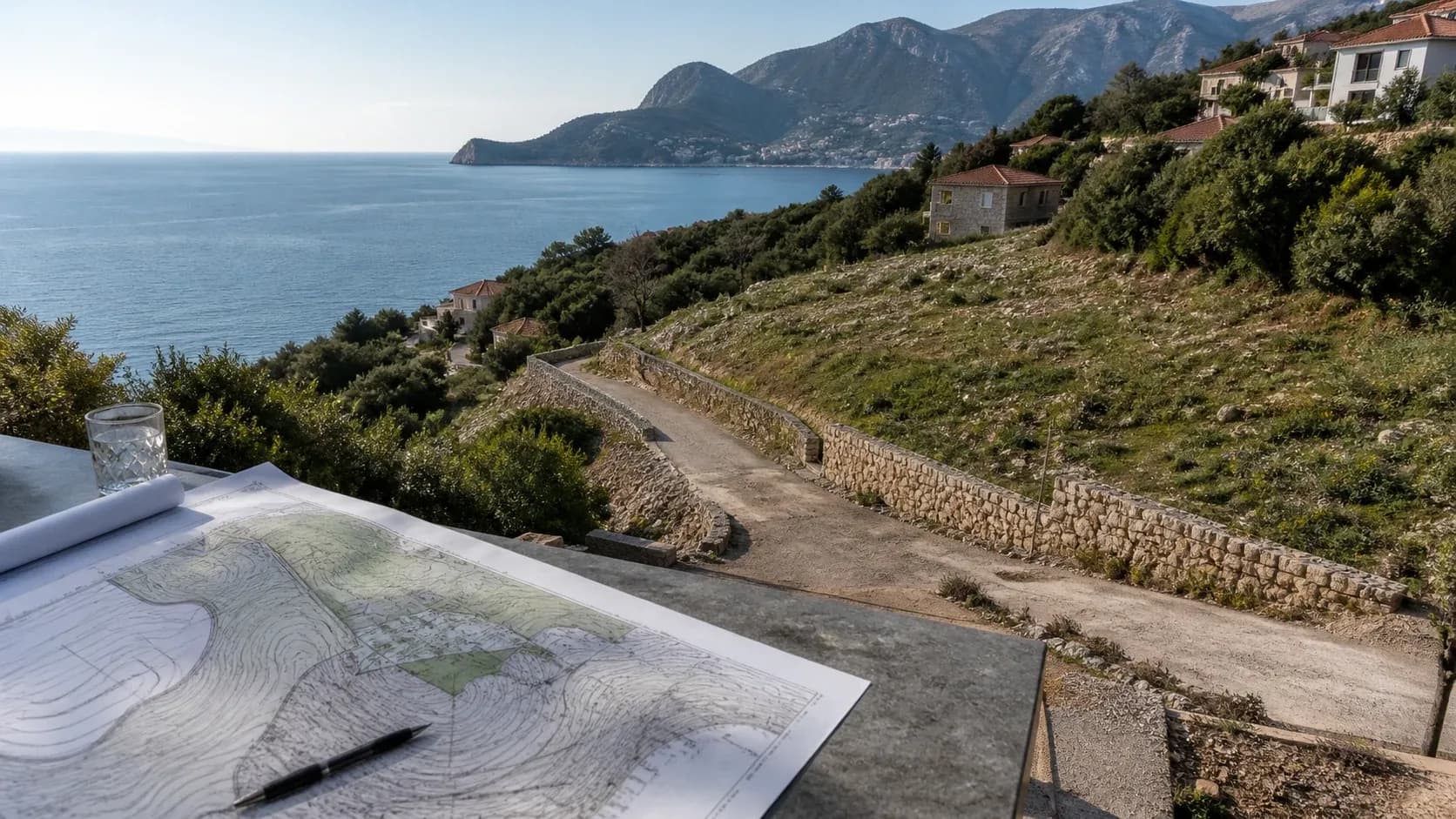
How to buy investment land in Montenegro: UTU, cadastre, and hidden costs
Investing in land in Montenegro requires the verification of the Urbanističko-tehnički uslovi (UTU) document, which defines construction parameters and access to infrastructure. A key element of due diligence is checking the Property Sheet (List Nepokretnosti) in the cadastre for legal encumbrances and the availability of a public road with state or municipal status. Site preparation costs depend on the slope of the land, the municipal utility fee, and the actual distance to the water and power supply networks. In the coastal zone, additional restrictions managed by Morsko Dobro apply, affecting architecture and the feasibility of the investment.


Article summary
The most important conclusions from the article in 30 seconds.
Investing in land in Montenegro requires the verification of the Urbanističko-tehnički uslovi (UTU) document, which defines construction parameters and access to infrastructure. A key element of due diligence is checking the Property Sheet (List Nepokretnosti) in the cadastre for legal encumbrances and the availability of a public road with state or municipal status. Site preparation costs depend on the slope of the land, the municipal utility fee, and the actual distance to the water and power supply networks. In the coastal zone, additional restrictions managed by Morsko Dobro apply, affecting architecture and the feasibility of the investment.
Purchasing land in Montenegro requires a different kind of due diligence than buying a ready-made apartment. The price of the plot, the sea view, and the seller's declarations are merely a starting point. Real investment value is determined by documents: current Urbanističko-tehnički uslovi (UTU), cadastre status, legal access to a public road, the possibility of connecting utilities, and restrictions resulting from local plans and the Morsko Dobro zone.
For an investor, the most important question is whether the plot actually allows for the construction of the type of building assumed by the financial model. The same plot of land may look similar on a map and in the field, but have a completely different value if one plot has current building conditions, access to a municipal road, and utilities at the border, while another requires easements, retaining walls, geological surveys, and a lengthy administrative procedure.
This article guides through three levels of verification: legal, planning, and technical. It shows how to read UTU, how to check the List nepokretnosti, when to treat a plot in the coastal zone with caution, how to estimate preparatory CAPEX, and when buying a ready-made apartment may be more rational than building on your own. Market context is important: Montenegro remains in accession negotiations with the European Union, and public institutions and international organizations are increasingly pointing to the need to organize spatial planning and limit informal development.
—
What is UTU in Montenegro and why is it the most important document?
UTU, or Urbanističko-tehnički uslovi (Urban and Technical Conditions), is a document that defines the technical and urban conditions for the use of a specific plot. In practice, this is the first document that should land on the desk of an investor analyzing land for a villa, a small apartment project, or a rental property. Without UTU, discussions about development potential rely mostly on declarations rather than binding parameters.
UTU shows whether the plot is located in a zone designated for construction, what the permitted functions are, what the maximum building height can be, how many floors can be designed, what part of the parcel can be built on, and what total gross floor area can be created. The investor should pay attention to two coefficients: indeks zauzetosti and indeks izgrađenosti. The first describes the permissible level of land occupancy by buildings, while the second determines the ratio of the total gross area of the building to the parcel area.
If a plot is 1,000 m² and the indeks zauzetosti is 0.3, it does not automatically mean that the entire project will have 300 m² of usable floor area. This is information about the footprint on the ground. Only by combining this parameter with the indeks izgrađenosti, the number of floors, height restrictions, building lines, and topography does one get a real picture of what can be designed. Therefore, the analysis of UTU should be carried out simultaneously by an architect and an investment advisor, rather than just by the salesperson.
The role of DUP and planning risk
DUP, or Detaljni Urbanistički Plan (Detailed Urban Plan), is a detailed urban plan for a specific area. Parameters transferred to UTU typically stem from this plan. Risk arises when the plan is outdated, suspended, amended, or when the plot is located in an area where planning documentation does not provide a clear answer. The mere fact that houses are being built in the neighborhood is not enough. An adjacent plot may lie in a different planning unit, have a different land class, or have different road access.
It is worth checking the documents in the planske dokumentacije registry and at the local secretariat for urban planning. The government's Urbanističko-tehnički uslovi section shows that UTU is a formal category of administrative documents, not a marketing description of land potential. In turn, local portals, such as the Secretariat of Podgorica, show the practical side of the process: applications, plans, permits, legalization, and utility fees are elements of a single administrative sequence.
How should an investor obtain and evaluate UTU?
The first step is parcel identification: plot number, cadastral municipality, municipality, and owner. Next, the investor or proxy submits an application to the relevant secretariat for urban planning. In practice, it is worth working through a local architect, as they can immediately see whether the document contains parameters useful for the project or just general references to the plan. The currency of UTU matters. If the document is a few months old or was issued before planning changes in the municipality, it must be confirmed whether it is still valid and whether a plan amendment procedure is underway.
The analysis of UTU should answer five questions. First, whether the plot is constructible in a planning sense, rather than just being marketed as buildable. Second, what building footprint and gross floor area are possible. Third, whether the permitted function matches the investor's model: vacation home, rental villa, apartments, small tourist facility. Fourth, whether infrastructure connection conditions are indicated. Fifth, whether there are landscape, conservation, environmental, or protection zone restrictions.
The lack of a current UTU does not automatically rule out a purchase, but it should change the valuation method. A plot without confirmed building conditions should not be compared one-to-one with a parcel that has a clear planning and technical status. In the financial model, a discount must then be applied for risk, waiting time, advisor costs, and the possibility of a negative decision.
—
How to check ownership status and legal access to a road?
The second pillar of due diligence is the cadastre. In Montenegro, the primary document is the List nepokretnosti (Real Estate Sheet), which is an extract from the real estate register. For an investor, this is the equivalent of a document that identifies the owner, property type, area, encumbrances, and restrictions. The official eKatastar portal provides access to cadastral data, and Uprava za nekretnine is also developing the electronic issuance of real estate sheets and ownership documents.
Most important is not only the section indicating the owner. Special attention must be paid to the section concerning encumbrances and restrictions, often described as Tereti i Ograničenja (Encumbrances and Restrictions). This is where mortgages, seizures, disputes, reprivatization notes, transfer restrictions, information about unpermitted buildings, or other entries that affect the ability to finance, sell, and build may appear.
1/1 ownership does not end the analysis
Investors often assume that if the seller is registered as a 1/1 owner, legal risk is limited. This is a premature conclusion. It should be checked whether the owner's data matches their identity document, whether there are warnings in the encumbrances section, whether the parcel boundaries correspond to the map, and whether the area declared in the offer matches the cadastral document. For larger plots, it is worth commissioning a surveyor to check the boundaries in the field, especially if the plot is sloped, partially overgrown, or borders a road, stream, or technical strip.
The next point is legal access to a public road. A physical road alone is not enough. Access may lead across a neighbor's private plot, via a road with unregulated status, or via a strip that does not meet design requirements. In the cadastre, it must be determined whether the plot has direct access to a road with state or municipal status, i.e., Država or Opština, or whether there is a properly established right of way, i.e., Službenost prolaza.
What happens when access is only customary?
Customary access means that locals all know which way is driven, but documents may not confirm this. For an investor building a house or a rental property, this is a serious problem. The lack of legal access can hinder or block permits, technical approvals, bank financing, and subsequent sale. It may also force the investor to negotiate easements with neighbors after purchase, when their bargaining power is weaker.
Road verification should cover three levels. The first is the legal status of the road corridor in the cadastre. The second is technical parameters: width, slope, surface, possibility of access for construction equipment and emergency services. In practice, a width of around 3.5–4 m can be a minimum starting point for discussion, but local conditions, the project, and agreements are binding. The third level is the cost of bringing the road up to the standard required by the project: drainage, retaining walls, slope stabilization, widening, and possible acquisition of land fragments.
A good practice is to include conditions precedent in the preliminary agreement. Example: the transaction is finalized after confirming the current List nepokretnosti, the absence of encumbrances in the Tereti i Ograničenja section, confirmation of access to a public road or the establishment of an easement, and obtaining an architect's opinion that the road parameters do not block the project. This is not a formality. It is a capital protection mechanism against buying a plot that cannot be used in accordance with the investment model.
—
How to estimate utility connection costs and the impact of terrain slope on CAPEX?
The third level of analysis concerns engineering and budget. Land sale offers often feature the phrase "utilities nearby." For an investor, this is not enough. It must be determined where exactly the water, electricity, and sewage networks are located, what the connection parameters are, who manages the infrastructure, whether there is free capacity, and what the cost will be of bringing utilities to the border and further to the designed building.
In Montenegro, utility analysis typically includes water (Vodovod), electricity (CEDIS or the relevant operator), sewage, a technological road for the contractor, and site drainage. In coastal regions, the difference between a plot with utilities at the border and a plot far from the network can be significant. One should ask not only about the straight-line distance, but about the actual route of the connection: whose land it crosses, whether it requires permits, whether it runs through a road, slope, stream, or protection zone.
When there is no sewage or water supply
The lack of sewage does not necessarily rule out a project, but it changes its cost, timeline, and technical obligations. In some locations, water tanks—locally referred to as bistijerna—are considered, or biological wastewater treatment systems and closed drainage solutions, if local norms and environmental conditions allow. Each of these solutions must be checked by the designer and approved by the relevant institutions. An investor should not assume that just because a neighbor used a similar solution, a new project will receive analogous approvals.
Electricity requires a separate calculation. If the nearest transformer has limited capacity or is far away, the investor may incur the cost of expanding a section of the network, the connection, or accompanying infrastructure. For a small vacation home, this may be acceptable. For several rental units or a villa with a swimming pool, heat pump, car charging station, and technical systems, this can change the entire CAPEX.
Terrain slope and retaining walls
On the Montenegrin coast, plots with sea views are often located on slopes. This can be a sales asset, but for the budget, it is a technical risk. A slope exceeding a dozen percent should trigger a detailed analysis of earthworks, equipment access, slope stability, drainage, and the costs of retaining walls, i.e., potporni zidovi. In regions such as Herceg Novi, Budva, or the Bay of Kotor area, geological surveys cannot be omitted, especially when the plot is located on a slope, near existing walls, old embankments, or areas with water issues.
Geological and geotechnical surveys are not a cosmetic cost. They make it possible to determine the type of soil, water table, need for reinforcement, building foundation method, and the risk of landslides, i.e., klizišta. If the project assumes an underground garage, a swimming pool, multi-level terraces, or large glazing facing the sea, the structural budget may grow faster than a simple cost estimate per square meter assumes.
How should an investor estimate preparatory CAPEX?
An initial model should separate the land price from project startup costs. Basic items include: surveyor, current List nepokretnosti, UTU analysis, architect's opinion, geological surveys, project concept, infrastructure approvals, connections, road, drainage, utility fee, and reserves for the executive design and supervision. Only the sum of these elements shows the real entry price.
If the seller provides a price per square meter of land, the investor should convert it per square meter of possible gross floor area resulting from UTU, and then per square meter of realistic usable area after accounting for circulation, walls, terraces, garage, and local restrictions. Only such a conversion allows comparing the land with a ready-made apartment or a development project that can be purchased via Montenegro real estate offers available at PlanoGroup.
—
Morsko Dobro zone restrictions and architectural standards
A plot by the sea requires a different due diligence logic than a plot located inland. In the first sea line and in zones associated with marine assets, not only the local plan and cadastre are important, but also restrictions managed by JP Morsko Dobro. This institution is responsible, among other things, for planning, arrangement, and control of the marine asset area, preparation of urban-technical conditions, and supervision of the use of the zone.
For an investor, this means the necessity to check whether the land lies in a zone where additional landscape, environmental, material, or usage conditions apply. It may turn out that the plot formally belongs to a private owner, but its use is subject to restrictions resulting from proximity to the shore, buffer zone, technical strip, landscape protection, or public access.
The first sea line does not always increase development potential
Seaside land valuation often rewards proximity to the shore. However, the investor should separate the value of the view from the value of development. A plot located closer to the sea may have lower design flexibility than land located slightly further away, but with better access, higher development parameters, and simpler infrastructure. In coastal zones, it is necessary to check regulatory lines, construction bans, permissible materials, color schemes, the relationship of stone, plaster, and stucco on the facade, roof geometry, and requirements regarding preserving the character of Mediterranean architecture.
This is not about aesthetics detached from finance. Architectural restrictions affect project cost, availability of contractors, approval time, and subsequent sales liquidity. If the market expects a villa with large glazing and a flat roof, but local conditions dictate other solutions, the investor must know this before purchasing. Otherwise, the sales or rental model is built on assumptions that cannot be realized.
Utility fee and site preparation cost
The cost analysis also includes the utility fee, often referred to as komunalije or naknada za komunalno opremanje. It is related to equipping the area with infrastructure and can depend on the municipality, zone, planned development area, and local rates. One should not assume a single amount for all of Montenegro. Budva, Tivat, Kotor, Herceg Novi, Bar, Ulcinj, or Podgorica may have different practices, different speeds of proceedings, and different planning priorities.
From a tax perspective, an investor should distinguish transaction costs from project preparation costs. According to PwC Tax Summaries, the real estate transfer tax in Montenegro is progressive and ranges from 3-6%, and the annual real estate tax for legal entities is indicated as 0.25-1% of market value. These values do not replace an individual tax analysis, but they show that the acquisition budget and implementation budget must be calculated separately.
—
Land or ready-made apartment – profitability and risk analysis
Buying land gives an investor greater control over the final product, but shifts more risk onto them. A ready-made apartment or a unit in a development project usually has a shorter entry time to rental, greater cost predictability, and a simpler management model. Land allows building margin at the product creation stage, but requires coordinating administration, design, construction, supervision, and sales or rental.
The build-to-sell model makes sense when the investor buys land below real project value, knows construction costs, has a local team, and can assess demand for a specific product. The build-to-hold model—building for personal maintenance and rental—requires yet another calculation: cost of capital, rental seasonality, property management, technical service, taxes, renovation reserves, and exit liquidity are just as important as the land price.
Higher margin is not synonymous with lower risk
Self-construction can provide greater influence over the standard, layout, area, and positioning of the property. It can also allow for Capital Appreciation—the increase in asset value due to changing its state from raw land to a finished product. However, potential must not be mistaken for a guarantee. Every month of delay, increase in material prices, road problem, change in administrative requirements, or error in demand assumptions lowers project performance.
With a ready-made apartment, due diligence is simpler, though still necessary. The investor checks the legal status, developer, permits, standard, Service Charge, rental operator, maintenance costs, and actual occupancy data. With land, they must additionally check constructibility, infrastructure, geology, access, UTU, utility fees, and contractors. Therefore, comparing ROI between land and an apartment only makes sense if it includes the full cost of operational risk.
Exit liquidity: what is easier to sell?
A ready-made apartment in a good location, with clear documentation and a functioning rental model, usually has a wider group of buyers than a plot of land with an architectural concept. A plot with a project may be interesting for a more advanced investor, but for a passive buyer it means further work and risk. This affects exit liquidity.
If the strategy assumes selling after a few years, the question must be asked: who will be the natural buyer. A different profile will buy an apartment in Tivat, another a villa in Budva, and another a plot for development in Herceg Novi. Analyzing real estate prices in Montenegro helps grasp the market context, but does not replace comparing a specific location, development parameters, and document quality.
When is it better to buy several ready-made units than to build one villa?
For some investors, it may be more rational to buy two or three ready-made apartments instead of one plot of land and building a large villa. Such a model provides diversification of locations, rental types, and market entry dates. It also reduces dependence on a single permit, a single contractor, and a single sales strategy. On the other hand, self-construction may make sense if the investor has a high risk tolerance, a proven local team, and wants to create a product that is missing from the current supply.
The decision should not stem from a simple comparison of land price and apartment price. It should stem from comparing the total cost of reaching the product, the time capital is frozen, administrative risk, exit liquidity, and rental potential. In this sense, the article on the profitability of investing in Montenegro can be a starting point, but for land, a separate technical layer is needed.
—
Due diligence before purchase: budget and questions for experts
Land due diligence in Montenegro should end with a short decision-making report. This is not about a collection of documents for the sake of order. It is about answering whether the plot meets the investor's criteria, what risks need to be priced, and what conditions should be included in the contract. A good report combines the perspectives of a lawyer, architect, surveyor, tax advisor, and a person familiar with the local rental or sales market.
Framework preparatory budget
The editorial table below can be reproduced in the CMS as a preparatory cost table.
| Cost area | What to check | Why it influences the decision |
|---|---|---|
| Land price | price per m² of land and price per m² of potential gross floor area | shows whether the land is actually cheaper than the finished product |
| Tax and transaction costs | transfer tax, notary, translator, registration | allows you to calculate the total cost of entry, not just the asking price |
| Surveyor and cadastre | property boundaries, title deed (List nepokretnosti), compliance of the map with the terrain | limits the risk of a boundary dispute or incorrect area |
| UTU and the Architect | building density indices, height, function, building lines | shows whether the investor's project is feasible in terms of spatial planning |
| Geological surveys | bearing capacity of the soil, groundwater, slope stability, landslide risk | affects the foundations, retaining walls, and construction budget |
| Media and drugs | distance from the network, road status, easements, capacity | determines the schedule, costs, and feasibility of the project |
| Investment reserve | minimum 10-15% for delays, price changes, and unforeseen work | protects the financial model against overly optimistic cost estimates |
Questions for the Architect
Before signing the contract, the investor should ask the architect whether the DUP is valid and up-to-date, whether the UTU refers to the correct plot, what the actual height of the building is after taking into account the terrain slope, whether the allowable number of floors permits the expected layout, whether the terraces, garage, and swimming pool fit within the parameters, and whether the municipality is planning roads, expropriations, or plan changes in the vicinity.
It is also worth requesting a quick concept test. The architect should draw not only the maximum building mass from the document, but also a realistic variant: with access, parking, walkways, technical rooms, slopes, retention, and privacy zones. Only such a sketch shows whether the potential from the UTU can be translated into a property that the market will accept.
Questions for the Lawyer
The lawyer should confirm whether the seller has full authority to dispose of the property, whether the ownership is 1/1, and whether the encumbrances section is free from mortgages, claims, transfer restrictions, or entries regarding illegal construction. They should also check whether easements are sufficiently registered, whether the access road has a legal basis, and whether the contract can include suspensive conditions protecting the buyer.
If the transaction concerns a larger plot of land, it is worth checking whether the purchase by an individual is the best structure. In some cases, a local company may be needed, especially when agricultural land, development activity, or a broader commercial project is involved. The decision on the ownership structure should be made before signing the contract, as a subsequent change can generate tax and organizational costs.
Questions for the Investment Advisor
The advisor should test three scenarios: baseline, conservative, and negative. In the baseline scenario, it is assumed that the UTU and road are confirmed, and the budget is within the plan. In the conservative scenario, administrative delays, higher earthworks costs, and a longer sales or rental period are added. In the negative scenario, it is checked whether the investor can still exit the project without excessive loss if permits, utilities, or demand turn out to be weaker than assumed.
Due diligence prepared in this way changes the conversation about the plot. The investor no longer asks only whether the land has a view and a good price. They ask how much it costs to bring it to an investment-ready state, how long it will take to obtain the decision, what plan B is, and whether the same amount of money could work more efficiently in ready-made units. This is the difference between an emotional purchase and a data-driven purchase.
—
What should you consider before buying land in Montenegro?
Buying investment land in Montenegro requires a much broader analysis than simply comparing available listings. Before making a decision, it is important to verify the documentation, the property's cadastral status, development possibilities, road and utility access, technical conditions, and the potential costs of the investment. Depending on the characteristics of the plot, consulting a local lawyer, architect, or other specialist may also be necessary.
Most importantly, the purchase decision should not be based on a single advantage, such as the view, a seafront location, the price per square metre of land, or a declaration that the plot can be developed. A thorough analysis should take into account factors such as UTU parameters, ownership status, road access, utilities, geology, municipal fees, taxes, the expected development timeline, and the exit strategy. Only by considering these elements together can the investment potential of a plot be realistically assessed.
If you are considering a real estate investment in Montenegro, it is worth comparing the different opportunities available on the market – from purchasing land and developing a project independently to ready-to-use properties and developments offered by established developers. PlanoGroup presents selected investment opportunities in Montenegro, including properties in Luštica Bay. Contact us if you would like to discover the current properties in our portfolio and discuss investing in Montenegro.
FAQ
Is every plot of land with a sea view suitable for construction?
No. A sea view affects demand and the perception of the location, but it does not determine the possibility of construction. This is decided by the UTU, local plan, land status, road access, infrastructure, and potential restrictions of the Morsko Dobro zone. A plot may have a good view while simultaneously having poor access, lack of utilities, landslide risk, or building parameters inconsistent with the investor's plan.
Before buying, you need to check whether the documents allow for a specific project: how many floors, what height, what gross area, what function, and where the building can be positioned. Without this information, the price of the land is only a price for the dirt, not for the ready investment potential.
Does the lack of sewage systems rule out the purchase of land?
Not always, but it requires a separate technical and environmental analysis. In some locations, biological wastewater treatment systems, septic tanks, or other locally permitted solutions can be considered. However, the key is whether such a solution will be accepted by the designer and the relevant institutions, and whether its cost does not destroy the financial model.
Why is access so important for land?
Access is one of the conditions for the feasibility of the project. If the plot does not have legal access to a public road or a properly established easement, the investor may have problems with permits, financing, construction, technical maintenance, and subsequent sale. A road visible in the field is not enough if its status does not result from documents.
Should an architect inspect the plot before purchase?
Yes. The architect should analyze the UTU, the plan, topography, sunlight, views, neighboring buildings, road, utilities, and technical constraints. Document analysis alone is not always enough, because in Montenegro the terrain can significantly change the construction cost. A plot on a slope may require retaining walls, special foundations, additional drainage, and a different organization of the construction site.
How to minimize risk when purchasing land?
An effective method is a combination of legal, planning, and technical audits. A lawyer checks ownership, encumbrances, and the contract. The architect analyzes the UTU, DUP, height, function, and design feasibility. A surveyor verifies boundaries and the map. A technical advisor or project manager assesses utilities, the road, slope, geology, and the cost of site preparation. An investment advisor compares the result with the alternative of ready-made apartments.

Author
Patrycja Kordys
BOARD MEMBER | SALES DIRECTOR
For nearly 17 years, she has been associated with the premium real estate market. She gained her experience working with international clients—particularly German and English speakers—ensuring the highest standard of service and communication. After years of working on the Costa del Sol, she now focuses on the dynamically developing market of Oman, where she supports clients in discovering new investment opportunities and lifestyles. She combines professionalism with a natural ease in building relationships, ensuring that the purchasing process is smooth and stress-free.

Related articles
How to buy real estate in Montenegro? A complete guide
Real estate prices in Montenegro – how much does an apartment cost and is it worth investing?
Is it worth investing in real estate in Montenegro?