


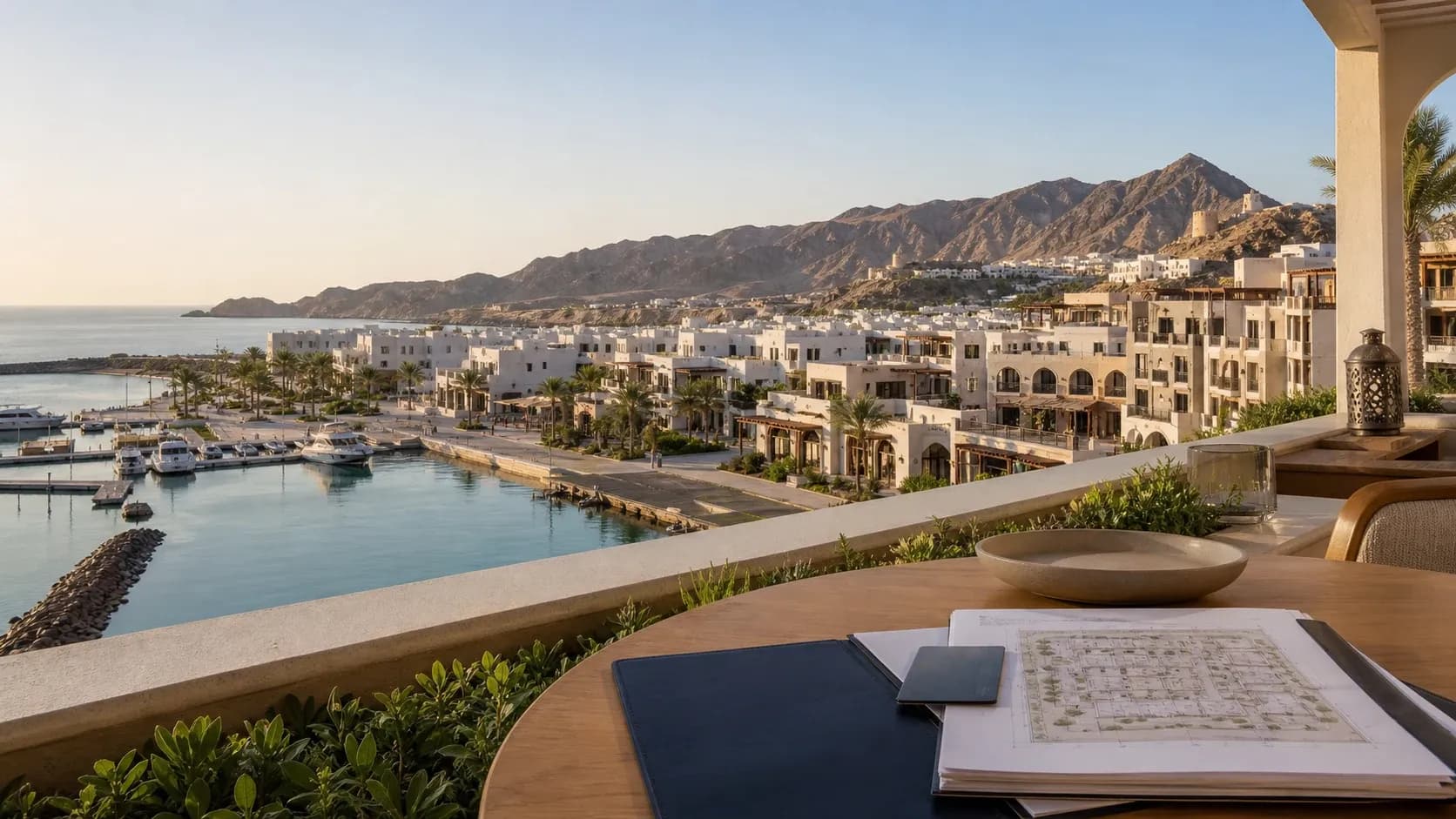
ITC in Oman: what does it mean for a foreigner buying property?
ITC in Oman is a key legal status for a real estate project, which is of particular importance to foreigners planning to purchase an apartment, villa, or investment property. It is the Integrated Tourism Complex status that determines whether a foreign buyer can obtain ownership rights, sell the property, rent it out, pass it on to heirs, and potentially apply for residency in Oman. Before making a decision, an investor should check not only the price and location, but above all, the documents confirming the ITC status, the type of legal title, registration rules, rental possibilities, maintenance costs, and exit conditions. A purchase within an ITC can be a safer and more transparent path for a foreign investor than a purchase outside a designated zone, but every decision should be preceded by thorough due diligence of the project, the developer, and the SPA agreement.


Article summary
The most important conclusions from the article in 30 seconds.
ITC in Oman is a key legal status for a real estate project, which is of particular importance to foreigners planning to purchase an apartment, villa, or investment property. It is the Integrated Tourism Complex status that determines whether a foreign buyer can obtain ownership rights, sell the property, rent it out, pass it on to heirs, and potentially apply for residency in Oman. Before making a decision, an investor should check not only the price and location, but above all, the documents confirming the ITC status, the type of legal title, registration rules, rental possibilities, maintenance costs, and exit conditions. A purchase within an ITC can be a safer and more transparent path for a foreign investor than a purchase outside a designated zone, but every decision should be preceded by thorough due diligence of the project, the developer, and the SPA agreement.
Can a foreigner buy property in Oman?
Yes, but for an investor from Poland, the most important question is: is the project located in an Integrated Tourism Complex (ITC)? ITC status is more important than the view from the window, the developer's brand, or the waterfront location itself, because it determines what legal title the buyer receives, whether they can sell the asset, how registration works, and whether the purchase can open a path to residency. This guide explains five areas: what an ITC is, what rights it gives the buyer, how it differs from usage outside an ITC, how it relates to staying in Oman, and what to check before paying a reservation fee. In the background, one must keep the GMSP in mind: the Greater Muscat Structure Plan assumes an increased role for tourism, mixed-use development, and designated investment zones, and Vol. 3 indicates an increase in the number of ITCs in Muscat from 4 to 8.
A good supplement to this text is the PlanoGroup guide: if and how a Pole can buy property in Oman.
—
What does ITC mean in Oman and why does it matter to a foreigner?
Legal status of the project, not a marketing slogan
ITC stands for Integrated Tourism Complex. In practice, this is not a description of the estate's aesthetics, but a legal category of the project in which a foreigner can purchase property under different rules than in a standard residential investment. Gov.om describes the ITC license as a service based on the property ownership system in Integrated Tourism Complexes issued under Royal Decree No. 12/2006 and the implementing regulations of Ministerial Decree No. 191/2007. For an investor, this means that due diligence begins with the document confirming the project's status, not with a sales brochure.
Step by step before discussing the price:
- check if the project has formal ITC status and who issued the confirmation;
- determine who the developer, operator, and landowner are;
- ask for the document qualifying the project as an ITC, not just a sales folder;
- verify whether you are buying freehold, usufruct, or another title;
- ask how the registration of the right looks at the appropriate office.
More about the purchasing process can be found in the PlanoGroup text: how to buy property in Oman.
—
What rights does purchasing property in an ITC project give?
Ownership, sale, inheritance, and rental
A purchase in an ITC usually gives a foreign buyer a wider range of control over the asset than a purchase outside a designated zone. In practice, an investor analyzes four rights: the ability to own property in the zone, the ability to sell, the ability to transfer rights to heirs, and the ability to rent according to the project's regulations. This matters for ROI, capital appreciation, and exit liquidity. However, ITC status alone does not mean that every SPA (Sales and Purchase Agreement) will be favorable. What counts is the exact wording of the legal title, the registration schedule, and the management rules after handover.
What to check in the documents:
- the type of right entered in the SPA and registration documents;
- whether the subject of the purchase is a unit, villa, land, or a share in a larger project;
- rules for resale and potential assignment before handover;
- restrictions on short-term and long-term rentals;
- the final document confirming the right to the property.
From a second-home perspective, it is worth combining legal analysis with maintenance costs, which is why the PlanoGroup text on the costs of living and maintenance in Oman is also useful.
—
Does a purchase in an ITC grant the right to stay in Oman?
Residency for the owner and family: what to check before deciding
Purchasing property in a tourism zone may be linked to a residency path, but one should not write or assume that residency is automatic. The official Oman Golden Residency website indicates owning property in tourism zones as one of the qualifying paths. Meanwhile, a 2025 announcement from the Ministry of Commerce, Industry and Investment Promotion describes Golden Residency as a tool for investors and indicates a threshold of OMR 200,000 for the investment program. Before purchasing, you must check the current program regulations on the date of application, as thresholds, documents, and validity periods can change.
Before paying a reservation fee, ask:
- whether the given property lies in a zone that qualifies for residency;
- what minimum investment value applies to the chosen path;
- whether the application can include a spouse and children;
- what documents are required: legal title, proof of payment, KYC, insurance, family documents;
- whether selling the property affects the renewal of residency.
—
How does ownership in an ITC differ from usage outside an ITC?
Freehold, usufruct, and practical consequences for the investor
The simplest distinction is this: for many foreign buyers, an ITC is a clearer path to owning property in a designated zone, whereas outside an ITC, structures based on the right of usage, i.e., usufruct, may appear. Dentons analysis regarding Ministerial Decision 357/2020 indicates that a non-GCC foreigner can, under certain conditions, acquire the usufruct of a unit in a multi-story mixed-use building outside an ITC for a period of up to 50 years, with the possibility of extension to 99 years. This right may allow for use and income generation, but it is not the same as ownership in an ITC project.
Practical list of questions:
- does the document speak of freehold, usufruct, or another title;
- for how long is the right granted and can it be extended;
- can the right be sold, when, and under what conditions;
- how does inheritance or the transfer of rights to heirs work;
- will a bank accept this title for financing?
For an investor comparing Oman with Dubai, it is also important that in Dubai, the concept of freehold areas is more widely known in the market, while in Oman, ITCs serve a similar function for many projects. However, procedures and contracts should be read according to local regulations.
—
Legal risks when purchasing in an ITC project
Not every project with a good sales presentation has the same safety profile
The most common risks do not stem from the ITC concept itself, but from the documents. An investor should be wary of a lack of clear confirmation of ITC status, imprecise SPA clauses, the lack of a registration schedule, rental restrictions, unclear Service Charge breakdowns, and a lack of information about the operator after the project is handed over. For off-plan, one must check the escrow account separately. Trowers Hamlins describes Omani escrow laws as a mechanism regulating the developer's access to buyer's funds in development projects.
The price per m² is only one parameter. Before deciding, compare:
- legal title and land status;
- developer, operator, and construction stage;
- conditions for resale, assignment, and delays;
- Service Charge after handover and the scope of common services;
- real rental model: operator, self-management, long-term or short-term rental.
A broader investment context for Muscat is described in the PlanoGroup article on the stability of the real estate market in Muscat.
—
Investor checklist before purchasing property in an ITC
Documents, questions for the developer, and red flags
- Does the project have formal ITC status? Ask for the document, not just the seller's declaration.
- What document confirms this? Check the name of the authority, the date, and the scope of approval.
- Are you buying a finished unit, off-plan, or a share in a project? The payment schedule and execution risk depend on this.
- When does registration of the right occur? Determine whether registration is after the SPA, after handover, or after full payment.
- What are the costs upon purchase? Compare registration fees, legal costs, and potential commissions.
- What are the annual maintenance costs? Ask for the Service Charge, indexation rules, and the common area budget.
- Can you rent out the property? Check the project's regulations, operator model, and licensing requirements.
- Can you sell before handover? Ask about assignment, administrative fees, and developer consent.
- Does the purchase qualify for residency? Verify the current program conditions, not materials from a year ago.
- What happens to the owner's rights in the event of death? Determine the inheritance procedure and documents required by the project.
3 questions before paying a reservation fee
- Does the ITC status cover exactly this phase and this type of property?
- Do funds from off-plan payments go into an escrow account or another controlled account?
- What does the exit from the investment look like: resale, rental, assignment, residency, and costs after handover?
Upon handover of a finished unit, it is worth using a separate technical checklist. The PlanoGroup text on handing over property from a developer in Oman will be helpful.
—
How does an ITC fit into the development of Muscat according to the GMSP?
The Greater Muscat Structure Plan shows that ITCs do not function in a vacuum. Vol. 1 assumes an increase in the population of Greater Muscat from 1.4 million in 2022 to 2.7 million in 2040 and an increase in the number of jobs from 890,000 to 1.83 million. Vol. 3 describes tourism, mixed-use districts, and special economic designations as an element of growth, and explicitly points to the planned increase in the number of Integrated Tourism Complexes in Muscat from 4 to 8. For an investor, this means that ITC analysis should include not only the property itself but also the project's position relative to the airport, MICE, Al Mouj, Madinat Al Irfan, public transport, services, and planned tourism zones.
The official description of the Greater Muscat structural plan can be checked on the Ministry of Housing and Urban Planning website.
—
How can PlanoGroup help with ITC analysis?
If you are considering purchasing property in Oman and want to check whether the chosen project truly meets ITC conditions, the PlanoGroup team can analyze the documents, investment status, maintenance costs, and risks written into the SPA. Support includes choosing a location and developer, verifying the contract, the registration process, and property management after purchase.
See current properties in Oman in the PlanoGroup offer or go to contact PlanoGroup.
—
FAQ
Is every beachfront property in Oman an ITC project?
No. Being located by the sea does not automatically mean ITC status. The investor should ask for a document confirming the project's qualification and check whether it applies to a specific phase, building, and property type. Only then can price, ROI, and rental potential be analyzed.
Can you rent out property purchased in an ITC?
Usually, this is possible, but the rules depend on the project's regulations, the operator, and the SPA clauses. Before purchasing, it must be determined whether short-term rental, long-term rental, a hotel model, or only management by a designated operator is allowed. This has a direct impact on yield and owner costs.
Does a purchase in an ITC mean Omani citizenship?
No. Purchasing property may be linked to a residency path, but it does not grant automatic citizenship. Residency programs have their own thresholds, forms, family criteria, validity periods, and renewal conditions.
What documents need to be checked before signing an SPA?
You should check the ITC status, legal title, developer documents, payment schedule, registration rules, purchase fees, Service Charge, rental possibility, right to resell, and the procedure in case of delay. For off-plan, you must check the escrow account rules separately.
Is an ITC better than purchasing outside an ITC?
For many foreign investors, an ITC is easier to evaluate because it was designed with non-Omani buyers in mind. Purchasing outside an ITC may be possible under other structures, for example, through usufruct, but it requires a more thorough analysis of the right's duration, restrictions, and exit rules.

Author
Beata Cieślukowska
COO / FOUNDER
For over 17 years, she has been supporting clients in investing in premium real estate, with a particular focus on investment apartments and condo-style projects. Over the years, she has built her position in the Costa del Sol market, where she helped clients select properties that combine lifestyle with investment potential. Today, she is developing PlanoGroup, expanding operations into international markets – including Oman and other investment destinations. She combines experience, market intuition, and an individual approach, which allows her to match a property not only to a budget but, above all, to the client's goal.

Related articles
How to buy property in Oman: 5 tips for buyers


Cost of living in Oman in 2025 – what is an expat's monthly budget?

Why is Muscat the most stable real estate market in the Gulf? Analysis 2020–2025