


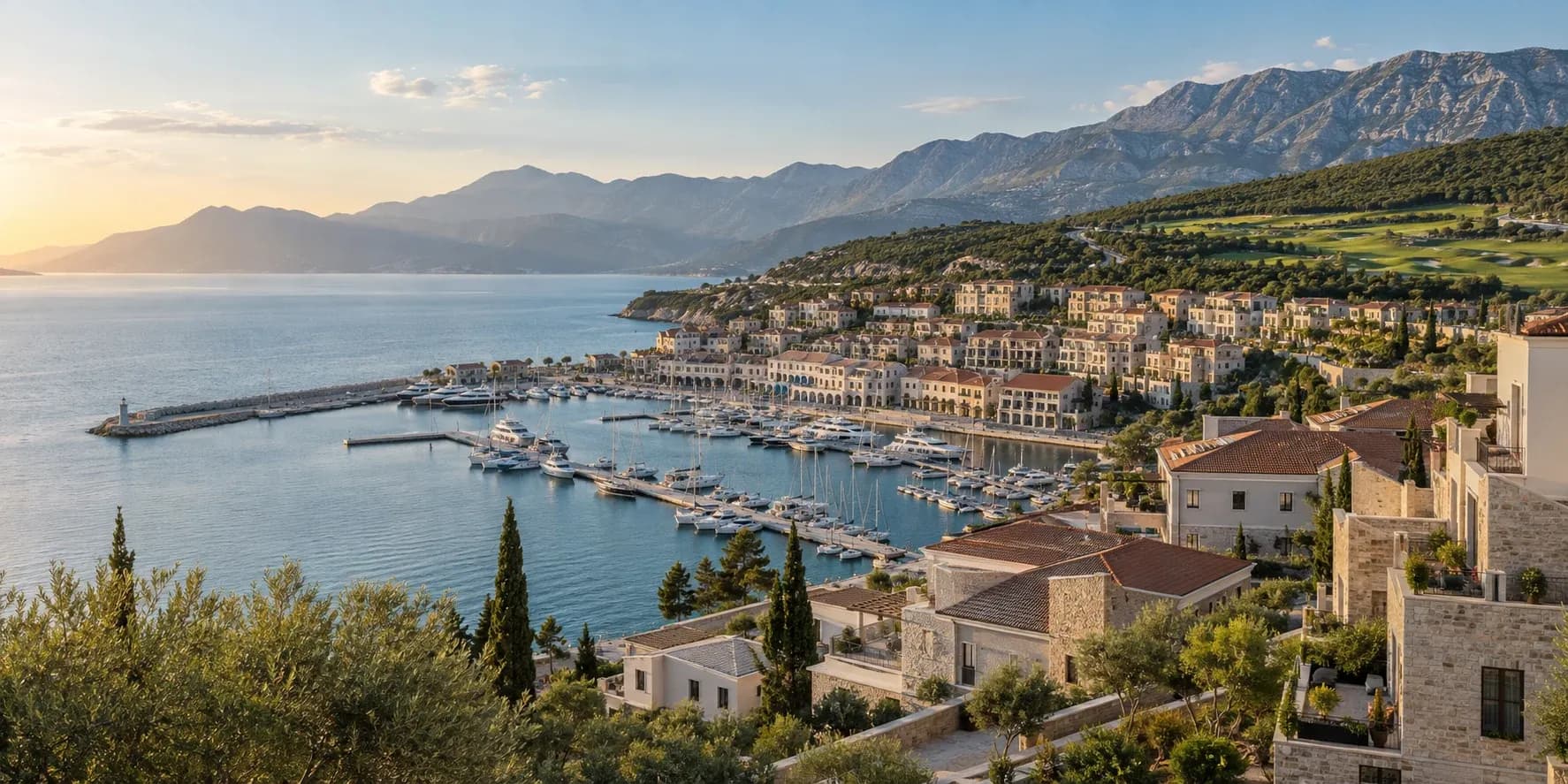
Investing in real estate in Montenegro: how to analyze Luštica Bay before buying?
Luštica Bay must be analyzed as a managed micro-market, not as a single apartment with a view. The investment outcome is determined by the master plan, construction phase, service charge, rental operator, Owner Usage rules, fit-out costs, legal documents, and real resale liquidity. The article shows how to read the phasing map, calculate Net ROI after costs, check the Rental Pool, assess resort infrastructure, and prepare a checklist of documents before booking. The conclusion is simple: Luštica Bay can make sense for a premium investor if the decision is based on numbers, documents, and risk scenarios rather than just the view. Variant stress tests are particularly important: a weaker season, higher costs, and an earlier exit from the investment.


Article summary
The most important conclusions from the article in 30 seconds.
Luštica Bay must be analyzed as a managed micro-market, not as a single apartment with a view. The investment outcome is determined by the master plan, construction phase, service charge, rental operator, Owner Usage rules, fit-out costs, legal documents, and real resale liquidity. The article shows how to read the phasing map, calculate Net ROI after costs, check the Rental Pool, assess resort infrastructure, and prepare a checklist of documents before booking. The conclusion is simple: Luštica Bay can make sense for a premium investor if the decision is based on numbers, documents, and risk scenarios rather than just the view. Variant stress tests are particularly important: a weaker season, higher costs, and an earlier exit from the investment.
Luštica Bay should be read not as a single apartment with an Adriatic view, but as a managed micro-market. The unit price, rental potential, and resale liquidity depend here on several layers at once: the masterplan, the construction phase, the operator's quality, common area costs, resort infrastructure, air connectivity, and the profile of buyers who will compete for similar units in the future.
For a Polish investor, this is important because Montenegro is a market outside the European Union yet close to Europe, with transactions settled in euros and the growing recognition of the Tivat and Boka Kotorska bay region. The European Commission classifies Montenegro as an EU candidate country, and MONSTAT publishes quarterly apartment price data for new buildings. These signals help assess the market background, but they do not replace an audit of a specific building, the contract, and the rental management model.
This article shows how to analyze Luštica Bay before buying: from reading the masterplan and service charges, through Rental Pool and Owner Usage, to Net ROI, legal documents, and a stress test for a second home. The starting point can be the Luštica Bay offer at PlanoGroup, but the investment decision should be based on current developer documents, operational data, and a comparison with real resale offers.
—
How to read the Luštica Bay masterplan and why it matters more than the apartment floor plan?
In a resort project, an apartment floor plan is just one of the documents. The second, often more important one, is the masterplan. It shows not only the current development, but also future supply, traffic flows, planned services, the neighborhood of subsequent phases, and infrastructure elements that can change the character of a specific address. In Luštica Bay, you need to check whether the purchased unit is located next to a completed part of the resort or near an area that will be a construction site for several years.
The Phasing Strategy affects three things: user comfort, the ability to generate rental income, and potential exit liquidity. An apartment from the first phase may gain in recognition when subsequent parts of the resort deliver restaurants, services, a golf course, internal transport, and higher guest traffic. However, the same apartment may temporarily suffer from noise, heavy transport, limited privacy, or a view of unfinished plots.
Therefore, an investor should ask not only for the floor plan, but also for the current phasing map. In practice, it is worth asking the developer a few simple questions: what will be built within a 100-300 meter radius of the unit, when earthworks are planned, whether another building could obstruct the view, where service roads and internal transport will run, and which infrastructure elements are already operational and which remain in the planning stage.
The Official Luštica Bay website describes the project as a waterfront town with a marina, hotels, various residential neighborhoods, and services. This is a good framework for analysis, but the investor should translate it into specifics: whether the unit is closer to the marina, the Centrale town center, the quieter Horizon part, or The Peaks area. The difference is not purely aesthetic. It affects the tenant profile, frequency of use, traffic exposure, and the likely buyer group upon resale.
The masterplan must also be read as a supply map. If many similar units are to appear in the same part of the resort in coming years, the investor should check whether their apartment has a defensive feature: a better view, a corner layout, a larger terrace, closer proximity to services, quietness, or easier parking access. Without such a distinguishing feature, secondary market sales may have to compete primarily on price.
A good exercise is to create your own masterplan risk table. In the first column, enter the planned element: building, road, beach club, marina, school, golf course, hotel, service center. In the second column, enter the impact on the unit: noise, privacy, view, tenant demand, pedestrian traffic, resale potential. In the third column, enter the confirming document: phasing map, schedule, permit, contract annex, or written confirmation from the developer.
This approach changes a purchase from an emotional choice of a view into an urban planning audit. In resorts like Luštica Bay, it is precisely the quality of urban planning, the sequence of phases, and the management of common space that create an advantage over a single building in Budva or Kotor. A view may sell a first impression, but the masterplan determines whether the asset will make sense after five, ten, and fifteen seasons.
—
What to check in owner fees and what is really included in the service charge?
A service charge in a resort project is not a regular administrative fee. It is the price of maintaining the entire environment meant to support rentals, resale, and private use. In Luštica Bay, it may include security, reception, common area cleaning, gardening, technical infrastructure maintenance, lighting, beach management, marina elements, internal roads, security systems, common area insurance, and community administration.
The investor's first mistake is comparing the per-square-meter rate alone without the scope of services. A lower fee does not always mean a better outcome if it leads to neglected common areas, poorer tenant service, or weaker resale liquidity. A higher fee is not automatically justified if it is unclear what services it finances and whether the budget is regularly accounted for.
Therefore, before booking, you must request the current 12-month operating budget for the given phase or community. You are interested not only in cost categories, but also in their volatility. Ask which items are fixed, which depend on occupancy, which may increase after subsequent resort elements are delivered, and whether owners have a say in approving the budget. Also check whether the service charge is calculated based on internal area, gross area, exterior space, or the share of common areas.
The second layer is the Sinking Fund, i.e., the renovation fund. In a coastal climate, material wear and tear is faster than in urban buildings. Salt, moisture, intense sun, tenant use, and seasonal occupancy spikes affect facades, railings, terraces, air conditioning, woodwork, and furnishings. If the renovation fund is too low or non-existent, future work may require one-off special assessments.
The third layer is costs excluded from the fee. The financial model should separately account for utilities, internet, unit insurance, local taxes, furniture refreshing, post-tenant repairs, accounting costs, payment commissions, and potential owner management. The fact that a given resort has a high standard of common areas does not mean all costs are bundled into a single flat rate.
The practical method is simple: build a "zero rental" cost model. Check how much it costs to maintain the unit when there is zero revenue all year round. Only then add occupancy scenarios. Thanks to this, the service charge ceases to be a minor item in a table and becomes an investment stress test. If the asset does not hold up under a conservative revenue assumption, a better view will not solve the problem.
It is also worth comparing Luštica Bay with other projects in the Tivat and Boka Kotorska region, but the comparison must involve similar standards. A building without a beach, without a marina, without a reception, and without sports infrastructure is not the right benchmark for a managed resort. A better point of reference is a project with a similar scale of services, even if located in a different part of the coast. The goal is not to find the lowest fee, but to understand whether you are paying for the real preservation of asset quality.
—
How rentals work: a managed portfolio or a standalone battle for clients?
The rental model in a resort determines whether an apartment is an operating asset or just a seasonal second home with occasional income. In Luštica Bay, an investor should distinguish between three possible approaches: Rental Pool, individual management by the operator, and independent rentals outside the resort structure, provided it is allowed by the documents.
A Rental Pool usually means that units of a similar category are treated as part of a shared portfolio, and revenue is distributed according to a specific key. The advantage is operational predictability and less dependence on whether your specific apartment happens to be chosen by a guest. The disadvantage can be limited control over pricing, the calendar, and usage methods. In individual management, the result may depend more on the quality of a specific unit, the view, layout, fit-out standard, and pricing flexibility.
An agreement with an operator must be read like a business contract. You need to check the gross revenue commission, the scope of services included in that commission, cleaning costs, linen and towel replacement costs, marketing, check-in handling, booking platform fees, cancellation policy, payout terms, minimum furnishing standards, and rules for damage repair. The commission rate itself means nothing if you do not know what it covers.
Owner Usage clauses are particularly important. Many investors buy a unit as a second home, but want to use it in July and August. These are usually the most valuable rental weeks. If the owner blocks the calendar during peak season, the financial model must reflect this. The unit may still make investment sense, but ROI cannot be calculated as if the apartment were available to guests during all the most profitable periods.
Another question concerns booking priorities. If the resort operates a hotel, owner apartments, and other rental units, it is necessary to determine how the operator distributes demand. Do they fill hotel rooms, their own portfolio, apartments of a certain standard, or all units according to a clear algorithm first? Does the owner receive a report on occupancy, ADR, number of nights, and costs? Can they compare their own unit's performance against the category?
Montenegro's seasonality must be calculated calmly. Tivat, Luštica Bay, and the Bay of Kotor have a strong summer season, but the investor should check how May, June, September, and October perform, and whether year-round infrastructure actually attracts guests outside of the holidays. A scenario of 70% average annual occupancy requires a very strong operational justification. Without operator data, it is safer to test a conservative variant, a baseline variant, and an optimistic variant.
A good rental model should include gross revenue, available nights, owner stays, average daily rate (ADR), operator commission, cleaning costs, service charge, utilities, taxes, furnishing replacement reserve, and repair fund. Only the result after these items is closer to Net ROI. If the developer or agent shows only gross revenue, the investor should ask for a post-cost version.
It is also worth checking the article on real estate rentals in Montenegro by PlanoGroup, because it shows that rental performance depends on location, standard, seasonality, and management. In a resort, another element is added: operator policy. It is the operator that can turn a good unit into an efficient asset or into an apartment that looks good in photos but does not provide transparent reporting.
—
How does the construction phase affect your capital liquidity?
An off-plan purchase in a project like Luštica Bay can provide access to a better selection of units, staged payments, and an entry price lower than in a completed, stabilized part of the resort. At the same time, it means freezing capital in an asset whose liquidity depends on the construction schedule, the quality of the developer, assignment conditions, and the pace of infrastructure development.
The biggest difference between off-plan and a completed unit is that the investor is buying the future function of a place, not just its current state. If you buy an apartment next to a planned golf course, you are paying partly for the fact that in a few years the neighborhood may have a different buyer profile. This can work in your favor, but it requires patience. In the first few years, the asset may be less liquid and rentals weaker due to construction work, a limited number of services, and lower recognition of the given phase.
Luštica Bay communicates the phased development of the golf course: selected elements are currently operating, and the full 18-hole layout is to be developed in subsequent phases. Luštica Bay s material on the golf course shows that phasing is a real element of the project, not a marketing detail. For an investor, this means the necessity of factoring time into the financial model. A unit near a completed marina is calculated differently than a unit near infrastructure that has yet to reach full function.
When buying during construction, you must check three documents: the payment schedule, delay rules, and resale or assignment conditions prior to handover. If the investor wants to exit early, the developer may require approval, charge an administrative fee, or limit the ability to transfer rights. These provisions can decide whether capital is relatively flexible or locked in until handover.
The second element is a comparison between the primary market and resale. If the developer is still selling new units in the same phase, an investor selling an assignment competes not only with other owners but also with the official sales department. Buyers may prefer to buy directly from the developer if payment terms, guarantees, and furniture packages are simpler. In that case, the investor's unit must have a specific advantage: price, layout, view, completed fit-out, or earlier availability.
The third element is the nuisance factor, i.e., the impact of ongoing construction on daily use and rentals. An apartment formally handed over for use may perform more poorly if heavy construction is underway nearby, access is temporary, and guests do not have full infrastructure. This does not mean the purchase is a mistake. It simply means the first years should be calculated as an approach phase, not as a stable operational result.
In practice, the investor should prepare two models: "hold to maturity" and "early exit." The first assumes you hold the unit until the key elements of the masterplan are completed. The second checks what happens if you have to sell earlier. In the early exit model, include transaction costs, potential assignment fees, taxes, agency commission, the PLN/EUR exchange rate for equity, and the time needed to find a buyer.
The link to the article real estate prices in Montenegro by PlanoGroup can help assess the broader market, but in Luštica Bay you always need to go down to the micro-location level. The market average will not answer whether a specific unit in a given phase has liquidity. That will only be answered by a comparison with current offers, historical transactions, availability of units from the developer, and real demand for that type of product.
—
When does a second home compete with a purely investment unit?
A second home and an investment unit do not have to be mutually exclusive, but conflict arises when the owner wants to use the apartment precisely when the market pays the most. In Montenegro, the peak season falls in summer, so private stays in July and August can lower rental income more than a few weeks off-season.
Therefore, before buying, you must answer the question: is the priority private use, capital protection, rental income, or a combination of these goals? If the unit is to serve the family for a few weeks a year, the ROI model should treat those weeks as an opportunity cost. This is not an investment mistake, but it must be calculated. Otherwise, the investor is comparing a fictional rental outcome with a real lifestyle.
The type of unit matters greatly. A one-bedroom apartment may be easier to rent short-term because it suits couples, short trips, and guests focused on staying by the marina. A larger apartment or villa may have fewer potential tenants, but better suit families, longer stays, and a capital strategy. There is no single better format. There is only a format matched to the investor's goal.
A managed resort differs from a standalone building in Budva, Kotor, or a smaller town in that the environment is more controlled. The owner does not have complete freedom, but in return gets a structure: common area standards, rental rules, guest services, more cohesive development, and lower risk of accidental investment on a neighboring plot. This can help with the exit strategy, though it does not replace an analysis of the entry price.
The stress test for a second home should be merciless. Check whether rental income from May, June, and September alone covers annual maintenance costs. Next, check the variant where July and August are partially blocked by the owner. Then add a weaker year scenario: lower ADR, more empty nights, higher service charge, and the necessity of replacing some furnishings.
If the unit still holds its ground in these variants, you can talk about a second home with sensible investment logic. If the result only works with full occupancy during peak season, the asset is more of a lifestyle choice than an investment. That can also be a conscious choice, but it should be named outright.
It is also worth reading reconnaissance in Montenegro before buying a second home, because it shows how to check logistics, microclimate, parking, services, and the daily rhythm in Tivat, Luštica Bay, and the Bay of Kotor on-site. These elements are not visible in an ROI table, yet they often decide whether the owner and tenant will want to return.
The best decisions in the second home segment are made when the investor honestly divides three budgets: the capital budget, the operating budget, and the private comfort budget. The first answers how much capital you are allocating. The second shows how much it costs to maintain the asset. The third says how much you are willing to pay for the private use of the place. Only the sum of these three perspectives paints the picture of the decision.
—
Why does resort infrastructure act as an insurance policy for the investor?
Resort infrastructure does not guarantee price growth, but it can limit some of the risks present in scattered vacation developments. In Luštica Bay, the investor looks not only at the apartment, but also at the marina, hotels, restaurants, services, sports, beaches, internal transport, green space maintenance, and year-round functions of the place. The more elements operating functionally, the less the unit depends solely on seasonal fads for a given address.
The official Luštica Bay website points to four real estate districts: Centrale, Marina Village, Horizon, and The Peaks. This is important because infrastructure is not distributed evenly. Marina Village may attract guests focused on the promenade and waterfront life. Centrale matters for daily services. The Peaks builds a golf narrative. Horizon may cater to the need for quiet and views. Each of these parts works differently for the investor.
Luštica Bay Marina states that the marina currently has 115 berths for yachts up to 45 meters with plans to expand further. For the real estate market, this is not just nautical information. The marina creates traffic, services, restaurants, technical facilities, and recognition for the place. Not every marina guest will rent an apartment, but the presence of marine infrastructure broadens the group of people who know the address and may treat it as a destination.
The golf course works similarly, albeit over a longer horizon. Luštica Bay materials indicate that the golf project is being developed in stages, targeting an 18-hole Gary Player Signature Design course. For the investor, slogans matter less than the schedule and current status. If golf infrastructure is under development, it must be established what is already operating, what has a delivery date, and what remains a plan.
Global branded residences reports, such as the Knight Frank Residence Report, show that properties tied to a brand, service, and management style can form a separate price category. However, this must not be mechanically transferred to every project. The brand premium only works when the name is backed by real service, maintenance quality, tenant demand, and resale liquidity. The mere presence of a hotel or marina does not exempt one from due diligence.
The investor should therefore evaluate the infrastructure through three questions. First: is a given element already operating and generating traffic? Second: is its maintenance funded transparently through the resort budget, service charge, or a separate business model? Third: does this element increase the usability of a specific unit, or does it just look good in sales materials?
In practice, a unit far from key functions may have a beautiful view, but require internal transport. A unit near the service center may be convenient, but less quiet. A unit near the future golf course may have an interesting capital narrative, but operate amidst unfinished infrastructure for a time. These compromises must be identified before purchase, not after picking up the keys.
Infrastructure is only an insurance policy if it is real, maintained, and used by the right target group. Otherwise, it becomes a cost in the service charge. Therefore, an audit of Luštica Bay should combine site visits, talks with the operator, document analysis, and comparison with projects of a similar profile on the Adriatic.
—
How to calculate real return (Net ROI) in a premium project?
Net ROI in a resort project must be calculated from the bottom up, not top-down. The starting point is not declared gross revenue, but the cash that remains for the investor after costs. In Luštica Bay, the model should include the purchase price, payment schedule, transaction costs, fit-out, service charge, operator commission, taxes, utilities, repair fund, insurance, furnishing replacement reserve, and periods of private use.
The simplest formula looks like this: gross rental revenue minus operator commission, cleaning costs, utilities, service charge, taxes, administrative costs, renovation fund, and CAPEX reserve. Only the result after these items can be compared with the total invested capital. If you enter only the purchase price and projected revenue into the model, you are not calculating an investment, but a sales brochure.
Transaction costs in Montenegro require separate verification. PwC Tax Summaries indicates that property transfer tax is progressive and ranges between 3-6%. The Multilaw Real Estate Guide for Montenegro outlines transfer tax thresholds and indicates that foreigners can generally own real estate, with restrictions on certain categories of land. When buying from a developer, one must additionally check whether VAT is included in the price and how the transaction is qualified.
Fit-out is often underestimated. If the operator requires a specific furnishing standard, the package of furniture, textiles, appliances, tableware, lighting, and decorations is not an aesthetic addition, but a condition for entering the rental program. It must be determined whether the fit-out is mandatory, who supplies it, whether it can be financed in stages, what the cost of replacing elements after a few seasons is, and whether the equipment must come from a list approved by the operator.
Capital Appreciation should be treated cautiously. In a project like Luštica Bay, some investors may assume the highest profit will come not from rentals, but from capital appreciation after infrastructure development. This is a possible scenario, but not a guarantee. In the model, it is worth separating cash yield from rentals against potential resale results. This shows whether rentals actually make money or just help cover maintenance costs during the wait for price growth.
The model should have at least three variants. Conservative variant: lower occupancy, lower ADR, full costs, and a larger repair reserve. Baseline variant: operator data adjusted for owner stays. Positive variant: better occupancy and higher rates after infrastructure completion. If an investment only makes sense in the positive variant, the risk is high.
It is also important to distinguish gross ROI from Net ROI and IRR. Gross ROI may look good, but it does not account for capital frozen during construction, staged payments, entry costs, and potential exit price. IRR better shows cash flows over time, especially off-plan. For most investors, however, a fair sheet is enough: entry capital, annual costs, post-season revenues, resale scenario, and safety margin.
If you need one practical test, calculate how many years of net rental revenue it takes to cover entry and fit-out costs. Then check what drop in resale price would wipe out the result after a few years. This will show whether the investment has a buffer or relies solely on price growth assumptions.
—
What documents to verify before making a reservation payment?
A reservation payment in a foreign project should take place only after understanding the documents, not after a mere unit presentation. In Luštica Bay, the investor should request at least a draft Sales and Purchase Agreement (SPA), a draft Management Agreement, a payment plan, unit specifications, finishing standards, fit-out rules, the current service charge budget, a phasing map, neighboring development plans, and information on assignment rules or pre-handover resales.
The SPA should clearly define the subject of purchase, payment schedule, delay conditions, handover procedure, finishing standard, liability for defects, defect removal deadlines, consequences of contract breach, jurisdiction, document language, and rules for refunding funds in certain situations. If any of these elements are described generally, ask for clarification before signing.
The Management Agreement is equally important if the unit is to operate in rentals. This is the document that will show who manages the apartment, what the commission is, what the owner's obligations are, whether the operator has exclusivity, how reporting looks, how costs are settled, whether the owner can independently use the unit, and what the consequences of exiting the program are. Many investment problems begin not in the purchase deed, but in an unread operating agreement.
Next, you need to check the legal title. Multilaw indicates that real estate ownership in Montenegro is disclosed in the real estate cadastre. The investor should ask a local lawyer to check the List nepokretnosti, encumbrances, compliance with the building permit, land status, rights to use common areas, and potential restrictions concerning foreign buyers. For a project under construction, permits and whether the sold unit matches technical documentation must also be verified.
A separate list concerns costs. Ask for the service charge schedule, projected utility costs, local taxes, administrative fees, assignment fees, fit-out costs, parking space costs, notary fees, translator costs, commissions, and payment deadlines. If any cost is to be "determined later," enter it in the model as a risk, not as zero.
It is also worth checking guarantees and post-handover liability. How long is the developer liable for the structure, installations, and finishes? How are defects reported? Is there a technical handover procedure with an expert surveyor? Can the owner withhold part of the payment until defects are removed? What is the liability for equipment supplied by the operator?
PlanoGroup can help compare offers, talk to the developer, and guide the process, but the investor should maintain their own checklist. In international transactions, cooperation with a local lawyer who knows the Montenegrin cadastral system, notary practice, and developer documentation is particularly important.
Before booking, ask one final question: what information do I still lack that could change the decision? If the answer concerns costs, legal title, rental capabilities, delivery date, owner restrictions, or resale liquidity, the reservation should wait. Time pressure is rarely a good advisor when purchasing foreign real estate.
FAQ
Does buying in a resort project differ from buying in a regular building?
Yes, such a purchase requires an additional analysis of the rules of the entire project, including verification of the operator, common area costs, and infrastructure construction stages.
Does a larger project always make renting easier?
No, because while infrastructure supports rentals, the ultimate outcome depends on seasonality, fixed owner costs, and the level of competition within the resort.
How to check owner fees?
You should request current service charge rates, the scope of services provided, the history of fee changes, and information on costs excluded from the flat rate.
What does buying at an early stage of a project mean?
An off-plan purchase allows for a wider selection of units, but requires an audit of the work schedule, stage financing, handover conditions, and resale possibilities.
Can a unit used privately still be an investment?
It can, as long as the financial model accounts for specific owner stay periods, lost rental nights, fixed costs, and a realistic operational management plan."

Author
Patrycja Kordys
BOARD MEMBER | SALES DIRECTOR
For nearly 17 years, she has been associated with the premium real estate market. She gained her experience working with international clients—particularly German and English speakers—ensuring the highest standard of service and communication. After years of working on the Costa del Sol, she now focuses on the dynamically developing market of Oman, where she supports clients in discovering new investment opportunities and lifestyles. She combines professionalism with a natural ease in building relationships, ensuring that the purchasing process is smooth and stress-free.

Related articles
Renting out property in Montenegro – how much can you earn from an apartment on the Adriatic coast?

Real estate prices in Montenegro – how much does an apartment cost and is it worth investing?
Montenegro in 48 hours: how to plan a scouting trip before buying a second home?