


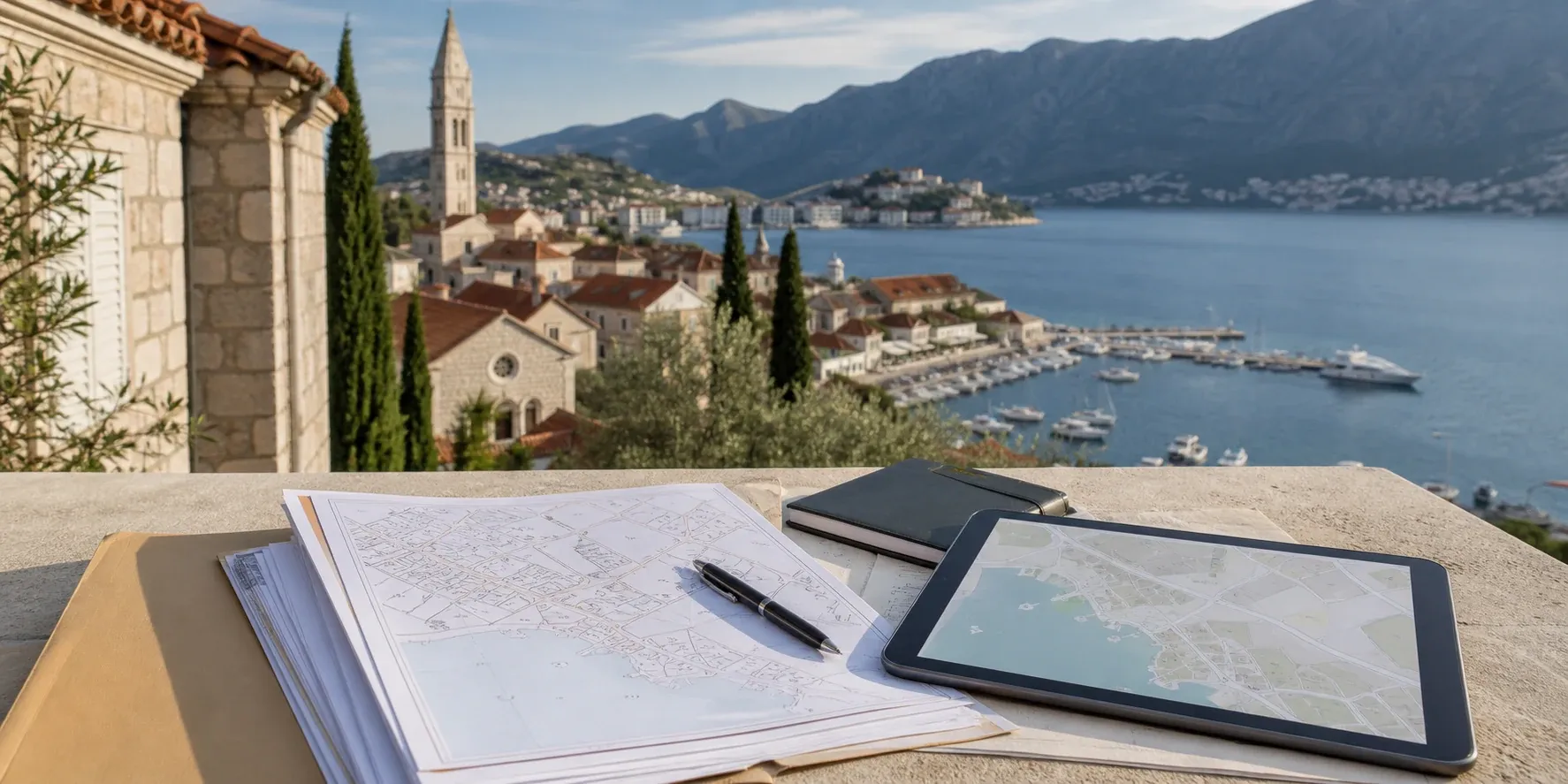
How to check the cadastre in Montenegro? Investor's guide
Property verification in Montenegro is based on the *List nepokretnosti* document, issued by the Real Estate Administration (Uprava za nekretnine). This document consists of sections describing the land, owner data, and any encumbrances, including mortgages and lawsuits (*zabilježba spora*). Before finalizing the purchase of an apartment or plot, it is essential to confirm the consistency of the actual state with the digital register on the ekatastar.me portal and to obtain a certified paper extract. A key element of the audit is checking the occupancy permit (*upotrebna dozvola*) and verifying the property's status within the Morsko Dobro coastal zone.


Article summary
The most important conclusions from the article in 30 seconds.
Property verification in Montenegro is based on the *List nepokretnosti* document, issued by the Real Estate Administration (Uprava za nekretnine). This document consists of sections describing the land, owner data, and any encumbrances, including mortgages and lawsuits (*zabilježba spora*). Before finalizing the purchase of an apartment or plot, it is essential to confirm the consistency of the actual state with the digital register on the ekatastar.me portal and to obtain a certified paper extract. A key element of the audit is checking the occupancy permit (*upotrebna dozvola*) and verifying the property's status within the Morsko Dobro coastal zone.
Verifying a property in Montenegro begins with the List nepokretnosti document, which is an extract from the Montenegrin cadastre. This is where the investor checks the plot, building, owner, shares, and encumbrances, including mortgages, easements, and dispute entries. The E-Katastar portal helps with the initial screening, but it does not replace the work of a lawyer, surveyor, and the current extract needed when finalizing the transaction. For apartments, the unit data, use permit, and status of common areas are crucial. For plots, a boundary audit, road access, land designation, and restrictions of the Morsko Dobro zone are added.
Purchasing an apartment or a plot in Montenegro often starts with the location: a view of the Bay of Kotor, distance from the marina, building quality, or rental potential in the season. From the perspective of capital protection, however, the first question should be different: is the legal status of the property as clear as the sales offer? The view, standard, and price are secondary to whether the buyer can safely acquire the exact asset described in the advertisement and reservation agreement.
In Montenegro, the primary tool for such verification is the real estate cadastre maintained by the Uprava za nekretnine. The official website of Uprava za nekretnine provides access to E-Katastar, the Geoportal, and extract-related services. For an investor, this means that the first analysis can be started online, but the transaction decision should not be based solely on a screenshot, a translation from the seller, or information from a developer's prospectus.
This article guides you through practical due diligence: how to read the List nepokretnosti, how to check the owner, how to interpret Section G with encumbrances, when to call a surveyor, and which documents are crucial when purchasing an apartment. The goal is not to replace a local lawyer, but to prepare the investor for a conversation with them. Well-asked questions before making a reservation can save weeks of negotiations, translation costs, and the risk of entering into a transaction that cannot be easily straightened out afterward.
—
What does the cadastre in Montenegro show? The structure of List nepokretnosti
The cadastre in Montenegro is the first filter of legal security for a property. It answers questions that neither a sales folder nor a conversation with an agent will resolve: what plot is the subject of the transaction, who is registered as the owner, what share the seller has, whether the building and unit are disclosed in the register, and what restrictions encumber the property. For an investor from Poland, the closest comparison is an extract from the land and mortgage register, but the Montenegrin document has its own logic, language, and structure.
Uprava za nekretnine, Geoportal, and E-Katastar
Uprava za nekretnine is the administration responsible for the geodetic and cadastral system. From there, the investor is led to two practical tools: the Geoportal and E-Katastar. The Geoportal helps with working with the map: plot location, boundaries, surroundings, access road, and comparing the spatial state with what is visible in the field. E-Katastar is used to analyze registry data, meaning who has rights to the property and what entries appear in the List nepokretnosti document. The E-Katastar login page indicates public access to the system, but in practice, caution must still be exercised when interpreting the data.
The most common mistake is that the buyer treats a single screen from the portal as full verification. Meanwhile, the online screen is a starting point. You should check whether the plot number, cadastral municipality, area, building, unit, and encumbrances correspond to the transaction documents. It is also worth agreeing with a lawyer on what type of current extract will be required by the notary and whether an additional certified document from the office is needed for a given transaction.
How to read sections A, B, V, and G
The List nepokretnosti is usually analyzed through four key parts. Section A describes the plot, area, land use method, and buildings. This is where the investor checks whether the plot from the offer is the same plot shown by the map and whether the buildings are disclosed. Section B shows the owner, shares, and the basis of acquisition, referred to as osnov sticanja. Section V is particularly important for apartments because it concerns buildings and separated parts, such as units, garages, or storage rooms. Section G shows encumbrances and restrictions: mortgages, easements, dispute entries, bans on alienation, and other information that may change the assessment of the transaction.
A practical discussion of the List nepokretnosti structure clearly shows why merely confirming the owner is not enough. An apartment may have a matching owner, but a problem with the use permit. A plot may have the correct number, but no disclosed road access. A building may exist physically, but not be fully reflected in the register. The investor should read the document as a set of related signals, rather than a single yes-or-no answer.
How to find a plot in the online system
For the initial screening, you need at least: the name of the cadastral municipality, i.e., opština, the plot number, and, in the case of a unit, the building and unit details. If the seller cannot provide the plot number, this is the first signal to stop the conversation. A professionally prepared offer should allow moving from the address and map to a specific number in the cadastre. Otherwise, the buyer does not know if they are analyzing the correct land.
The order of work is simple. First, you need to find the plot on the map and compare its location with the location from the advertisement. Then, you need to read the registry data in E-Katastar and check if they match the seller's documents. Finally, the lawyer should confirm the validity of the extract and prepare a list of risks for the reservation or preliminary agreement. In the case of purchasing a primary market property, the verification should also include the developer's documents, payment schedule, building and use permit status, and the method of transferring ownership of a specific unit.
—
How to check the property owner and ownership right?
Section B is where the investor checks whether the selling person has the right to sell the property. This sounds obvious, but in markets with a history of inheritances, co-ownership, and family use of properties, this part of the audit is often more important than the price. The seller may be a negotiating person, a family member of the owner, an attorney, or one of the co-owners. For the buyer, what matters exclusively is who is registered in the register and to what extent they can dispose of the right.
Section B: owner details, shares, and basis of acquisition
The first test involves comparing the data from Section B with the seller's passport and the draft agreement. The name, surname, document number, share, and type of right must be consistent. If the cadastre shows a 1/2 share, the seller cannot independently sell the entire property. If a legal entity is registered, you need to check the company's documents, persons authorized for representation, and any resolutions required for the sale.
The second element is osnov sticanja, meaning the basis of acquisition. A property bought a few years ago in a typical transaction is assessed differently than one acquired through inheritance, received as a gift, or resulting from a court judgment. The basis of acquisition does not have to be a problem, but it should lead to specific questions: has the probate proceeding been completed, are there any undisclosed claims, does the seller's spouse need to give consent, does the power of attorney cover all activities needed for the sale?
Co-ownership, spouses, and inheritance
Co-ownership requires documentary discipline. If several owners are listed in the document, each of them should participate in the transaction or grant a proper power of attorney. When purchased by a foreign investor, it is particularly important that the power of attorney complies with the requirements of a Montenegrin notary, has the proper form, translation, and scope. A general consent to sell may not be sufficient if it lacks the price, property number, right to receive funds, or consent for cadastral registration.
In the case of inherited property, the lawyer should confirm whether the chain of owners is closed. A missing link in the history of ownership may not be noticeable at first glance, but it returns during the registration of a new owner, financing, or subsequent resale. This is particularly important for family homes and plots that have been used in accordance with local practice for years, but have not always been updated in the register on an ongoing basis.
Questions for a lawyer before reservation
Before paying the reservation fee, it is worth asking a lawyer a few simple questions. Is the seller the sole owner? Is there a co-owner, spouse, heir, or attorney whose consent is necessary? Does the basis of acquisition create additional risk? Has a fresh entry appeared in recent months that requires clarification? Do the owner's details in the cadastre match the identity document and the draft agreement?
Only after this verification does a conversation about the price, payment deadline, and schedule make sense. Without it, the investor may negotiate the terms of purchasing an asset that the seller is unable to effectively transfer. In the premium segment, the cost of such a mistake is not limited to the deposit. There is also lost time, the costs of advisors, translations, travel, and sometimes the loss of another, cleaner investment opportunity.
—
How to read encumbrances and mortgages in the List nepokretnosti document?
Section G, meaning Tereti i ograničenja, is a part of the document that must not be treated superficially. This is exactly where information appears that can block the transaction, lower the value of the property, or change the payment model. A clean Section G is not a guarantee of the absence of all risks, but an entry in Section G always requires clarification before signing the agreement. The investor should understand whether a given encumbrance is technically manageable or if it constitutes a reason to stop the process.
Mortgage, zabilježba spora, and ban on alienation
A mortgage does not always mean that the property cannot be bought. It can be a standard loan security that will be paid off from the sale price. Then the key elements are: the current debt balance, bank consent, payment method directly to the creditor, brisovna izjava (meaning the document allowing the mortgage to be canceled), and the sequence of actions at the notary. Without this procedure, the buyer risks paying the seller while the encumbrance remains in the register.
Zabilježba spora, meaning an entry about a court dispute, should be treated differently. Such an entry signals that the right to the property or a specific action is being contested. In many cases, it should halt the transaction until a clear legal opinion is obtained. A ban on alienation (zabrana otuđenja) works similarly. If there is a ban on sale, the seller's assurance that the matter is a formality is not enough. You need to see the document, the basis of the entry, and the method of its cancellation.
Bez dozvole, prekoračenje dozvole, and legalization
In audit practice, entries related to permits also appear. Phrases like bez dozvole (without a permit) or prekoračenje dozvole (exceeding the permit) may indicate a lack of a permit, construction outside the scope of consent, or exceeding parameters. Not every such case has the same weight, but each requires an analysis of costs, time, and legalization possibilities. For an investor, this means a question not only about whether the property can be bought, but also whether it can be rented, insured, financed, later sold, and safely handed over to the next buyer.
In the primary market, the developer's mortgage also requires context. If the investment is bank-financed, the entry may be part of the normal project structure. However, the investor should know when the mortgage will be released for a specific unit, whether the payment schedule is linked to construction stages, whether funds go to an account compliant with the documentation, and what happens if the developer fails to meet the conditions. There should be no ambiguities in this part of the agreement.
When an encumbrance is manageable versus when it blocks a transaction
An encumbrance is manageable when it has a clear basis, a known amount or content, the consent of the proper party for cancellation, and a safe payment sequence. Example: a bank mortgage where part of the price goes directly to the bank, the bank issues a document for cancellation, and the rest of the price goes to the seller only after conditions are met. This still requires a lawyer, but it has a logical procedure.
An encumbrance blocks a transaction when it is unknown who can cancel it, when there is a dispute, when the entry indicates a ban on disposition, when the seller cannot present documents, or when they expect payment outside the agreement. In such a situation, the investor should not compensate for the risk solely with a lower price. A price discount does not fix the inability to register ownership nor does it remove a dispute that can drag on for years.
—
What to check regarding plot boundaries and when to call a surveyor?
When purchasing land, analyzing the cadastral document is just the beginning. A plot exists simultaneously in the register, on the map, and in the field. These three things should match each other. If the fence, road, slope, retaining wall, or utility access does not overlap with the map, the buyer must understand whether they are dealing with a technical error, local usage custom, neighbor dispute, or a real construction restriction.
Cadastral map versus state in the field
The cadastral map shows the plot boundaries, but it does not always solve the problem of physical use. A fence may stand a few dozen centimeters outside the boundary, the access road may run across someone else's property, and part of the garden from the offer may belong to the neighbor. For plots located on a slope, the difference between the cadastral area and the realistically usable area can be significant. What matters is not only the number of square meters, but also the slope, the possibility of positioning a building, heavy equipment access, and earthwork costs.
A surveyor should appear when the investor is purchasing land for construction, expansion, or a second-home project, and the boundaries are not obvious. A surveyor's visit is also advisable when the property has a high unit price due to the view, sea access, or construction potential. With such an asset, a difference of a few meters at the boundary can decide the driveway location, terrace size, building line, or building exposure.
Road access and easements
One of the most important points of a plot audit is access to a public road. A plot may look good on the map, but be practically blocked by private land if there is no properly established right of way and passage. Then the investor is buying a negotiation problem with neighbors, not full-value construction land. The easement should have a clear content, route, and scope. The right of way on foot looks different than driving a car, and running utilities is yet another matter.
In Section G, easements encumbering the property should also be checked. If a right of way for a neighbor, a technical strip, a utility routing right, or another restriction runs through the plot, this affects the design, privacy, construction cost, and subsequent resale. This is not about automatically rejecting such a plot, but about pricing the risk before purchase.
Morsko Dobro zone and waterfront plots
For properties located close to the coast, the topic of Morsko Dobro arises. The JP Morsko Dobro website describes the public enterprise managing Montenegro's marine property, including the use of coastal areas and infrastructure related to the coastal zone. For an investor, this means the necessity of checking whether an attractive seaside location does not involve usage restrictions, leasing, public access, permits, or planned changes in land development methods.
If the seller presents a plot as a private waterfront parcel, ownership rights must be separated from actual usage rights. You can own the land, but have restrictions regarding construction, beach access, a pier, fencing, or rental activities. It is worth asking a lawyer to check the local plan, Morsko Dobro documents, and urban-technical conditions before the price is accepted.
—
What documents are crucial when purchasing an apartment?
An investment apartment requires a different audit than a plot. With land, the investor focuses on the parcel, boundaries, designation, and access. With a unit, the most important thing is confirming that the purchased apartment is a properly separated unit, has a matching area, the correct number, assigned rights to additional parts, and is not burdened by building problems. In the short-term rental segment, these elements directly affect the asset's operability.
Section V, unit and common areas
Section V should allow identifying the specific unit: its location, floor, area, and status as a posebni dio, meaning a separated part of the building. The investor must compare this data with the floor plan, agreement, sales plan, and the actual unit shown during the viewing. If the prospectus states 72 m² and the document shows a different area, the discrepancy must be explained before signing. Sometimes it concerns the balcony, terrace, gross area, or a marketing description. Sometimes it is an error that should change the price.
Parking spaces, storage units, lockers, and shares in common areas require separate analysis. It must be established whether the parking space is a separate cadastral unit, a common area with the right of exclusive use, a space resulting from the regulations, or just the seller's promise. In seaside investments, a parking space can be of great significance for rentals, so its status should be written into the documents, rather than left in email correspondence.
Use permit and building status
Upotrebna dozvola, meaning the use permit, is one of the critical documents for a ready-made apartment. The lack of such a permit does not always mean that the building does not legally exist, but it should halt the decision until clarified. The investor should know whether the unit can be formally used, rented, insured, connected to utilities, and transferred without risk. If the building is new, it is worth checking whether the developer has completed the acceptance procedures, not just the construction work.
For premium apartments, the audit of the building's management or operator is equally important. The buyer should learn the rules of the Service Charge, common area maintenance costs, rental management fees, renovation fund, arrears of the previous owner, and unit usage regulations. In some jurisdictions, arrears or disputes related to the unit can hinder the smooth takeover of the property. This is not an administrative detail, but an element of NOI calculation and real ROI.
UTU and the investment surroundings
The UTU document, meaning urbanističko-tehnički uslovi, helps understand the construction conditions and the project's surroundings. For an apartment with a sea view, the investor should ask whether another building can be erected in front, whether road changes are planned, whether the neighboring plot has the right to higher construction, and whether the infrastructure nearby is final. The view is part of the utility and market value. If it can be blocked, this must be taken into account in the price and exit strategy.
The apartment audit should therefore include not only the unit, but the entire legal ecosystem of the building: the cadastral document, permits, common areas, management, fees, parking status, utilities, and planned changes in the surroundings. Only then can the investor compare various offers on the primary and secondary market in a way that makes financial sense.
—
Why must a legal audit in Montenegro precede the purchase decision?
In foreign markets, the biggest mistakes often arise not from a lack of information, but from reversing the sequence of actions. The buyer first reserves the property, then engages a lawyer, and only at the end discovers that the documents do not match what was promised in conversation. In Montenegro, the sequence should be reversed: first, screening of the cadastre and documents, then negotiations of terms, and only later reservation and payment.
Red flags before the reservation agreement
The first red flag is pressure for a quick payment without the full set of documents. If the seller expects cash outside the agreement, delays handing over the current List nepokretnosti, or refuses to provide the plot number, the investor should stop the process. The second flag is discrepancies in the area, unit number, floor, plot boundary, or parking status. The third is unclear entries in Section G, especially a dispute, a ban on alienation, a mortgage without a cancellation procedure, or an easement with imprecise content.
The fourth flag is the lack of a use permit for a unit sold as ready. The fifth is a situation where the notary is only supposed to confirm signatures, and the entire burden of risk assessment is left to the buyer. The notary plays an important role in the transaction, but does not replace the investor's independent advisor. The official website of the Notary Chamber of Montenegro allows verifying the notary system and offices, but the scope of economic analysis, rentals, CAPEX, Service Charge, or resale potential should be prepared independently.
Safe purchase sequence
The safe process looks as follows. First, the investor identifies the property and obtains the plot number, unit data, and seller documents. Then, the lawyer checks the List nepokretnosti, ownership, encumbrances, permits, and building documents. In the case of a plot, a surveyor and planning analysis enter the process. Only after this phase can the reservation agreement be signed, preferably with suspensory conditions that allow withdrawal if the documents do not confirm the state declared by the seller.
The next stage is the preliminary or final agreement at the notary, the payment schedule, a deposit or a safe procedure for paying off encumbrances, and submitting an application for registration. In a transaction with a mortgage, part of the price may go directly to the bank. When purchasing from a developer, payments should be linked to documents and stages. In every variant, the investor should know which document confirms the transfer of ownership and when their registration will appear in the cadastre.
PlanoGroup's perspective
PlanoGroup's experience in foreign markets shows that a good property is not defended solely by its location. It is defended by documents, a predictable procedure, a realistic maintenance model, and the possibility of subsequent resale. This applies particularly to Montenegro, where investors often compare properties by photos, views, and prices, and pay too little attention to how a given apartment or plot will behave in the formal purchase process.
Professional due diligence is not an add-on after selecting a property. It is part of the selection. It allows rejecting assets with problems, negotiating the price where the risk is calculable, and shortening the path to the notarial deed where the documents are ready. For an HNW investor, what matters most is not only the possibility of purchase, but also risk control, asset liquidity, and the quality of decisions before committing capital.
—
PlanoGroup support when purchasing real estate in Montenegro
If you are planning to purchase real estate in Montenegro, it is worth conducting a technical and legal verification before reservation pressure appears. PlanoGroup can support the investor in analyzing the List nepokretnosti, initial plot screening, talking with a local lawyer, assessing developer documents, and comparing risks between an apartment, a house, and a plot.
For coastal properties, combining legal and investment analysis is particularly important. A clean cadastral entry alone is not enough if the Service Charge, rental seasonality, lack of parking, or Morsko Dobro restrictions lower the asset's usability. On the other hand, an entry requiring clarification does not always disqualify a transaction if there is a clear procedure for its removal and the price accounts for the risk. This is precisely the role of advisory: separating a technical problem from a risk that is not worth taking on.
Current offers and market context can be checked on the PlanoGroup website: offers in Montenegro. For investors beginning their analysis, the PlanoGroup guide on buying property in Montenegro and the PlanoGroup article on investing in real estate in Montenegro will also be useful.
FAQ
Is the title deed shown by the seller enough?
No. The document shown by the seller must be compared with the current state in the cadastre, the plot number, owner details, shares, encumbrances, and unit or land documents. The date of the document is also important. In a transaction, you should not rely on an old extract, an unconfirmed scan, or a translation prepared exclusively by the selling party. The lawyer should confirm whether the document corresponds to the current register state and whether it can be used in the notarial process.
Does an encumbrance in the cadastre always block a purchase?
Not always. A bank mortgage can be handled with a safe procedure if the bank confirms the balance, repayment method, and the document needed for cancellation. An entry about a dispute, a ban on alienation, or an unclear easement looks different. Such entries can significantly increase the risk or halt the transaction. The key question is: does a clear, documented, and lawyer-controlled way of removing or accepting the encumbrance exist?
Who should check the cadastral document?
The initial screening can be done by the investor or advisor, but the final assessment should be prepared by a local lawyer familiar with the Montenegrin cadastre, document language, and notarial practice. For a plot, it is worth involving a surveyor, and for the primary market, also analyzing developer documents. An investment advisor can help combine legal risk with price, ROI, maintenance costs, and an exit strategy.
Can plot boundaries be assessed solely on the advertisement map?
No. The map from the advertisement is informative and often simplifies reality. When purchasing land, you must compare the cadastral map, the Geoportal, the state in the field, fences, road access, easements, slope, and planning designation. If boundaries affect construction potential, a licensed surveyor is necessary. Without this, the investor may buy a plot that looks good on screen, but has limited usability.
What to do when the area in the offer differs from the document?
You need to halt the decision and establish the source of the difference. In an apartment, the discrepancy may result from gross area, a terrace, a balcony, common areas, or an error in the description. For a plot, it could concern boundaries, measurement, a slope, a road, or a piece of land used without a right. The correct area should end up in the transaction documents, and the price should reflect the state confirmed in the register and in the field.
Is E-Katastar enough for a notarial deed?
E-Katastar is very useful for initial verification, but during the transaction, you must agree with the lawyer and notary on what document is formally required. The portal allows detecting a problem faster, but it does not exempt you from obtaining current documents, translations, and confirmations needed for signing. In practice, the investor should treat the online version as a screening tool, rather than a replacement for legal services.

Author
Patrycja Kordys
BOARD MEMBER | SALES DIRECTOR
For nearly 17 years, she has been associated with the premium real estate market. She gained her experience working with international clients—particularly German and English speakers—ensuring the highest standard of service and communication. After years of working on the Costa del Sol, she now focuses on the dynamically developing market of Oman, where she supports clients in discovering new investment opportunities and lifestyles. She combines professionalism with a natural ease in building relationships, ensuring that the purchasing process is smooth and stress-free.

Related articles

How to buy real estate in Montenegro? A complete guide
Is it worth investing in real estate in Montenegro?

Real estate prices in Montenegro – how much does an apartment cost and is it worth investing?