


Investments in Ulcinj and Ada Bojana: An Investor's Guide
Ulcinj, Ada Bojana, and Velika Plaža require a separate investment analysis because they do not operate like Tivat, Budva, or the Bay of Kotor. A lower entry price may mean more work: verification of UTU (urban planning and technical conditions), List Nepokretnosti (property deed), the Morsko Dobro maritime zone, utilities, access roads, a rental operator, and actual seasonality. Field reconnaissance based on data is most important: travel time, road conditions, internet, water, parking, noise, tenant reviews, and off-peak service availability. Only after applying such a filter can one compare ROI, legal risk, fixed costs, and the exit strategy. The south of Montenegro can be interesting for an investor, but it requires discipline: separating the purchase price from the total budget, sports demand from family demand, and the potential of the location from the quality of the documents.


Article summary
The most important conclusions from the article in 30 seconds.
Ulcinj, Ada Bojana, and Velika Plaža require a separate investment analysis because they do not operate like Tivat, Budva, or the Bay of Kotor. A lower entry price may mean more work: verification of UTU (urban planning and technical conditions), List Nepokretnosti (property deed), the Morsko Dobro maritime zone, utilities, access roads, a rental operator, and actual seasonality. Field reconnaissance based on data is most important: travel time, road conditions, internet, water, parking, noise, tenant reviews, and off-peak service availability. Only after applying such a filter can one compare ROI, legal risk, fixed costs, and the exit strategy. The south of Montenegro can be interesting for an investor, but it requires discipline: separating the purchase price from the total budget, sports demand from family demand, and the potential of the location from the quality of the documents.
Ulcinj, Velika Plaža and Ada Bojana are not a simple extension of the Tivat, Budva or Kotor Bay markets. This southern coast of Montenegro operates on a different logic: land, spatial planning, the wind season, access to infrastructure, and the status of the coastal zone matter more. An investor who looks only at the price per square meter may miss the most important risks.
For a Polish buyer, Ulcinj can be an interesting market to analyze, but it should not be evaluated like a ready-made premium product with a marina, an operator, and a full ecosystem of services. Here, field reconnaissance carries more weight. You need to check the access road, water, electricity, internet, distance from functioning services, rental rules, and land documents. Only then can you compare the entry price with the real cost of getting the product to a state suitable for rental or resale.
The starting point is the awareness that the south of Montenegro combines several demand profiles: families looking for a larger beach, kitesurfers, guests interested in nature, second-home owners, and investors looking for a lower barrier to entry than in the Bay of Kotor. Each of these groups has different requirements. Therefore, a good exploratory trip to Ulcinj is not about admiring the view. It is about gathering data that a sales brochure will not show.
—
Why do Ulcinj and Ada Bojana require a separate investment analysis?
The biggest mistake is transferring assumptions from Tivat or Budva to the south of the country. Tivat is a market supported by an airport, a marina, mixed-use projects, and a more recognizable tenant profile. Budva relies on intense holiday traffic, but it also faces high competition and greater price pressure. Ulcinj is different. Its asset is not the same type of infrastructure, but the scale of the beach, lower building density in selected locations, and the possibility of building a product for longer stays.
In price analysis, three levels must be separated. The first is top locations in the Bay of Kotor and around Tivat, where prices often stem from a ready-made environment: marinas, services, management, and resale liquidity. The second is Budva and Kotor, where tourist recognition is at play, but also seasonality and spatial constraints. The third is Ulcinj and the Velika Plaža area, where a lower entry price may mean greater potential, but also more work on the investor's part.
If offers show ranges of EUR 4,000–7,000 per m² in projects around Boka and EUR 2,200–3,500 per m² for new products in the Velika Plaža area, they should not be treated as a single market index. This is a starting point for verification. The investor should check whether they are comparing a finished serviced apartment, an off-plan unit, a plot with UTU (Urban and Technical Conditions), or a property requiring legalization and technical outlays. The difference in the price per meter can disappear when CAPEX, roads, utilities, an operator, and vacancies are added to the model.
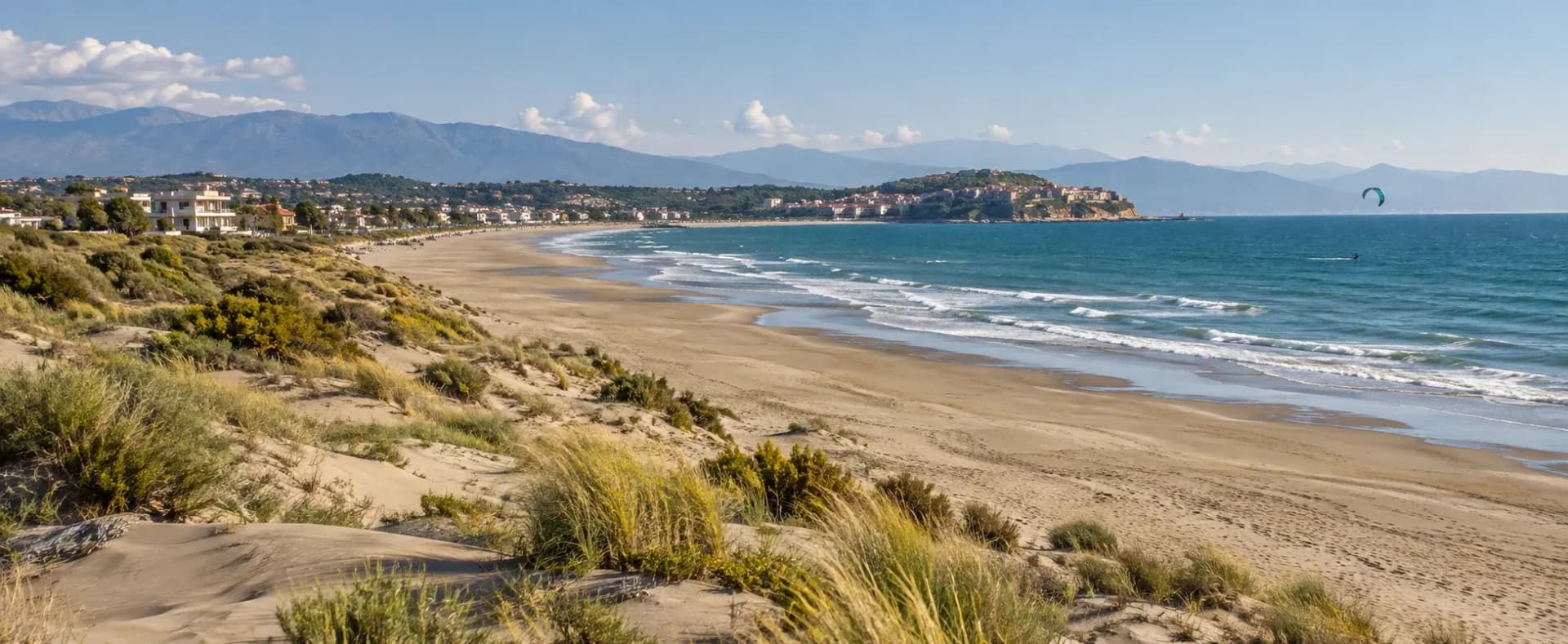
However, Velika Plaža has a feature that cannot be copied in the northern part of the coast: a long sandy strip, recognizable among people looking for wind sports and less urbanized space. The National Tourism Organisation of Montenegro describes Velika Beach as a 13-kilometer beach and points to Ulcinj, Ada Bojana, and Long Beach as the main spots for kitesurfing. For an investor, this is not an emotional argument. It is a hint that demand may stem from activity, length of stay, and the wind season, rather than just proximity to the sea.
One must also look at the region in the broader tourism setup. The World Bank report on the structure of tourism in Montenegro indicated that the vast majority of overnight stays are concentrated on the coast, and the share of Bar and Ulcinj along with the Boka region increased during the analyzed period. This is an important signal, but still not a guarantee of a specific property's performance. Rather, it shows that the south is worth analyzing separately, with its own risk map and its own demand test.
Three steps before the first reservation
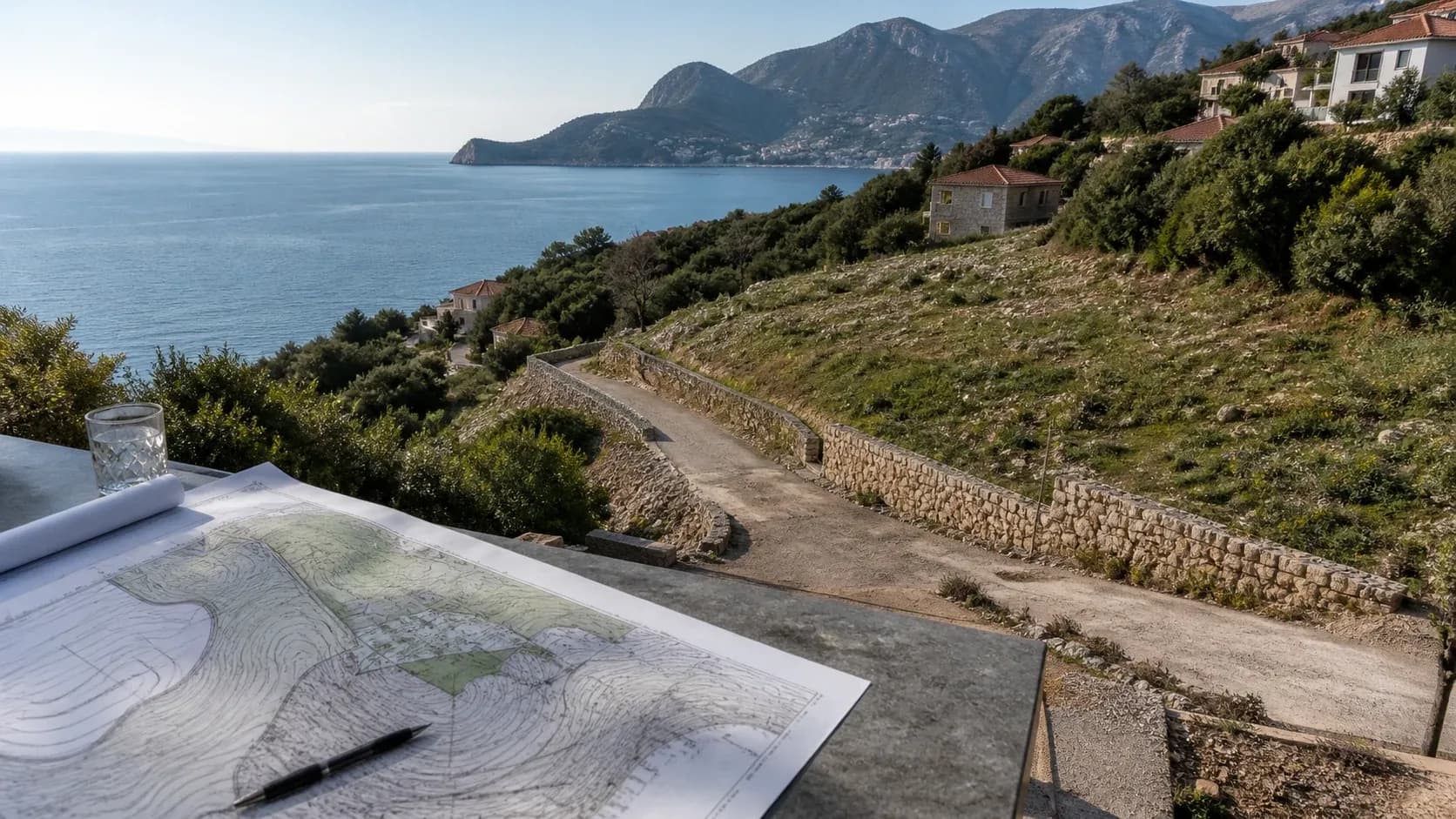
The first step is checking spatial planning. For land or a low-rise project, the investor should request the UTU (Urbanističko-tehnički uslovi) and check whether the assumed function of the building is feasible. What matters is not only the plot area, but also building density, height, distances from borders, the public road, utilities, and coastal zone restrictions.
The second step is verifying real transactions and comparable offers. It is not enough to ask the seller about the price of a neighboring plot. You need to compare active offers, data from local agencies, negotiation history, and differences between finished units and properties under construction. It is worth comparing this with PlanoGroup’s guide to the primary market in Montenegro to immediately separate the purchase price from the full entry budget.
The third step is the infrastructure map. Mark future and existing roads, kitesurfing schools, restaurants, shops, parking lots, medical points, areas with water problems, and sections with narrow access. If the investor cannot build this map after 24 hours on the ground, they do not yet have sufficient data to make a reservation.
—
Logistics and infrastructure: how to plan a reconnaissance route?
Reconnaissance of Ulcinj should start with logistics, not with the prettiest beach. The simplest option is flying to Podgorica, driving along the route towards Bar, and further south. Turistička organizacija Podgorica lists the Podgorica-Ulcinj distance as 95 km, and the Podgorica-Bar route as 60 km through the Sozina tunnel. In practice, the investor should measure not only the distance, but also travel time at various times of the day.
A 24-hour plan can look simple. Landing in Podgorica in the morning, picking up a car, and driving to Ulcinj. At noon, the first loop: the center of Ulcinj, the road towards Velika Plaža, the nearest shops, petrol stations, parking lots, and access roads to specific plots. In the afternoon, the second loop: Ada Bojana, access to temporary structures, an internet test, conversations with local operators and water sports schools. In the evening, return via the same route or drive towards Tivat if the investor wants to compare travel comfort with the north of the coast.
Such a test quickly shows the difference between the main road and local roads. An apartment may look good in an offer, but if access requires a narrow road without sensible parking, the rental product will have limitations. For families, kitesurfers, and remote workers, very practical things matter: where to leave equipment, how to drive up after dark, whether the water pressure is stable, and whether the internet works under seasonal load.
What to check under the hood of a real estate property?
The first area is water and energy. In areas with informal or seasonal development, you need to ask about the water source, tanks, sewage, septic tanks, history of power outages, and the cost of maintaining the installation. It is not enough to be told that everything works in July. The question is how the installation behaves at full occupancy and after heavy rainfall.
The second area is technology. If the product is to work for digital nomads, families staying longer, or second-home owners, check 4G/5G speeds at several points on the plot and inside the building. Test in the morning, afternoon, and evening. Your own measurement is better than the operator's declaration, because the tenant evaluates the user experience, not the coverage map.
The third area is noise and beach use. In Ulcinj and on Velika Plaža, you need to check which sections have music, quad bike traffic, water sports schools, parking lots, and weekend traffic. The micro-location can change the tenant profile more than the distance to the sea itself. A guest looking for kitesurfing will accept a different level of activity than a family with small children.
The fourth area is infrastructure projects. The World Bank announced in December 2025 financing for Montenegro's first modern fishing port at Cape Đeran-Velika Plaža in the Ulcinj municipality. Such a project may improve the region's economic background, but it should not be automatically translated into an increase in the price of a specific plot. For an investor, this is rather a point on the map to observe: where infrastructure is emerging, which roads will be congested, and which parts of the coast may change their function.
Route notes that matter for ROI
After visiting each location, it is worth recording five pieces of data: travel time, road quality, access to services, utility status, and the neighborhood profile. Photos should include not only the view, but also meters, roads, garbage cans, facades, parking, beach access, and potential noise spots. Only such material allows for an objective comparison of several offers.
A good reconnaissance should end with a shortlist, not a reservation. If, after one day in the field, the investor has 2-3 micro-locations, a list of questions for a lawyer, data for the cost model, and dismissed risks, the trip has served its purpose. If they only have photos of the beach, it needs to be repeated.
—
Ada Bojana and Velika Plaža: from kitesurfer profile to rental yield
Ada Bojana and Velika Plaža are often described through the lens of landscape. The investor should start with the user profile. A kitesurfer, a family with children, a resort guest, a regional tourist, and a second-home owner have different expectations of the product. The length of stay, seasonality, price sensitivity, and the range of services that must be provided will also differ.
Kitesurfing is particularly important because it structures the season differently than classic beach tourism. The official Montenegro.travel website points to Mistral and the season from May to September as part of this activity's characteristics. This can support longer stays, but only if the property meets the needs of this group. Space for equipment, quick drying, parking, easy access to the school, stable internet, and easy cleaning after guests all matter.
Families look for something else. For them, silence, safe access, a kitchen, a washing machine, shade, an easy beach, proximity to a store, and parking availability will be more important. If a unit is to serve both groups, the standard of equipment must be resistant to intensive use. The ROI model should account for more frequent textile laundering, equipment replacement, a higher number of cleanings, and a reserve for minor repairs.
What does the presence of larger operators say?
The presence of hotel and resort brands is a signal that the region has demand that extends beyond private apartments. Karisma Hotels features Azul Beach Resort Montenegro in Ulcinj and refers to Ada Bojana as a place associated with kitesurfing. This is a good reference point for an investor, but not proof that every property in the area will perform like a resort.
In practice, a larger operator raises guest expectations. If there is a facility in the area with gastronomy, swimming pools, entertainment, and service infrastructure, a private apartment must have a clear advantage. This could be larger surface area, privacy, better access to a specific sports school, the possibility of a longer stay, or a lower total cost for a family. The mere proximity of a resort is not enough.
How to check seasonality without a hotel report?
First, check booking platform calendars for comparable properties. You are interested not only in August rates, but also in availability in May, June, September, and October. If a property has many empty windows outside of the peak season, you need to calculate ROI based on a shorter season. If there are longer stays and repeatable guest reviews, it is worth checking what generates them: location, standard, operator, or price.
Next, read reviews with an eye on risks. Noise, beach cleanliness, mosquitoes, access, lack of water, weak internet, and parking problems are more important than the overall rating. Reviews show which micro-locations have recurring problems. This does not replace due diligence, but it effectively filters places for further analysis.
Finally, check what works off-season. Restaurants, shops, technical services, rental shops, and local transport build the real utility of a property. PlanoGroups article on second homes and ROI shows that the calendar of private use and rental should be calculated as an element of financial performance, not as an addition to the purchase.
—
Due diligence in the south: how to turn potential into a secure investment product?
In the south of Montenegro, due diligence must combine law, planning, and rental operations. A low price alone is not enough. The most important thing is the property's status: whether the building is disclosed in the cadastre, whether the land has clear ownership, whether there are encumbrances, whether access is legally secured, and whether the property is in a zone that restricts construction or use.
In Ada Bojana, the topic of temporary structures and the Morsko Dobro zone is of particular importance. The Government of Montenegro has published the program of temporary structures in the maritime domain zone for the period 2024–2028, with separate materials for Ulcinj and both banks of the Bojana River. This is not a document that an investor should treat as a formality. If the subject of the discussion is a building or land close to the coastal zone, a lawyer must check whether the purchased asset actually grants the rights the investor expects.
List Nepokretnosti and the encumbrances section
The basis is an up-to-date List Nepokretnosti (Title Deed). The official eKatastar allows you to check registry data, but the online screen should not replace the analysis of the document by a local lawyer. Uprava za nekretnine is the institution responsible for cadastre and real estate ownership matters, which is why its data is the starting point. However, a starting point does not mean the end of the investigation.
In practice, the investor should check the owner, share, plot number, area, buildings, premises, mortgages, disputes, easements, notes, and restrictions. Special attention should be paid to the section on burdens and restrictions, often described as Tereti i Ograničenja. If an entry is unclear, it must not be ignored just because the price looks favorable.
It is also worth reading PlanoGroup's article on the cadastre and List Nepokretnosti. It shows how to separate map data, registry information, and the documents needed for a transaction. For land, PlanoGroup's guide to UTU, cadastre, and hidden costs is also helpful, because the south of the country often requires a separate technical assessment.
Exit strategy: to whom will you sell the asset?
Ulcinj may have a lower barrier to entry than Tivat, but it usually requires a more cautious exit strategy. Porto Montenegro or Luštica Bay have brand recognition and a ready-made environment that makes product comparison easier. In Ulcinj, the buyer will ask more questions about documents, access, rent, utilities, and the operator. This may narrow down the group of future buyers.
Therefore, the exit strategy must be defined before purchase. Is the asset to be sold to a family looking for a second home? An investor for short-term rental? A local operator? A buyer from Albania, the DACH region, or Poland? Each of these profiles evaluates the location differently. If it is not known who the natural buyer will be in 5-10 years, the investment model is incomplete.
Five questions to ask before making a decision
The first question: what is the full entry cost? It includes the price, tax, notary, lawyer, translator, registration, equipment, technical work, service, utilities, operator, and reserve. ePorezi points to a progressive property transfer tax: 3%, 5%, and 6% depending on the transaction value. Current rules for a specific case must be confirmed.
The second question: who manages the property after purchase? The lack of a professional operator can eat up part of the margin, even when the nightly rate looks good. Ask about commission, reporting standards, pricing policy, repairs, cleaning, deposits, reviews, and response to failures.
The third question: does the property have a working season outside of July and August? If not, ROI must be calculated cautiously. The model should have a pessimistic, baseline, and optimistic variant, without entering maximum rates as the norm.
The fourth question: do the documents allow for the intended use? This applies in particular to land, properties close to the shore, and temporary structures. Not every property can be easily transformed into an investment product meeting the buyer's expectations.
The fifth question: what happens if the sale takes longer than anticipated? Liquidity in Ulcinj may be lower than in more recognizable northern projects. This does not rule out the investment, but it requires a larger reserve of time and capital.
—
When is it worth talking to PlanoGroup?
Ulcinj and Ada Bojana require a combination of field data, legal analysis, and a rental model. If an investor does not have a local team, the biggest risk is not the price itself, but the lack of an orderly process. First, you need to establish a strategy, then a shortlist of locations, then documents, and only then negotiate terms.
PlanoGroup can help in selecting real estate offers in Montenegro, preparing an exploratory trip, putting together questions for the seller, checking documents with a local lawyer, and comparing the ROI model. The greatest value appears when the investor is not looking to confirm an emotional decision, but wants to reject weak assets before locking up capital.
A good next step is a discussion about whether the goal is a ready-to-use apartment, land for a project, a unit in a new investment, or a second home with partial rental. These four strategies look similar at the browsing stage, but they carry different risks, horizons, and liquidity.
—
FAQ
Does Ulcinj have the same investment profile as Tivat?
No, Ulcinj is a market with a different seasonal dynamic, a different tourist profile, and different real estate supply specifics, which requires a separate profitability analysis.
Is Ada Bojana only suitable for a beach trip?
No, but its investment sense depends on documents and infrastructure. Ada Bojana can be strong for guests associated with nature, wind sports, and longer stays. At the same time, it requires caution regarding temporary structures, the coastal zone, water, energy, access, and environmental protection. Before purchasing, it must be established whether the subject of the transaction grants stable rights of use, rather than just favorable access to the location.
From which airport is it most convenient to check out the south of Montenegro?
The investor should compare flight networks and travel times from airports in Podgorica and Tivat, taking into account transport costs and seasonal traffic congestion.
How to check the real seasonality of the region?
One should analyze the availability of services off-season, compare accommodation prices across different months, and verify occupancy with local rental operators.
Does a short stay provide a basis for booking a property?
A reconnaissance trip helps narrow down the choice of location, but full verification of legal documents, the land registry extract, and a reliable ROI model is crucial."

Author
Patrycja Kordys
BOARD MEMBER | SALES DIRECTOR
For nearly 17 years, she has been associated with the premium real estate market. She gained her experience working with international clients—particularly German and English speakers—ensuring the highest standard of service and communication. After years of working on the Costa del Sol, she now focuses on the dynamically developing market of Oman, where she supports clients in discovering new investment opportunities and lifestyles. She combines professionalism with a natural ease in building relationships, ensuring that the purchasing process is smooth and stress-free.

Related articles

Second home as an investment – how to manage rentals and ROI?


Real Estate in Montenegro: A Guide to the Primary Market
How to buy investment land in Montenegro: UTU, cadastre, and hidden costs