


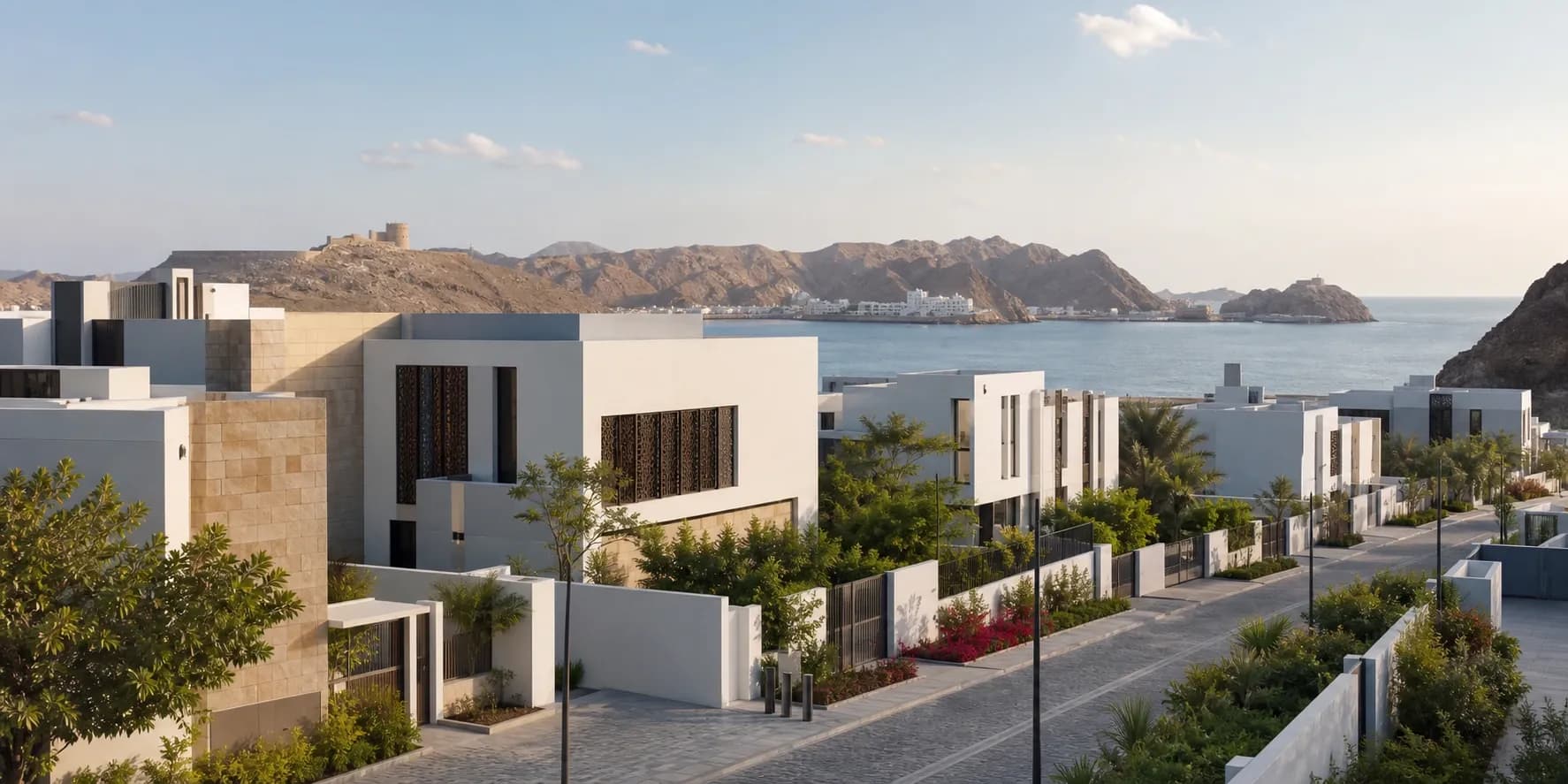
Can foreigners buy real estate throughout Oman following the 2026 changes?
The 2026 legal changes in Oman do not mean that foreigners can buy real estate throughout the entire country. Royal Decree 56/2026 reforms the Real Estate Registry and the method of confirming rights, while Royal Oman Police Decision 87/2026 streamlines selected residency procedures for owners of qualifying properties. These are still three separate issues: the right to acquire a specific asset, the registration of the right, and potential residency. An investor from Poland should verify the project status, the legal basis for purchase by a non-Omani, the type of title deed, the SPA or PSPA, and documents regarding registration before paying a reservation fee. The article also shows how to distinguish ITCs, future cities, Surouh, and off-plan projects from regular sales offers.


Article summary
The most important conclusions from the article in 30 seconds.
The 2026 legal changes in Oman do not mean that foreigners can buy real estate throughout the entire country. Royal Decree 56/2026 reforms the Real Estate Registry and the method of confirming rights, while Royal Oman Police Decision 87/2026 streamlines selected residency procedures for owners of qualifying properties. These are still three separate issues: the right to acquire a specific asset, the registration of the right, and potential residency. An investor from Poland should verify the project status, the legal basis for purchase by a non-Omani, the type of title deed, the SPA or PSPA, and documents regarding registration before paying a reservation fee. The article also shows how to distinguish ITCs, future cities, Surouh, and off-plan projects from regular sales offers.
The short answer is: no. Oman did not open its entire territory to foreign property purchases in 2026. The changes that sparked discussions among investors primarily concern the registration of real estate rights and residency regulations for individuals who hold a qualifying asset.
The confusion arose because two different legal announcements were issued within a short period of time: Royal Decree No. 56/2026 Issuing the Law of the Real Estate Registry and Decision No. 87/2026 Royal Oman Police concerning residency regulations. The first act organizes the rights registration system, while the second facilitates selected visa and residency procedures for property owners. Neither of these acts should be read as a blanket approval for a Polish investor to purchase any apartment, house, or land in Oman.
For a buyer, these are three separate questions. First: as a foreigner, can they legally acquire a specific property. Second: how their right will be registered in the Real Estate Registry. Third: whether the purchase of this specific property can serve as the basis for a visa or residency. These answers must be checked separately before paying a reservation fee, signing an SPA or PSPA, and before assuming that the project is available to a non-Omani buyer.
In practice, an investor should start not with a sales brochure, but with the documents: the legal status of the project, the legal basis permitting acquisition by a foreigner, the type of right entered into the registry, and the rules of potential residency. A broader transactional context is discussed in the PlanoGroup legal guide to real estate investments in Oman, but this article focuses exclusively on one question: what the 2026 regulations really changed and what they did not change.
Did Oman open its entire real estate market to foreigners?
No. The 2026 changes do not mean that a foreigner can buy property in every district, every town, and every project in Oman. The officially described residency changes must be separated from the rules of property ownership.
The first step is to distinguish the scope of the regulations. Royal Decree 56/2026 concerns the Law of the Real Estate Registry, which is the manner in which real estate rights are registered and confirmed. This is an important reform for the market because the registry is the place where the rights of the owner, buyer, developer, or creditor become visible in the system. However, this is not an automatic change to the list of places where a non-Omani can purchase an asset.
The second step is to separate registration from eligibility to own. The possibility of entering a foreigner's right into the registry matters when the foreigner has the legal basis to acquire that right. The registry does not create the right to purchase on its own. It confirms, discloses, or handles a right that must stem from the relevant regulations and project documents.
The third step concerns residency regulations. Decision No. 87/2026 of the Royal Oman Police facilitated some of the procedures related to the property owner's visa or residency, including, in certain situations, without a local sponsor. This still does not mean that a foreigner has been granted the right to buy throughout the country. The right of residence may be the result of owning a qualifying property, but it does not replace the analysis of whether a given property can be acquired by an investor from outside Oman.
In June 2026, the Ministry of Housing and Urban Planning was widely quoted in local media explaining that the residency-related changes do not open the entire country to foreign ownership. The Arabic discussion of the Ministry of Housing and Urban Plannings stance indicated that existing rules and restrictions regarding non-Omani ownership remain in force, and ownership is not unconditionally available across the entire territory of the Sultanate.
This distinction is particularly important for Polish citizens. GCC nationals operate under separate rules, and their situation should not be applied to an investor from Poland. If an advisor, agent, or sales material simply says: "new regulations allow foreigners to buy in Oman," one must ask: on what legal basis, in what zone, in which project, and what legal title will be entered into the registry.
What did Royal Decree 56/2026 actually change?
Royal Decree No. 56/2026 Issuing the Law of the Real Estate Registry was issued on May 13, 2026, published in Official Gazette No. 1648 on May 17, 2026, and entered into force on May 18, 2026. The text of Royal Decree 56/2026 on Decree.om also indicates that the new act replaced the previous Real Estate Registry framework resulting from Royal Decree 2/98.
The essence of the change lies in the modernization of the real estate registry, rather than an automatic change in the rules of purchase by foreigners. The new law streamlines how real estate rights are registered and confirmed. In practice, this means greater importance for registry documents, electronic folios, documents issued by competent authorities, and the formal process of disclosing rights.
The Decree Blog's discussion of the new real estate registry law points out several elements relevant to the investor: the Preliminary Real Estate Registry for off-plan projects, the possibility of officially disclosing buyer rights before construction is completed, the recognition of electronic documents, and the clarification of the function of the mulkiya, which is the document confirming property title. These are practically important changes, especially where purchases are made off-plan.
However, two concepts should not be confused: the registration framework and ownership eligibility. The registration framework answers the question of how a right is entered, confirmed, and displayed in the system. Ownership eligibility answers the question of whether a given person can acquire this right at all. Royal Decree 56/2026 should not be interpreted as an independent basis for purchasing any apartment in Muscat, a house in a local neighborhood, or land outside the area permitted for non-Omanis.
Additionally, the decree itself provides for a stage of executive regulations. Until they are issued, previous regulations and decisions remain in effect to the extent that they do not contradict the new law. For the investor, this means that the headline about the new registry alone is not enough. One must check the current executive status, the practice of the competent authority, and the documents of the specific project.
Why were the new regulations perceived as opening Oman to foreign buyers?
The source of the misunderstanding was chronology. First, the market saw the new Law of the Real Estate Registry. Shortly thereafter, changes concerning residence permits for property owners appeared. In sales commentary and some headlines, these two topics began to function as a single piece of information: foreigners can now buy real estate in Oman more broadly than before.
This simplification is risky. The ability to purchase real estate is not the same as the registration of ownership rights, and the registration of ownership rights is not the same as the right of residence. The right of residence also does not automatically mean that an investor can buy any property in Oman.
Three issues must be separated: the possibility of purchasing real estate, the registration of ownership rights, and the right of residence. A change in one area does not mean an automatic change in the other two.
If an investor bypasses this distinction, they may mistakenly assume that the mere possibility of obtaining an owner visa confirms the legality of the purchase. They may also treat the registry entry as proof that the project is available to a non-Omani, whereas the entry is a registration step, not a full analysis of the conditions permitting the purchase.
In practice, every announcement must be read through the prism of the question: what exactly does the regulation concern? If it refers to the Royal Oman Police, it usually concerns entry, visas, stay, or residency. If it refers to the Real Estate Registry, it concerns the registration and documentation of rights. If it refers to the Ministry of Housing and Urban Planning, one must check whether the announcement concerns planning, ownership, registration, project, zone, or procedure.
Such discipline in reading sources is particularly important for off-plan purchases, where the investor sees a brochure, a payment plan, and a promise of a future title deed. This is precisely where it is easiest to confuse the marketing stage with the legal stage.
Where can a foreigner buy property in Oman in 2026?
A foreigner can buy property in Oman only in locations and structures that provide for this possibility. The answer is not limited exclusively to ITCs, but it does not mean freedom to buy across the entire market either.
The best-known category is the Integrated Tourism Complex, or ITC. For many investors from Poland, this is the primary starting point, because ITC status has been the clearest path for a foreign buyer for years. However, it is worth remembering that ITC is the legal status of a project, not a description of building standards. An article on ITCs in Oman prepared by PlanoGroup explains more about this structure.
The second category indicated in announcements is selected future cities. Local discussions of the Ministry of Housing and Urban Planning's stance mention examples such as Sultan Haitham City, Al Thuraya City, and Al Jabal Al Aali. This does not mean that every unit in every phase of such an area is automatically available to an investor from Poland. One must check the specific project status, phase, property type, and approval procedure.
The third category is integrated residential neighbourhoods, including projects referred to as Surouh. Here, too, the name of the district or the developer's brand is not enough. A document showing that a given unit can be acquired by a non-Omani and that rights registration will be possible under the appropriate procedure is required.
For every property, an investor should go through the same sequence:
- determine the exact plot, building, phase, and unit number;
- confirm the legal status of the project;
- obtain the document or legal basis permitting acquisition by a non-Omani;
- verify the land title and the project owner;
- determine whether they are purchasing freehold, usufruct, a share, or another type of right;
- check how and when the right will be entered into the Real Estate Registry.
If a developer or agent says that a project is sold to foreigners, that is only the beginning of the conversation. For an investor, the proof is not a screenshot of an offer, but a document linking that project to the appropriate legal category. It is worth combining this with the practical guide on how to buy property in Oman, but in this specific analysis, the legal basis of acquisition is paramount.
Does ITC still matter after the 2026 legal changes?
Yes. The 2026 changes should not be read as abolishing the significance of ITCs. Integrated Tourism Complexes remain an important category for foreign buyers because they combine location, project status, acquisition rules, registration, resale, rental, and often a residency pathway.
Royal Decree 56/2026 streamlines rights registration. It does not replace the entire history of regulations concerning ITCs, including Royal Decree 12/2006 and executive regulations, which for years formed the basis for foreign purchases in such projects. For the investor, this means that ITCs still need to be analyzed as a separate legal category.
In practice, there are at least three situations that must not be lumped together. The first is an ITC project, where the mechanics of purchase by a foreigner are usually more recognized. The second is another approved zone or project available to non-Omanis based on appropriate regulations. The third is an ordinary local residential project, where an advertisement alone does not mean an investor from Poland can become an owner.
The status of the project affects the scope of ownership rights, the possibility of subsequent resale, inheritance, rental rules, service charges, the method of registry entry, and the potential residency pathway. Therefore, the question "is this an ITC?" remains valid, even if other project categories and procedures emerged in 2026.
It is also important not to repeat the shortcut: "foreigners can only buy in ITCs." Such a shortcut may be too narrow if current regulations and official mechanisms also provide for future cities, integrated residential neighbourhoods, or other qualifying projects. A better question is: what exact legal basis allows a foreigner to acquire this specific property?
Do the new residency regulations mean the right to buy property?
No. Eligibility for residency and eligibility for property ownership must be analyzed separately. The new residency pathway may facilitate the situation of a qualifying property owner, but it does not create the right to purchase an asset where a foreigner cannot legally acquire ownership or another stipulated title.
The Oman Observer report on ROP Decision 87/2026 describes the changes as an update to visa and residency permit rules for foreign buyers, owners, and eligible family members. It indicates, among other things, the possibility of obtaining a visa without a sponsor based on a certificate from the competent authority, including for units whose registration procedures have not yet been completed. It also describes the visa validity period from six months to a year, renewal for a similar period, and a stay of up to three months per entry.
These are important details, but their scope is residency-related. They do not say: "buy anywhere." Rather, they say: if you own or are acquiring a qualifying property and meet administrative conditions, the residency procedure may be simpler than before.
From an investor's perspective, one must separate Owner Visa, Property Owner Residency, Golden Residency, or another investment pathway. Each may have different conditions, documents, validity periods, family ties, the impact of asset sales, and requirements for confirmation by the competent authority. One should not assume that a single conversation with a developer is enough to confirm all these pathways.
The most important caveat is simple: a residency right resulting from owning a qualifying property does not create the right to purchase property in a place where a foreigner cannot legally acquire it. If residency is the investor's goal, the analysis must be performed before selecting the unit, and not only after paying the reservation fee. Helpful context is provided by the article Visa and residency for an investor in Oman.
How to check if a specific property can be bought by a Pole?
The safest answer is not "yes" or "no" based on nationality, but rather based on the documents of the specific asset. A Pole should check a project step by step before money goes into a reservation fee, booking fee, developer's account, or escrow account.
Step 1: determine the exact plot, project, and unit
The name of the project is not enough. One must know the plot, phase, building, unit number, property type, and the selling party. In multi-phase projects, one phase may have a different formal status than another.
Step 2: confirm the legal status of the project or zone
The investor should obtain a document confirming whether the project is an ITC, future city, integrated residential neighbourhood, a project in another approved zone, or a structure based on a separate regulation. The mere description "available for foreign buyers" is not sufficient.
Step 3: obtain the basis for non-Omani acquisition
This should be a document, decision, regulation, confirmation by a competent authority, or a transactional package showing why a foreigner can buy this particular property. It is worth asking for a specific provision or procedure to be indicated, rather than just relying on commercial assurances.
Step 4: verify the mulkiya, title deed, and land owner
The investor should know who holds the land title, who the developer is, who is selling the unit, and what final document the buyer is to receive. In off-plan projects, the question of preliminary registration arises.
Step 5: determine the type of right
Not every transaction grants the same title. One must distinguish between freehold, usufruct, right to a unit, share ownership, contractual rights, and rights after final registration. The difference affects resale, financing, inheritance, leasing, and potential residency.
Step 6: check the off-plan pathway and preliminary registration
For properties under construction, one must ask when the SPA or PSPA is signed, whether the project has the required approval, how payment control works, whether buyer rights are disclosed in the Preliminary Real Estate Registry, and what happens in case of delays.
Step 7: analyze the SPA or PSPA before making a significant payment
The contract should be read not only in terms of price and schedule. One must check the definition of legal title, developer obligations, termination conditions, delays, assignment, common costs, service charges, finishing standards, and the moment of registration.
Step 8: separately verify residency
If residency is part of the investment goal, one must determine which pathway is realistic for a given unit, what documents will be required, whether family members are included in the procedure, and what happens to residency after the property is sold.
In the background of this list are also KYC and AML. In a cross-border transaction, the investor should prepare source-of-funds documents, asset history, and consistency of transfers with the contract. This area is described in the article KYC and AML in Oman and Dubai real estate.
What do the 2026 changes mean for an off-plan investor?
For off-plan, the most important change is not the slogan about opening the market, but the greater importance of the formal registration of buyer rights. The Preliminary Real Estate Registry can be an important element of protection because it allows for organized disclosure of rights before construction is completed. However, it does not remove the risk of the developer, delays, construction quality, or errors in the SPA.
An investor should distinguish four stages. A reservation or booking fee usually means securing a unit under specific conditions, but it does not always create a full legal title. An SPA or PSPA describes the obligations of the parties, the payment schedule, and acquisition conditions. Preliminary registration concerns the formal disclosure of rights in the system before the project is completed. Final registration or title deed confirms the final entry after meeting the conditions provided for a given project.
The formal registration of buyer rights before construction completion increases the importance of legal documentation, but it is not a promise of project completion or profitability. The investor should still check the project license, land documentation, developer, permits, payment account, escrow account, work schedule, and the right to withdraw in case of delays.
When purchasing off-plan, sequence errors are particularly dangerous. First comes the presentation, then the view, price, and schedule. Only later does the investor ask for documents. The correct sequence should be reversed: first the project status, the basis for non-Omani acquisition, land documentation, and registration rules, then the price and payment plan. The thread of payment control is expanded upon in the article on escrow accounts in GCC and off-plan purchases.
If residency regulations allow, in certain situations, applying for a visa or residency even before full final registration, this still requires confirming the current legal basis, a certificate from the competent authority, and the status of the specific unit. One should not apply the general description of the program to every investment under construction.
What should an investor check before buying after the 2026 changes?
The hierarchy of evidence is paramount. In first place stands the applicable legal act and executive regulations. In second: the official stance of the competent authority, e.g., the Ministry of Housing and Urban Planning or the Royal Oman Police, depending on the topic. In third: the document confirming the status of the specific project. Only further down: developer documentation, SPA or PSPA, payment plan, and sales materials.
Marketing materials can help compare square footage, layout, views, and payment plans. However, they cannot replace answers to three questions:
1. On what legal basis, as a Pole, can I acquire this specific property?
2. Exactly what legal title will be registered in my name?
3. What document confirms the project status and the possibility of acquisition by a non-Omani?
If these questions are not answered before making a reservation, the investor should not treat the transaction as verified. Risk does not necessarily mean the project is bad. It means the decision has not yet been based on proper evidence.
The 2026 changes increase the importance of correct registration, as the Real Estate Registry becomes an even more central element in confirming rights. At the same time, they do not eliminate the need for due diligence of the specific asset. An investor should view Oman as a market with a growing number of formal mechanisms, but one that still requires precise legal, project, and residency verification.
How can PlanoGroup help with buying property in Oman?
If you are considering buying property in Oman following the 2026 changes, the most important thing is to determine what exactly you are buying and on what basis. PlanoGroup can help compare projects, verify the legal status of an investment, check the possibility of foreign acquisition, organize developer documentation, and analyze an SPA or PSPA before making a decision.
Support can also include discussing the registration procedure, the residency pathway, post-purchase costs, and property management. This is not about promising an administrative or visa decision. It is about ensuring the investor knows which documents confirm their position and which elements require further verification.
The PlanoGroup team has 17 years of experience in the real estate market and works with investors interested in Oman from the perspective of purchase, capital diversification, second homes, and post-transaction asset management. The team's presence in Oman allows them to guide the client from project selection, through developer negotiations and document analysis, to ongoing property management.
A good starting point is the page Polish real estate agency in Oman, current real estate offers in Oman, and contacting PlanoGroup.
FAQ
Does Royal Decree 56/2026 allow Poles to buy apartments anywhere in Oman?
No. Royal Decree 56/2026 reforms the real estate rights registration system. It should not be interpreted as an automatic abolition of the rules determining where and on what basis a foreigner can buy property. A Pole should check the status of the specific project, the basis for non-Omani acquisition, and the type of right that will be registered.
Can a Pole buy property in Sultan Haitham City?
The possibility of purchase depends on the status of the specific project, phase, unit, and approval procedure. Sultan Haitham City appears in discussions as a future city, but this does not exempt the investor from the obligation to obtain a document confirming that a given property can be acquired by a non-Omani and entered into the registry on the proper basis.
Can a foreigner buy an ordinary apartment from an Omani on the secondary market?
One should not assume that every property from the local secondary market can be bought by a foreigner. Location, property status, project category, potential restrictions, and regulations enabling acquisition by a non-Omani are decisive. Before discussing the price, one must verify whether the transaction can be properly registered.
Do the 2026 changes also apply to off-plan properties?
Yes, the new registration framework matters for off-plan, particularly through the Preliminary Real Estate Registry. However, this does not mean that off-plan purchases are free from risk. The investor should check the project license, land documentation, developer, payment schedule, escrow account or other cash flow control, and the terms of the SPA or PSPA.
Does buying property in Oman automatically grant a residency visa?
A purchase should not be treated as an automatic guarantee of residency. Purchase and residence are two separate issues. One must check whether the property qualifies for a given pathway, what documents are required, whether the procedure includes family members, how long the status is valid, and what happens after the property is sold.

Author
Mariusz Cieślukowski
CEO / FOUNDER
Co-founder of PlanoGroup and the person responsible for the development of the entire group. He built a brand based on quality, trust, and effectiveness, developing it in the Spanish market and subsequently expanding operations to further investment destinations. Today, he is developing PlanoGroup - a project that responds to the needs of clients who are looking not only for real estate but also for new opportunities for living, investment, and relocation. He specializes in trend analysis and building investment strategies in foreign markets - including Spain, Oman, and emerging locations such as Montenegro.

Related articles
Escrow account in the GCC: Oman, Dubai and Saudi Arabia


KYC and AML in Real Estate: Oman and Dubai - A Guide
Investor visa and residency in Oman - a guide