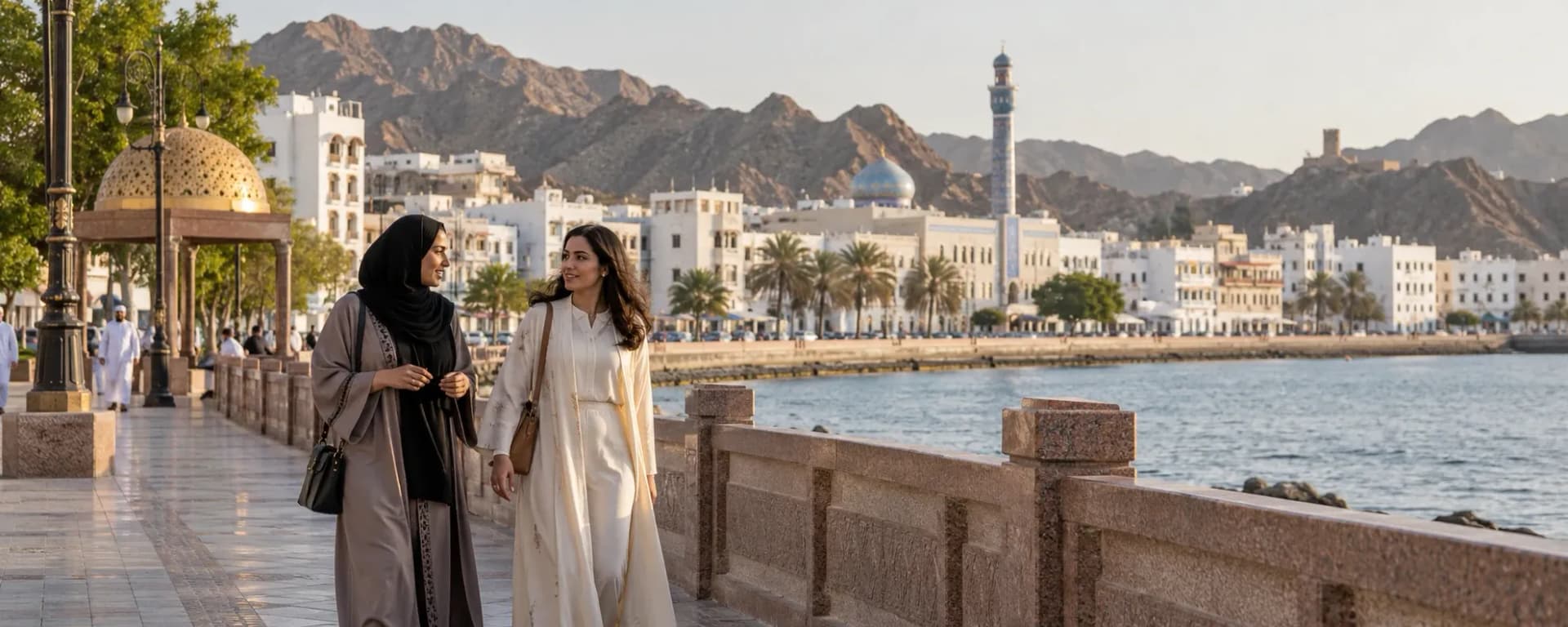
Women in Oman: rights, work and everyday life beyond stereotypes
What does the life of modern women in Oman look like? Omani women study, develop their own businesses, work in the public and private sectors, and own real estate independently. In 2025, 270,696 Omani women were working, and in the 2024/2025 academic year, 79,250 female citizens were studying at universities. Their presence in fields such as energy, cybersecurity, and entrepreneurship demonstrates the diversity of career opportunities. The article also explores the daily lives of women in Muscat, the importance of family and tradition, as well as their rights and participation in public life. Celebrated on October 17th, Omani Women's Day provides an opportunity to learn about their achievements and the social transformations taking place in the country.


Article summary
The most important conclusions from the article in 30 seconds.
What does the life of modern women in Oman look like? Omani women study, develop their own businesses, work in the public and private sectors, and own real estate independently. In 2025, 270,696 Omani women were working, and in the 2024/2025 academic year, 79,250 female citizens were studying at universities. Their presence in fields such as energy, cybersecurity, and entrepreneurship demonstrates the diversity of career opportunities. The article also explores the daily lives of women in Muscat, the importance of family and tradition, as well as their rights and participation in public life. Celebrated on October 17th, Omani Women's Day provides an opportunity to learn about their achievements and the social transformations taking place in the country.
The stereotypical story about women in Arab countries rarely leaves room for their own choices and achievements. Meanwhile, modern Omani women study, run businesses, drive cars, and work in administration, the private sector, and technical professions. A growing number of them also own apartments and land. In Muscat, professional and family life is often intertwined with local customs, and women are present in public debate and social organizations. What does women's lives in Oman look like when, instead of relying on a stereotype, we look at the numbers, specific careers, and everyday practices? This article guides you through education, work, property, politics, and culture, while also highlighting areas where changes are still needed.
Omani Women's Day – Why is it celebrated on October 17th?
Omani Women's Day falls on October 17th. This date was adopted following a women's symposium in Sohar in 2009, as described by the Omani Ministry of Education. It is a holiday distinct from International Women's Day celebrated on March 8th. Public institutions organize meetings, discussions, and events dedicated to women's achievements in science, work, and social life. This is a good time to hear about their specific projects and professional paths.
The holiday serves as a reminder of the transformations of recent decades: the development of education, the greater presence of women in institutions, and the expansion of professional opportunities. Events organized on October 17th include presentations of achievements and talks on work and social activity. Alongside the celebrations, it is worth following NCSI data: they show how many Omani women are studying, working, and managing their own wealth. It is they who give the story of change a tangible shape.
What rights do women have in Oman?
The Omani Basic Statute of the State declares the equality of women and men and prohibits discrimination on the grounds of sex. It protects property and outlines the right to work and education. For the Polish reader, the practical consequences are significant: Omani women can study, pursue a profession, run a business, and independently dispose of property. Women's rights in Oman vary across different spheres of life; family situations are discussed separately.
Can women drive, work, and run businesses?
Yes. In Oman, women drive cars, take up employment, and register business activities. A government report submitted to the UN noted 13,106 Omani women running businesses in 2023 and eight Omani businesswomen committees operating across the governorates. Entrepreneurship includes services, trade, and crafts. According to the same report, 1,946 women benefited from the Tamkeen program between 2021 and 2023, which helps develop small businesses and access sales points. The environment surrounding new businesses is also important: Khaula Al Harthy, introduced by the Omani Ministry of Foreign Affairs as the head of Injaz Oman, supports programs that develop business and financial skills among young people. Running one's own business can give women income, a space to utilize their skills, and an impact on the local economy.
Can women own real estate independently?
Yes. Omani female citizens can own property and manage their wealth. NCSI data on apartments and plots belonging to Omani women show the real scale of this ownership. For many families, property is an important part of assets, and having one's own legal title gives a woman the ability to make decisions regarding her assets. The rules for purchase by foreigners are a separate topic; they are discussed in the PlanoGroup guide on buying property after the 2026 changes.
Do women have the same family rights as men?
Omani women's rights to education, work, and property coexist with inequalities in family law. The UN Committee on the Elimination of Discrimination against Women (CEDAW) pointed out discrepancies regarding marriage, divorce, inheritance, and child custody. It also noted the requirement for a guardian's consent when a woman marries, although in case of refusal, it is possible to appeal to a court. This is an important distinction between property rights and the rules of family life.
Oman's 2025 Nationality Law provides for granting citizenship to a minor child of an Omani woman and a foreign national upon meeting certain conditions. In the case of a father who is an Omani citizen, the path is different. This is one of the legal issues that remains a subject of debate regarding gender equality.
Women in the Omani labor market – what do the statistics say?
Women's work in Oman is growing in scale. According to the NCSI Statistical Yearbook, 270,696 Omani women were working in 2025 compared to 249,222 the year before—an increase of about 9%. The economic activity rate of female citizens aged 15 and over was 32.9%, according to NCSI data cited by the Omani news agency ONA. This includes both those working and those actively looking for work, which is why it differs from the percentage of the employed.
Behind this number lie various career paths. The NCSI Yearbook lists 107,212 Omani women in the government sector, 146,081 in the private sector, and 17,403 in the family sector. Thus, the largest group works outside of administration. This is a broader picture than the traditional association of women's work exclusively with schools or offices: it also includes service companies, trade, and self-employment.
Women are present in education, healthcare, administration, services, science, and technical professions. Official profiles showcase specific paths: Zainab Al Saadi, holding an engineering degree, became the Director of Health, Safety, and Environment at the Ministry of Energy and Minerals, and Iman Al Rawahi heads electronic information security in the Muscat Governorate. These careers demonstrate opportunities even in areas that less frequently appear in stories about Omani women. Further data on salaries, positions, and working conditions will reveal more about the scale of advancement and quality of employment.
Women's education in Oman – studies and professional development
In the 2024/2025 academic year, 79,250 Omani women were studying in Omani higher education, according to the NCSI Yearbook. The Omani news agency, citing the NCSI, reports an increase in this number by about 5% compared to the previous academic year, as well as an increase in the number of women with postgraduate qualifications. These figures pertain to female Omani citizens, not all female students in the country.
Studies open the path to specialization, professional work, and self-employment. They also mean a greater ability to independently choose a workplace and manage income. Among Omani graduates are specialists developing careers in energy, cybersecurity, and healthcare. The transition from a diploma to a first job depends on available offers, recruitment practices, and childcare; therefore, the increase in the number of female students should be read alongside the growing number of working Omani women.
Women in the Omani parliament and politics
Oman's parliament, called the Council of Oman, consists of two chambers. Members of the State Council are appointed, while members of the Consultative Council, or Majlis A'Shura, are elected. Women also participate in public life outside of parliament: they work in offices, operate in organizations, and sit on businesswomen committees. However, both chambers remain an important gauge of their influence on state decisions.
The State Council appointed in 2023 included 18 women, which is about 21% of its composition, as confirmed by an Omani government document submitted to the UN. Their presence gives women a voice in the work of the appointed chamber. In the 2023 Consultative Council elections, no female candidate won a seat, so access to the elective chamber remained a challenge.
In June 2026, the Sultan ordered the creation of 11 additional seats for women in the Consultative Council, one for each governorate. The Omani Ministry of Interior described the mechanism whereby a seat is to be awarded to the female candidate with the highest percentage score among women in a given governorate. This is a decision regarding the rules of future representation, not a confirmation of filled seats. Its practical significance can be assessed after the next elections.
Women and real estate in Oman
According to NCSI data cited by the ,,Oman Observer'', in 2025, 75,611 Omani women owned at least one residential property, about 3% more than the previous year. At least one plot of land was owned by 313,732 Omani women, an increase of about 2%. This is the concrete scale of independent ownership. The data counts female owners, not properties; a single person may appear in both groups.
A title deed provides the opportunity to make decisions about an apartment or land: using it, transferring it to loved ones, or—in accordance with relevant regulations—selling it. For a woman, this can mean a stronger financial position and greater influence on family decisions. The number of female owners does not yet indicate the value of the assets or whether they were purchased or inherited, and therefore it should not be equated with the wealth level of all Omani women.
Data regarding Omani women pertains to female citizens of the country. A person from Poland considering purchasing property in Oman should check the separate rules for foreigners: project status, legal title, documents, and registration conditions. These issues are described in the PlanoGroup legal guide on real estate in Oman. Meanwhile, the growing number of Omani female owners shows that women are participants in the local market, not merely observers of family asset decisions.
What is the daily life of women in Oman like?
Women's lives in Oman have many rhythms. In Muscat, a day might combine commuting to university or work, shopping, family gatherings, and time with friends. In other governorates, the distance from a university or office more strongly influences choices regarding education and employment. Equally important are generation, family situation, and residency status. Therefore, it is worth getting to know the specific experiences of Omani women rather than looking for a single template for the entire country.
Does every woman in Oman have to wear a hijab?
The question "do women in Oman have to wear a hijab?" does not have a single answer that applies to every situation. There is no universal mandate requiring all women to cover their hair. Many Omani women wear a hijab as an expression of faith, tradition, or as part of their own style; practices vary between families and social circles. Daily attire can combine local designs with modern fashion. One person's appearance does not say much about other women's choices or their rights.
A female tourist does not have to wear traditional Omani attire. The Omani Ministry of Foreign Affairs advises visitors to dress modestly, especially in religious sites. Upon entering the Sultan Qaboos Grand Mosque, women should cover their hair and body, as stated by the Omani Ministry of Higher Education. In public spaces, it is worth adjusting one's clothing to local norms, and asking for permission before photographing people. More practical tips can be found in the PlanoGroup article on traveling to Oman.
Family, tradition, and modern lifestyle
Family plays an important role in Omani social life. Education, work, social gatherings, and activities in local organizations often coexist with caring for loved ones and religious customs. According to the Omani Ministry of Foreign Affairs, at the end of 2024, there were 68 women's associations operating in the country, bringing together 13,570 Omani women. One woman develops a business, another chooses administration, and yet another focuses on family for a period of time. Aspirations and expectations regarding education and work change across generations. Support from loved ones and access to childcare influence how many of these plans can be realized.
Women in Muscat – between change and tradition
Muscat concentrates institutions, universities, companies, and services. It is easy to see here how different roles fit into a single city: female students on campuses, female specialists in offices, businesswomen in shops, and women driving to work or family gatherings. A professional career can go hand in hand with an attachment to holidays, clothing, or family life. The capital does not represent all regions, but it shows how modernity and tradition can shape the everyday life of the same person. A broader cultural background is presented by the PlanoGroup article on daily life in Oman.
The future of women in Oman – in what direction is the country heading?
Statistics from recent years show more Omani women working and among real estate owners, and data for the 2024/2025 academic year confirms their strong presence in universities. Careers in energy and cybersecurity demonstrate that the range of professional choices is also changing. The 2026 decision opens the path to greater representation in the Consultative Council, although its effect will be known after the elections.
Oman Vision 2040 sets the framework for economic and social development. Women's education, entrepreneurship, and work can be an important part of this process: they expand the country's pool of skills and the number of people making professional decisions. The direction of transformation is best inferred from subsequent employment data, election results, and the practice of law enforcement. They allow us to track both achievements and matters requiring further action.
FAQ – Frequently Asked Questions
Can women in Oman work?
Yes. Omani women work in administration, private companies, education, healthcare, and technical professions, among others; they also run their own businesses. The NCSI recorded 270,696 working Omani women in 2025. This figure applies to female citizens, and working conditions and advancement opportunities vary across industries.
Can women in Oman vote?
Yes, Omani female citizens can vote and run for the Consultative Council. In 2023, no female candidate won a seat in it. In June 2026, a mechanism of 11 additional seats for women was announced, one in each governorate. Filling them will depend on the results of the next elections. The appointed State Council functions separately, to which 18 women were appointed in 2023.
Do women in Oman have to cover their hair?
Not every woman in Oman is obligated to cover her hair in every situation. A hijab can be an expression of religion, tradition, or a personal decision, and social norms vary depending on the place. Female tourists are expected to dress modestly in public spaces. Separate rules apply in places of worship: when visiting the Sultan Qaboos Grand Mosque, a woman should cover her hair and body.
Can women in Oman buy real estate?
Yes. According to NCSI data cited by the ,,Oman Observer'', in 2025, at least one residential property was owned by 75,611 Omani women, and at least one plot of land by 313,732. The data pertains to female citizens of the country. A Polish woman considering purchasing property should check the separate rules for foreigners, project status, legal title, and registration procedures.
What is worth remembering?
Modern Omani women study, develop businesses, work in specialized professions, participate in public life, and own real estate. Behind the statistics lie concrete careers and everyday decisions regarding education, work, and family. Oman is undergoing social transformations whose pace varies across areas of life; issues of family law, citizenship, and representation still require attention. The stories of Omani women allow us to discover a lesser-known face of Oman—a country where tradition meets modernity, and women are increasingly actively participating in shaping its future."

Author
Beata Cieślukowska
COO / FOUNDER
For over 17 years, she has been supporting clients in investing in premium real estate, with a particular focus on investment apartments and condo-style projects. Over the years, she has built her position in the Costa del Sol market, where she helped clients select properties that combine lifestyle with investment potential. Today, she is developing PlanoGroup, expanding operations into international markets – including Oman and other investment destinations. She combines experience, market intuition, and an individual approach, which allows her to match a property not only to a budget but, above all, to the client's goal.

Related articles
Can foreigners buy real estate throughout Oman following the 2026 changes?

Real Estate Investment in Oman – 2026 Legal Guide

Oman – what's worth knowing before you travel? The most important information